History

Mormon Handcart Story: The Thirteen Hundred Mile Journey of Faith

They Left It All Behind

Would you be willing to leave your home country, your family, friends and everything you are familiar with to follow your faith? Would you sell everything you own to take a ship to a new country without knowing what might lie ahead of you? Relying only on faith, could you walk thirteen hundred miles in extreme heat, rain and freezing snow while pushing and pulling a heavy cart up steep mountains and across raging, freezing rivers? As you watched your fellow brothers and sisters fall sick and die along the way, do you think your faith might falter along the way?

This is exactly what an estimated fifteen hundred Mormon saints did in the year 1856. In 1856 the Mormons had sent missionaries to several European countries and converted thousands to the Mormon faith. Brigham Young, a dynamic Mormon church leader encouraged these converts to immigrate to the United States to an area in the Salt Lake City Territory. Here they were promised life would be better than Europe.

The problem was that many of the new converts were also too poor to meet the expenses necessary to pay for the entire journey. Expenses included the cost of passage on a ship to America, then taking the railroad to Iowa, then buying a covered wagon with a good team of oxen, as well as provisions along the way. Attempting to cut expenses to make it more affordable, Brigham Young and the Mormon Church had come up with the handcart companies.

This would allow the converts to make it to Iowa where they would be outfitted with a handcart which they would each be allowed to take seventeen pounds of bedding, clothing and a few personal items. Each company would have close to five hundred members and experienced leaders would lead each company west to Salt Lake City. Several covered wagons and teams of oxen would carry provisions and would carry those who became sick or were too old or injured.

Handcart Regulations

  1. One family for each cart
  2. Up to five people were assigned to a cart
  3. Each person was allowed a total of seventeen pounds

Tents which held twenty people and provisions were carried on wagons with teams of oxen

The Test Of Faith Begins

Several handcart companies with hundreds of converts left Europe and made it to Iowa early enough that even with the hardships of the trail, the first companies made it safely to their new home in the Salt Lake Valley. However, two of the later companies were not as fortunate.

The Willie Company left Liverpool, England in mid May and would not reach the New York Harbor until Mid June. As they approached the New York Harbor there was much rejoicing, excitement and giving of thanks for a safe journey. During the trip, there had been a few deaths, births and a wedding or two. In general though, the saints were in good spirits and they spent a lot of their time on board in worship meetings and prayer.

After landing in New York they were allowed a few days of rest before they would proceed by train through the state of New York to Lake Erie. A steamboat would carry the converts across the lake, where they would board trains to take them as far as Iowa City, Iowa.

The Willie Company left Iowa City in Mid July and the Martin Company left almost two weeks later close to the end of July. It would be a four month trip and both companies were getting a late start. By the time they made it to Wyoming, it was possible they could encounter early winter weather.

The Journey Becomes A Disaster

In Iowa City, the immigrants were awaken by the sound of the bugle calling them to worship services after which time the handcarts lined up and they started one of the longest walks in history. They left Iowa City in high spirits, singing songs of praise and full of hope for their new destiny, having no real idea of what horrors and trials might lay ahead of them.

In July, they suffered through the intense heat of the summer each day and managed to walk between twelve and twenty miles a day depending on the trail conditions. They stopped only for brief periods for lunch and camped each evening along a creek or river so there was water for the saints as well as the livestock. As the days wore on, the elderly began to take sick and die along the way. Few of the elderly would live to see their new homeland. They would be buried along the trail.

By early August, they had reached the Missouri River and by mid to late August they had reached Florence, Nebraska. Here, each company held meetings to discuss whether they should spend the winter in Florence or continue onward to the Salt Lake Valley. Although some, including one of the more experienced leaders Levi Savage, voiced the opinion of staying due to the coming onset of winter, pointing out the lack of warm clothing, pregnant women, children and the elderly. However, the saints were anxious to reach their destination and the final decision was made to try to reach Salt Lake City before winter.

Throughout September things went well but in October the weather began to change rapidly and became much colder. Provisions began scare and were rationed. The saints began to lose weight and strength needed to pull their carts. More and more of the elderly and the children became sick and deaths increased almost on a daily basis.

The journey had become a nightmare but through all the terrible hardships the saints held fast to their amazing faith in God that he would deliver them safely to their new homeland.

Both the Willie and the Martin companies got caught in October with an early snowstorm. Both companies ran low on supplies and had to ration supplies causing many to die of starvation. They crossed rivers in the freezing cold water and many suffered from frostbite and had limbs amputated. Some simply could not go any further and froze to death.
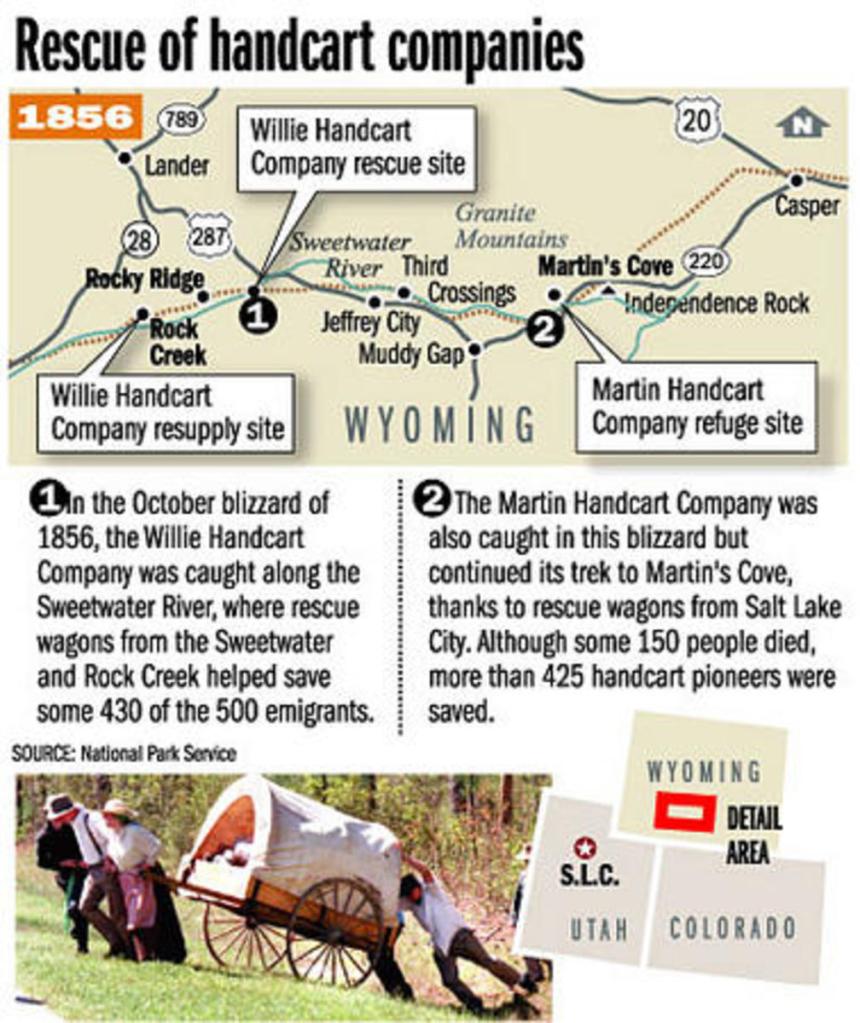
Rescue of the Mormon Handcarts

The Rescue

At the end of their endurance, rescue teams sent out from the church began to reach both companies but not before both companies had terrible losses. Even with the rescuers arrival, supplies were still limited and the freeing conditions continued to hamper their progress.

Through all the hardships and sorrows one thing endured and that was their faith in God. As one gentleman who survived said: The journey was one of the hardest that anyone would ever experience. However, in spite of everything, the hardships, death and sorrows along the way, the journey had made them one with God because at the end they had nothing else.


history

The Eccentric Wealthy Heiress

Sarah Lockwood Pardee

Young Sarah was just an ordinary girl of the nineteenth century. However, she had more advantages than many other young ladies. She had the benefits of a superior education in private schools. She could play the piano extremely well, as most young ladies of that era. She was also fluid in four different languages. Sarah was the daughter of Leonard Pardee and Sarah W (Burns) Pardee of New Haven, Connecticut. Sarah was small, petite, and pretty. She was very active socially. In fact, she was sometimes referred to as the “Belle of New Haven.”

Sarah Weds William Winchester

The American Civil War was still raging on when Sarah Pardee married William Winchester, the only son of Oliver Fisher Winchester. Sarah was twenty three when she married William on Sept 30th 1862 and her new husband was thirty. The wedding despite the civil war was a great social event because the groom was from a wealthy family who owned Winchester Repeating Arms Company. Sarah’s father in law had started out with a business making men’s clothing. However, in 1857, Oliver saw great opportunity in the rifle business with the coming civil war.

Little Annie Winchester

After the wedding Sarah and William settled down to a busy life as newlyweds. Sarah became involved with various social functions and charity events while William learned the rifle business from his father. Soon Sarah was expecting their first, and as it turned out their only child, a daughter Annie Winchester. Their happiness with their infant daughter was short, a mere forty days and little Annie passed away on July 24, 1866 leaving grief stricken parents. Just fifteen years later, Sarah lost William who died in 1881 leaving Sarah a very wealthy young lonely widow.

The Lonely Widow

We can only image the pain and loneliness that the young widow must have endured after losing her only child and her husband. Rumors are that Sarah begin to visit a psychic and somehow she began to blame the Winchester guns as the reason for her misery. Perhaps she felt that losing her own child and husband was a curse or punishment for all the lives that had been lost due to a Winchester rifle. Perhaps she felt that all the millions she had inherited had those dead souls blood on them. It’s really impossible to fully understand what motivated Sarah to think like this. Or was she just severely depressed?

Sarah Moves to Santa Clara County CA

In 1886 Sarah Winchester moved across the country to Ca to begin a new chapter in her live. Perhaps the rumors were true that a psychic had influenced her move but it seems there were other reasons. After losing her husband it could be that she wanted a fresh start. Another theory suggested by a distant family member is that her doctor advised her to move due to health concerns. My guess is that all this factors combined is why Sarah Winchester made the decision to move to Ca.

Bedroom in the Winchester Mystery House

Building the Famous Winchester Mystery House

When Sarah arrived in San Jose, Ca in 1886, she immediately purchased a small farmhouse. It had a lot of acreage. The first thing she did was to hire a crew of men. They started remodeling and building more rooms to the house. Gossip followed about the wealthy heiress as she added more rooms and the house grew. In 1906 California suffered from the Great Earthquake and the earthquake also destroyed parts of the Winchester mansion. While it had grown to a seven story house, some of those upper stories suffered earthquake damage. At that point Sarah decided to build no higher than the four remaining levels. Perhaps this explains the parts of the house where stairways go nowhere. Other odd features exist if these areas were simply closed off and never repaired. But now the house continued to expand outward inside of adding more stories.

Sarah the Legend

The work continued, the house grew and so did the gossip about the eccentrically wealthy Winchester widow. The stories began that Sarah was building the house to appease the souls that had been killed with the Winchester rifles.

Sarah’s story and the legend of the Winchester Mystery House fascinates me and I hope to one day visit this mansion.

Uncategorized

True Sisters is a novel written by Sandra Dallas

A Story of Struggles Survival and Love

True Sisters is a novel written by Sandra Dallas. While this story is not an actual true story and the characters are not based on real people, it is a story of an event in American history. It is based on journals, accounts and stories from the people who survived the hardships of the 1,300 mile journey across the United States from Iowa to Salt Lake City, Utah. It is the story of strong courageous women.
This novel is about the struggle for survival against enormous hardships. At the same time it is also the story of strong, courageous women from very different backgrounds who learn to love each other and form bonds as strong as any blood sisters, thus making them True Sisters.

The Immigrants

Ella Buck is a young married woman, who along with her husband Andrew, and her sister Nannie have come from Edinburgh, Scotland as new Mormon converts. They made the decision to seek a better life and follow their faith all the way to Salt Lake City, Iowa. Brigham Young has declared that the Utah territory will be the Mormons new Zion. They will sail from Europe, then go by train to Iowa where they are to meet up with other new Mormon converts.Ella is pregnant with the couple’s first child and Nannie is hoping to find a husband when they arrive in Salt Lake City. All three are full of hope and confident of a bright, happy and prosperous future when they reach Salt Lake City. But they have no idea what hardships they will face along the way west.

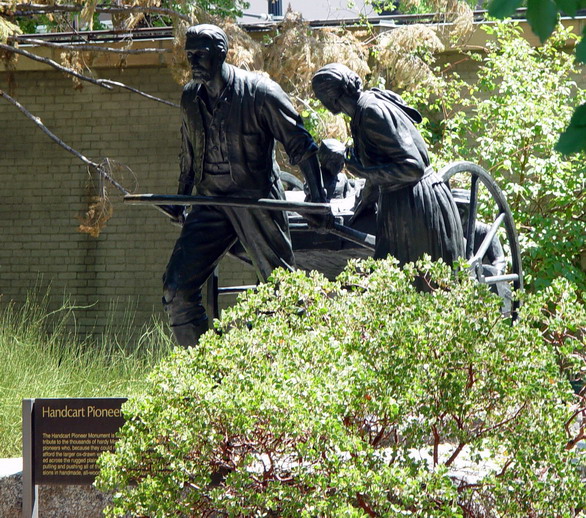
Statue Honoring The Thousands Who Made The Journey Across America

Annie and John Sully

Annie Sully had been given little choice about making the trip to America and the journey west. She had not converted to Mormonism and did not want to give up her own faith but her husband John had converted and he had made the decision to leave London and join the other converts in Iowa. Annie had been quite content with her life in London. Her father had left her a successful gentlemen’s clothing shop which Annie was happy to continue the business with her husband. Annie also had three small children and is pregnant with a fourth child. She is quite concerned with giving birth in a strange country while pushing a handcart across the country for 1,300 miles. Nevertheless, John has sold their business and even given most of their money to the elders of the church so that others can afford to make the trip also. Annie has made the choice to follow John against her better judgment, but she will face many trials, heartache and hardships along the way. But she will also find other women who will love her, and care for her and her family even though she holds steadily to her own faith.

Louisa and Thales Tanner

Louisa Tanner is a newly married young woman whose husband is Thales Tanner, one of the missionary leaders. He is in charge of one hundred of the new converts who will be heading west. Louisa feels she is very lucky to have such an important man as her husband. Along with Louisa, her sister Huldah and her elderly parents will be making the journey west. Not all of them would survive the grueling journey.

Jessie Cooper

Jessie Cooper and Louisa Tanner have always been good friends. Before Louisa married Thales Tanner, he had previously courted Jessie. The two friends did not let this come between them, because truthfully Jessie was happy that Louisa had married Thales. She felt that Louisa was a much better match for Thales. Jessie was sure that when she arrived in Salt Lake City that she would find a husband of her own. Jessie and her brothers Ephraim and Sutter had made the decision to leave their tenant farm in the hopes of finding good fertile land in the Salt Lake Valley. So they sold their small farm and belongings and paid for their passage to America. They met the handcart train in Iowa. Jessie and her brothers were optimist and excited about their future never guessing what hardships lay in store for them. 

The Journey Begins

Near the end of July 1856, the Martin Company of converted Mormons slowly started on the long journey. Everyone was in high spirits and excited to be on their way. Families would walk and push and pull their handcarts which held their meager possessions. Each person was allowed seventeen pounds to be put on their carts but along the way much of their worldly goods would end up being left behind.
The carts were made of green lumber and poorly made. There were no oxen or horses to pull the carts, they would be pulled by human power only.This is the story of these four brave, courageous women as they faced unbelievable dangers, heartbreak, death of loved ones and hardships on their journey. These women would have to learn to help, love and lean on each other. There would of course, be many other members of the Martin Company they would meet and help along the way but these four would become Truly Sisters for the rest of their lives.


Reasons I Recommend Reading True Sisters

  • I truly enjoyed reading True Sisters. I had never even heard of this part of our American history until I read this book. If you enjoy reading about history, this is a great novel
  • The book is well written and the characters well developed
  • It is an emotional story that will tug at your heart. It did mine
  • It is the type of book that will keep you interested from start to finish

Uncategorized

THE DAME ELIZABETH TAYLOR

Born Beautiful

Some people, it seems, are simply born to be beautiful and famous. Elizabeth Taylor was one of those people.

Elizabeth Her Early Years

Elizabeth Taylor, was born on Febuary 27, 1932 in London. She was the second child of Francis and Sara Taylor, and was welcomed home by an older brother, Howard, who was two at the time. 

For the first seven years of young Elizabeth’s life, her family remained living in London, but as fears of World War began to look quite likely, Francis Taylor decided to move his family back to the safety of  Los Angeles, California. Sara Taylor had been an actress herself before marrying Francis Taylor so it was not surprising that after moving back to Los Angeles, she began actively encouraging her young daughter to seek work as an actress.

The Young Actress

It wasn’t long before Elizabeth began to be noticed and in 1943, she was signed on with the Metro-Goldwyn-Mayer studio, which was probably the biggest and the best studio in Hollywood at the time. Liz was cast as the rich Duke’s granddaughter in the highly success “Lassie Come Home”. In 1944, Liz starred in another smash movie “National Velvet” in which she plays a young girl who works with a wild but gifted horse and enters England’s Grand National Sweepstakes. While filming “National Velvet” Liz fell from a horse and broke her back, but she was so committed to her work that she refused to allow this to stop her from finishing the movie. 

Elizabeth loved being an actress. She loved the attention, the clothes, the makeup and the make believe, where she could be whoever her character was at the time. At the young age of fifteen, she was declared “The Most Beautiful Woman in the World”.  As a result, while filming movies such as “Little Women” and “A Place in the Sun” Liz managed to acquire a reputation for being difficult, demanding and needing special treatment. Liz’s face was the cover of about one thousand magazines.

Liz, Romance and Marriage

One of the things that Liz would become famous for would be her many romances and her eight marriages. When Liz was barely 18, on May 6, 1950 she married hotel heir Conrad N Hilton Jr. aboard the Queen Mary. They were divorced a year later. On February 21,1952, she married Michael Wilding, with whom she had two sons and whom she divorced in 1956.  Michael Todd was Liz’s fourth husband. They were married on Februaruy 2, 1957 and had one daughter together. Michael Todd was killed on March 21, 1958, when his private plane crashed in New Mexico, on his way to an awards banquet. After losing her husband, Liz found comfort in the arms of Eddie Fisher, who was married to her friend Debbie Reynolds, at the time. Liz and Eddie Fisher were married on May 12, 1959 and divorced in March of 1964. On March 15, 1964 Liz married Richard Burton, whom she had co-starred with in the film “Cleopatra” with Burton playing the part of Marc Anthony. The couple divorced, then remarried Oct 10, 1975 only to be divorced again in July 1976. Liz’s husband number seven was John Warner, who was running for U.S. Senator from Virginia. They were married on December 4, 1976 in a sunset ceremony on his farm in Virginia. They divorced on December 15, 1981. Liz’s eighth and final husband,  was Larry Fortensky, whom she met while at the Betty Ford Clinic in 1988. They were married in 1991 and divorced in 1996.

A Young and Very Beautiful Liz Taylor

Awards and Achievements

Elizabeth Taylor is also know for the many awards she received for her work over her lifetime.  “Raintree Country” (1957) earned her the first of several Academy Award Nominations. “Butterfield 8” was her second nomination while “Cat on a Hot Tin Roof” gave her a third nomination. Liz won the best actress Oscar for “Butterfield 8” and another Oscar for “Who’s Afraid of Virigina Woolf”? In 1993 the Academy of Motion Pictures Arts & Sciences gave Liz Taylor a special humnitarian award for her work with the AIDS Foundation. Liz was also honored by the Queen of England and was given the honorary title of Dame.

After losing several close friends including actor Rock Hudson, fashion designer Halston and her own private secretary, Malcom Forbes to AIDS, Elizabeth Taylor became the first great legendary personality to speak out on behalf on AIDS research. In 1985, she became the co-founder and chair of the American Foundation for AIDS research. In 1999 Elizabeth was awarded the Angel Award for her work with patients inflicted with Aids.

An older but still beautiful Liz Taylor

Queen Elizabeth Honors Liz Taylor

In 2000, Elizabeth visited Buckingham palace with other celebrities where Queen Elizabeth II honored her with the title of Dame. Dame is the female word which is equal to the male term of Knight. This was one of the highest honors given in Britain.

The beautiful Elizabeth Taylor legend will continue and Liz will be remembered for her many husbands, her films, the White Diamonds Perfume, her trips to the Betty Ford Rehab Center and much more. She should always be remembered for her beauty. Perhaps she should be remembered most for the good works she has done in trying to help AIDS victims.