Writers are important but so are readers. Readers and writers need each other. Writers provide their audiences with news, valuable information as well as entertainment.
I would start a new team named Jungle Sports. A money would be the team mascot and the team colors would be jungle colors of greens and browns. A monkey would be the team mascot.
You need to be competitive in tree climbing, rope climbing, and swinging from ropes to join the Jungle Sports team. Coconut throwing would also be included. Eating a lot of bananas would be helpful.
If anyone thinks they could be interested, well it’s up to them to get this sports team started.
Daily writing prompt
If you started a sports team, what would the colors and mascot be?
First I love Sandra Brown books. Blood Moon is one of her newest books published this year 2025.
Blood Moon is a novel about Detective John Bowie who is just trying to keep his job. But he has a case that the police department arrested a suspect, prosecuted him and convicted him. But Detective Bowie has always questioned whether the right man was convicted.
Beth Collins is a producer of a true crime television show. Her boss is airing a show about the Crissy Mellin case. She feels that something wasn’t quite right about the Crissy Mellin case. Beth believes the real killer is still out there and is going to strike again when there’s another blood moon in just a few days. She convinces Detective Bowie to at least take a second look at the case.
Blood Moon
Bowie doesn’t want to get involved. However, his doubts about the case force him to get involved. Bowie also has an ex wife and doesn’t want to have another relationship. But Beth might just change his mind as they spend time together going over the case.
I always enjoy a Sandra Brown book. But for me this book wasn’t one of her best. But that’s just me. I didn’t enjoy or understand a lot of the scientific details about blood moons. I never did like science. For those, into science and the solar system, they will understand it better.
The characters were good. I liked all the characters. I was particularly fond of John’s teenage daughter. She was dealing with the usual teenage issues, as well as coping with her parents’ divorce. Beth was very believable as the girl who left the area and held a fast paced television producer position. John was the good cop dealing with an unreasonable boss and corruption in the police department.
Even though this wasn’t my favorite Sandra Brown novel, I would recommend reading it. The suspense is good and it keeps you guessing about who really is the killer.
The perfect place for my personal reading and writing space would start with a small cottage looking out over a beach. I would be sitting on a small porch in the mornings sipping a cup of tea while watching the sun rise over the water. That is always a beautiful sight. The evenings I would sit on that same porch with a glass of wine in hand watching the amazing sunset.
At times I would be sitting on that small porch in a comfortable chair reading a good book or eating meals watching and listening to the ocean. Afternoons would be time for a long relaxing walk on the beach.
View of the Seal Rocks at the north end of Ocean Beach, San Francisco, California.
It would be a small cottage just big enough for one person. But there would be modern appliances and good air conditioning. Small and easy to clean. I don’t want to waste my time doing a lot of cleaning.
My ideal writing spot would be by a window with good lighting and an ocean view. It would be furnished with a long desk positioned near that window. The window would be open to allow the ocean breeze to gently blow the lacy curtains. A computer and a comfortable chair for the desk with drawers for paper, and other writing supplies. A plant hanging in the window would be a nice touch. Bookcases or shelves where I can organize my favorite books would cover one wall.
How peaceful and relaxing that small cottage of my dreams would be. How awesome to have a space just for me for writing and reading. Morning tea on the porch and wine at night. Eating meals outside while enjoying the ocean breeze. A girl can dream can’t she?
In 1974, the government required that steel companies hire women and minorities. This included the Eveleth Iron Mining co. This was the immediate start of the first class action suit by women claiming sexual harassment, abuse, and violence against women in the workplace. The case was Jenson v. Eveleth Taconite Co.
As women who were looking for good paying jobs to support their families, some brave women went to work for Eveleth Taconite Co. These women had no idea of the stress, harassment, humiliation and intimidation they were going to face. The men who worked for the mining company highly resented women taking good paying jobs from men. In their view, women should be staying at home, cooking, cleaning and raising children. These women really had no choice. Some were single mothers or the main breadwinner of the household. They needed good paying jobs every bit as much as the men.
Lois Jenson was one of the first women to go to work for the Eveleth Taconite Co. and became a member of the union workers. Right from the start she was a target of sexual harassment. Lois and the other women were victims of stalking, groping, and threats of rape and physical violence. Another problem that the women faced was the lack of bathroom facilities. They often weren’t near a bathroom and some developed urinary problems from holding their urine for extended periods of time.
Lois Jenson filed numerous complaints with management, the union and the mine owners regarding the abuse the women were subjected to. All wanted these women to quit, so all of her complaints were ignored or even sneered at. Eventually, Jenson filed a complaint to the Human Rights of Minnesota office. The state ordered Ogelby Norton to pay $11,000 to Jenson and form sexual harassment policies. The Eveleth Taconite Co. refused to follow the states orders.
Finally, in desperation, in 1988 Jenson hired private attorneys Paul Springer and Jean Boler to file a complaint. Jenson was joined by Pat Kosmach and one other woman to make it a class action lawsuit. Unfortunately, Pat Kosmach would die from Lou Gehrig’s disease before the lawsuit was settled.
Not all women supported the lawsuit. They feared for their jobs and the intimidation on the job became even worse. It became so unbearable that Jenson was under so much mental stress that she quit working at the mine.
During the trial the women were subjected to intensive and invasion of their privacy. Questions were asked about their pasts regarding former relationships. Their former sexual pasts were put on display. There were accusations that their behavior had caused the problems of harassment. They were accused of lying about the effects the harassment had on their physical and mental health.
After years of fighting in court the women finally got their verdict. Their case was settled on Dec 31, 1988 for $3.5 million. Not all women received the same amount. Each case was judged separately with some receiving more than others. But most important for the women was that the company had to have and enforce a no harassment policy. This policy protected the women from the abuse they had been dealing with. They could keep their jobs without the fear of harassment and violence. They had won the right to be respected.
It was 1987 when I bought a 1983 Chrysler New Yorker 5th Avenue used car. It was in excellent condition and I had just gotten a new job so I was making enough to afford the payments.
It was a beautiful dark blue with soft blue interior. In 1987 it had all the newest electronic features like electric windows and doors. The first time I drove it to work, my supervisor was asking who the nice car belonged to.
A 1983 Chrysler New Yorker Fifth Avenue en.wikipedia; PD
I made sure that car was well taken care of. I refused to let my husband at the time work on it. He thought he was a great mechanic but he often times made problems worse. Instead for the first time, I started paying a real mechanic. I wasn’t going to let him mess up this car. And when my husband and I separated that car went with me. It survived my kids growing up and being hauled everywhere.
I drove that car for over six years, then made the mistake of buying something newer. Many times I wished I still had that 1983 Fifth Avenue car back. I have even been doing some searching for one like it. The memories are great but it’s time to move on and go with the SUV style of today’s popular vehicles with more modern features.
Catherine of Valois was born a princess of France on October 27, 1401. Catherine was the daughter of King Charles VI and Isabeau of Bavaria. She spent her life as a neglected child of this royal couple.
King Charles often suffered from bouts of madness. and was often referred to as “Charles the Mad” or sometimes the Mad King. Meanwhile, her mother, Isabeau of Bavaria, would act as Regent for France in her husband’s place during his spells of madness. Rumors spread that she was much more interested in her young lovers than her children.
Brothers and Sisters
Although King Charles VI and Isabeau of Bavaria had a total of twelve children only a handful of them lived to become adults. Some that did survive died early deaths. Three were given the name Charles and two were named Jeanne after babies that had not lived very long.
Jeanne of Valois (two were named Jeanne)
Charles (three were named Charles)
John
Philip
Marie of Valois
Michelle of Valois
Dauphin Louis (brother)
Isabelle of Valois (Catherine’s older sister)
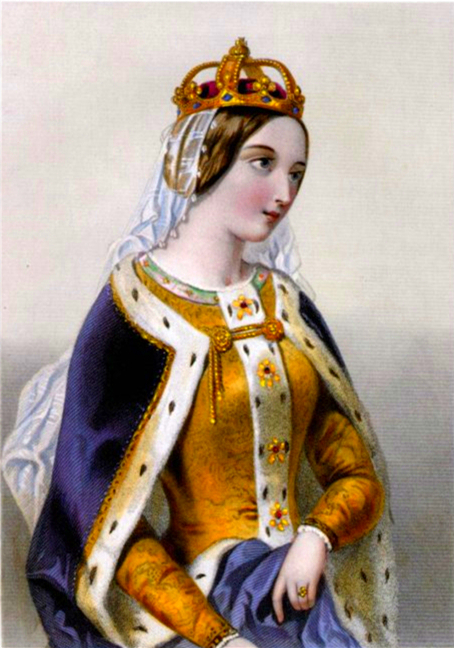
Catherine of Valois
Catherine of Valois
Catherine being the youngest child was probably the most neglected. She faced many challenges due to her father’s madness. Her mother’s lack of interest also affected her life, so she certainly did not live the life of a pampered fairy tale princess. Catherine did spend some of her young life growing up at Poissy Convent which was the basis for her religious education. Catherine was raised understanding that she would be merely a pawn when it came who her future husband would be. There had been negotiations since she was fairly young regarding a possible marriage to the future king of England, Henry V.
I believe that like most young princesses of Europe, she hoped for love and a family with her husband. Yet, her marriage would be to whichever member of European royalty was most beneficial to France.
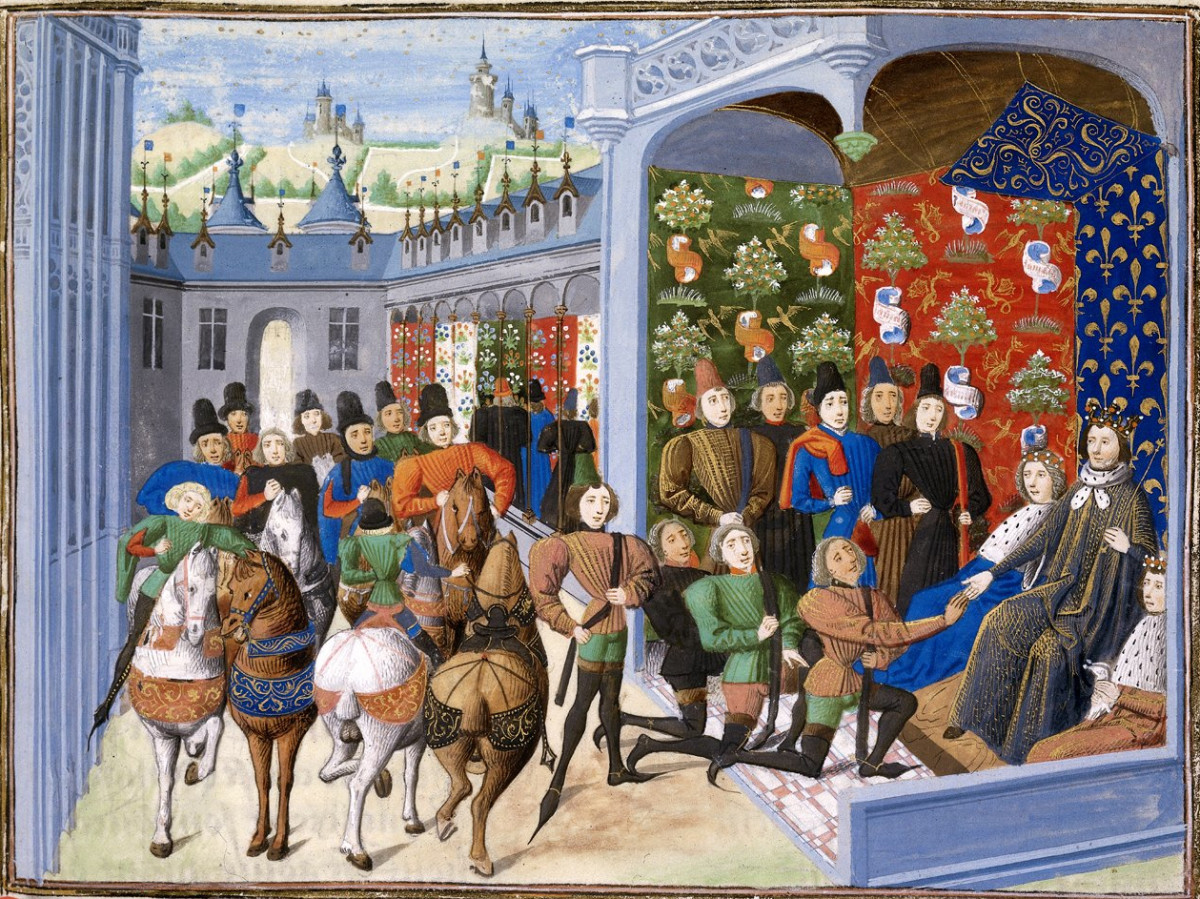
Signing the Treaty for Catherine and Henry’s Marriage—Isabeau of Bavaria and Charles VI at the Treaty of Troyes | Source
Peace Through Marriage
King Charles VI reign was filled with war (known as The Hundred Year Wars). One effort at achieving peace was through marriage. Isabelle, Catherine’s older sister was married to England’s King Richard at a mere six years of age. The marriage was never consummated due to her young age and the early death of King Richard in 1400. She was held in England for some time after Richard’s death before she was allowed to return to France.
King Henry V
King Henry was a young man when he was crowned the king of England. For much of his father’s reign, the royal English family fought with France. This conflict came to be known as the “One Hundred Years War”. King Henry V signed a treaty with France on May 21, 1420. In the treaty, he demanded the return of lands that had once belonged to England. This was the Treaty of Troyes which also included Henry’s marriage to the young eighteen-year-old Catherine of Valois. A large dowry was also included in the marriage contracts.
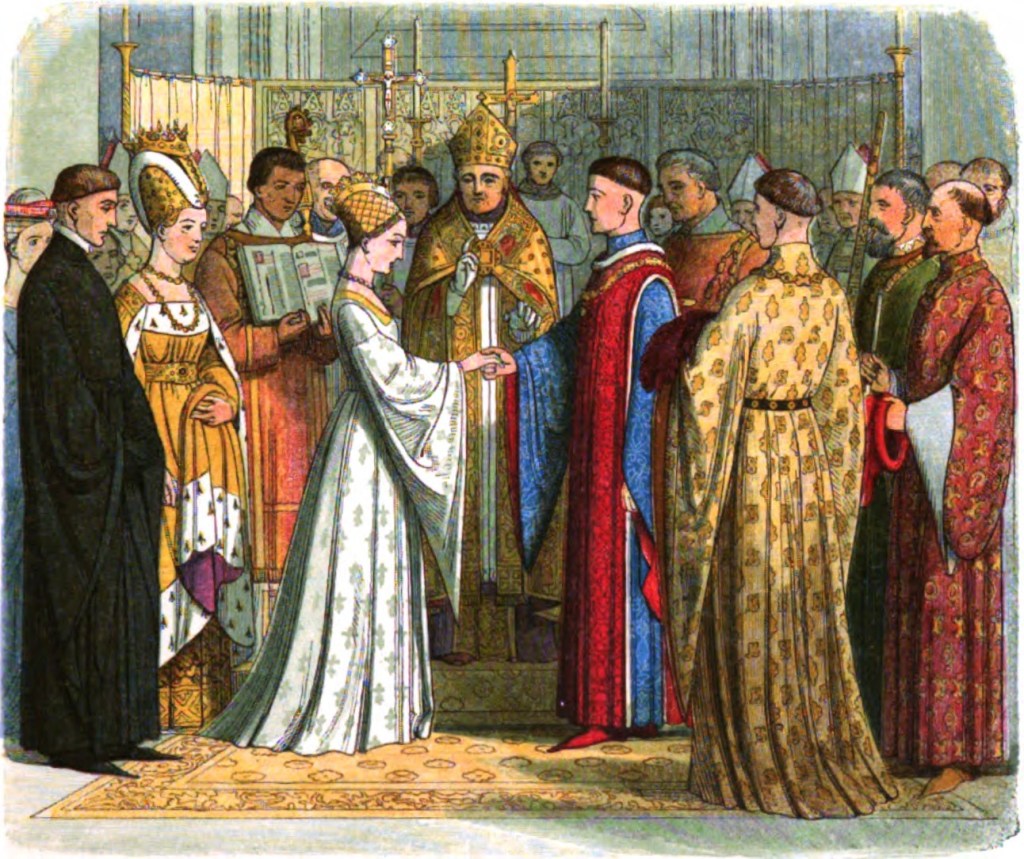
Wedding of King Henvy V and Catherine of Valois
King Henry V and Catherine of Valois were married on June 2, 1420, and Catherine was crowned queen of England in February 1421. The royal couple soon welcomed their only son Henry VI heir to both the English and France thrones. Their marriage proved to be a brief marriage. Henry V died on a battlefield in 1422 leaving a twenty-one-year-old widow and an infant son. Henry VI was only an infant when his father died. His two uncles, the Duke of Gloucester and the Duke of Bedford, controlled the government.
Queen Catherine was sent off to live quietly, at Baynard’s Castle, with only a small household staff. Her brothers-in-laws who were controlling England were concerned that if Catherine were to remarry, any new husband might influence the infant king and they would lose their power over the boy and England.
Forbidden to Love Again
The two dukes and the English parliament had specific ideas on how this young widow should conduct herself. She was also the mother of the boy king Thus they decided how she should be allowed to live her life. Therefore, parliament passed a law that forbade Catherine from establishing romantic relationships and she was forbidden to marry again without parliament’s or her young son’s approval. Any man with a title or lands would lose both his title and his land if he were to marry King Henry V’s widow. No man was willing to take the risk of angering parliament or losing their lands or titles. As her son was only a year old and would not be able to give his consent for years, Catherine’s fate had just been sealed. She would never be allowed to return to France, love again, or have more children to love.
The Queen’s Secret Love
But Catherine was lonely and a very young widow. Catherine was only in her early twenties and wanted to love and marry again. She wanted more children also. However, she was shut away from society in a huge castle with little company other than those who were her servants. She was even deprived of her young son, the future king. Henry had nurses and governesses and was allowed little time with Catherine.
At some time, Catherine met and became involved with a young handsome Welsh gentleman who was in charge of the royal wardrobes. Owen Tudor was in reality a high-ranking Welshman. Thus, the two of them began a secret love affair. Although there seems to be no record of their marriage, and though it was forbidden, Catherine and Owen were secretly married. A marriage that would produce more children for Catherine to love but would also have tragic endings for both Catherine and Owen. When the marriage caught the attention of Parliament, Catherine entered a nunnery and died a short time later. Owen would be captured and imprisoned. Owen eventually escaped prison and served with Catherine’s oldest son King Henry VI but was later captured by the enemies of Henry VI and was beheaded in Hereford marketplace. He was buried in Hereford.
Children of Owen Tudor and Queen Catherine
Owen Tudor an Catherine had several children together but two would play a huge part of English royalty history. Catherine’s oldest son King Henry VI would later make his half brothers and sisters legitimate and bestow them royal titles.
Edmund Tudor 1st Earl of Richmond and father of the future king Henry VII.
Jasper Owen Earl of Pembroke who would help to bring Henry VII the crown of England.
There may have been two daughters and another son named Edward but this is unknown for certain.
Catherine’s grandson would later become king making Catherine the wife of a king, the mother of another king, and the grandmother of the first Tudor king.
References
Griffiths, Ralph A., and Roger S. Thomas. The Making of the Tudor Dynasty. NY: St. Martin’s Press, 1985.













 History Lovers Corner