History, Uncategorized, Women and History

The Tragic Life of Catherine of Valois

The Neglected Young Princess

Catherine of Valois was born a princess of France on October 27, 1401. Catherine was the daughter of King Charles VI and Isabeau of Bavaria. She spent her life as a neglected child of this royal couple.

King Charles often suffered from bouts of madness. and was often referred to as “Charles the Mad” or sometimes the Mad King. Meanwhile, her mother, Isabeau of Bavaria, would act as Regent for France in her husband’s place during his spells of madness. Rumors spread that she was much more interested in her young lovers than her children.

Brothers and Sisters

Although King Charles VI and Isabeau of Bavaria had a total of twelve children only a handful of them lived to become adults. Some that did survive died early deaths. Three were given the name Charles and two were named Jeanne after babies that had not lived very long.


  • Jeanne of Valois (two were named Jeanne)
  • Charles (three were named Charles)
  • John
  • Philip
  • Marie of Valois
  • Michelle of Valois
  • Dauphin Louis (brother)
  • Isabelle of Valois (Catherine’s older sister)
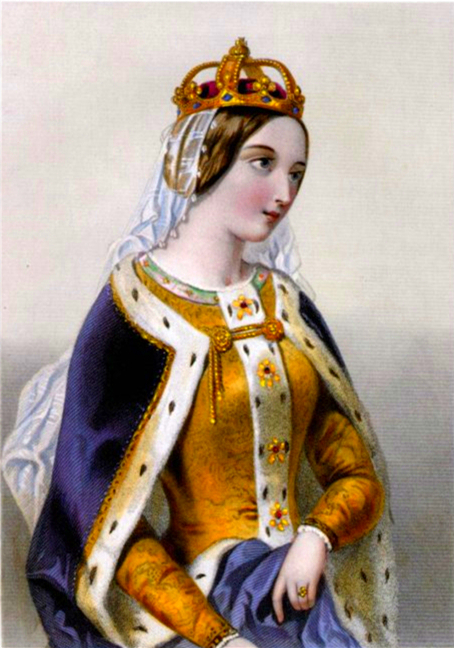
Catherine of Valois

Catherine of Valois

Catherine being the youngest child was probably the most neglected. She faced many challenges due to her father’s madness. Her mother’s lack of interest also affected her life, so she certainly did not live the life of a pampered fairy tale princess. Catherine did spend some of her young life growing up at Poissy Convent which was the basis for her religious education. Catherine was raised understanding that she would be merely a pawn when it came who her future husband would be. There had been negotiations since she was fairly young regarding a possible marriage to the future king of England, Henry V.

I believe that like most young princesses of Europe, she hoped for love and a family with her husband. Yet, her marriage would be to whichever member of European royalty was most beneficial to France.
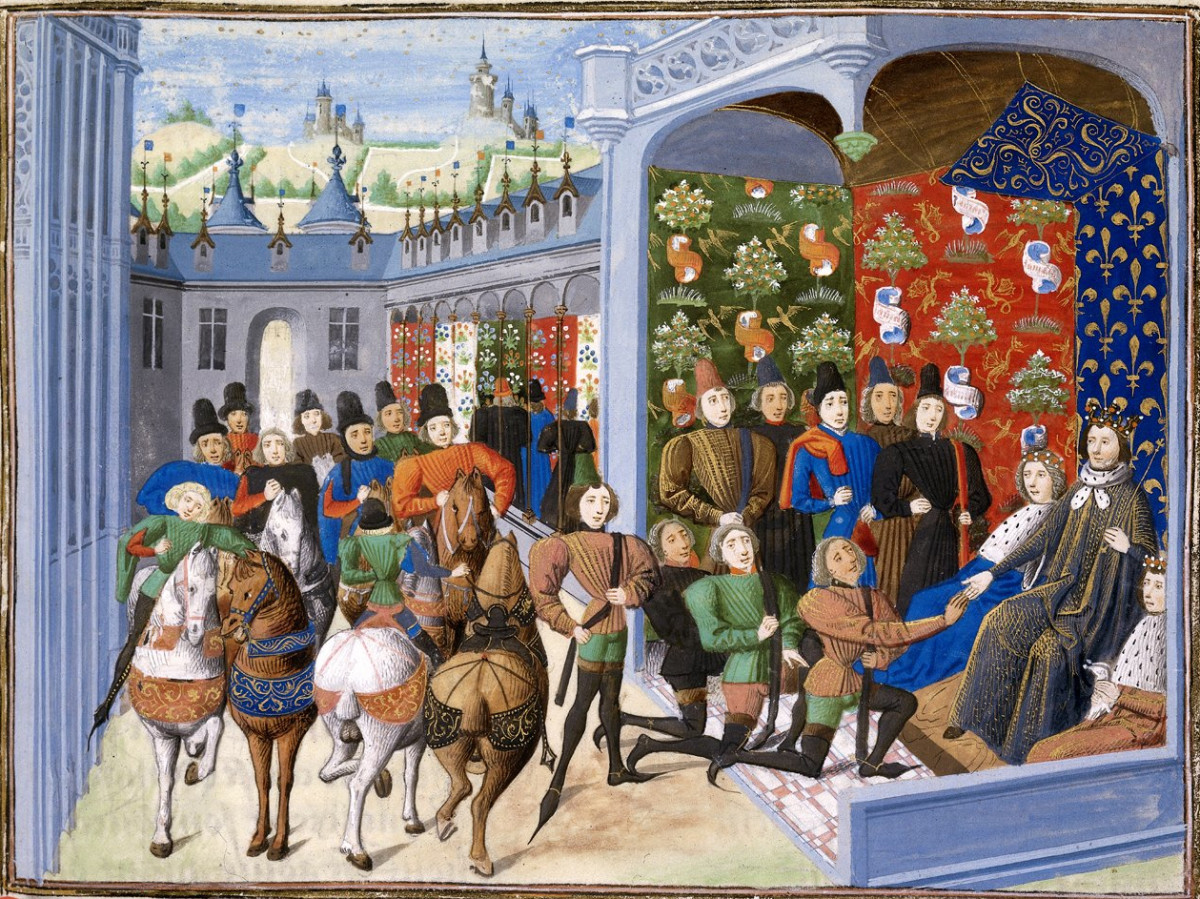
Signing the Treaty for Catherine and Henry's Marriage—Isabeau of Bavaria and Charles VI at the Treaty of Troyes
Signing the Treaty for Catherine and Henry’s Marriage—Isabeau of Bavaria and Charles VI at the Treaty of Troyes | Source

Peace Through Marriage

King Charles VI reign was filled with war (known as The Hundred Year Wars). One effort at achieving peace was through marriage. Isabelle, Catherine’s older sister was married to England’s King Richard at a mere six years of age. The marriage was never consummated due to her young age and the early death of King Richard in 1400. She was held in England for some time after Richard’s death before she was allowed to return to France.

King Henry V

King Henry was a young man when he was crowned the king of England. For much of his father’s reign, the royal English family fought with France. This conflict came to be known as the “One Hundred Years War”. King Henry V signed a treaty with France on May 21, 1420. In the treaty, he demanded the return of lands that had once belonged to England. This was the Treaty of Troyes which also included Henry’s marriage to the young eighteen-year-old Catherine of Valois. A large dowry was also included in the marriage contracts.
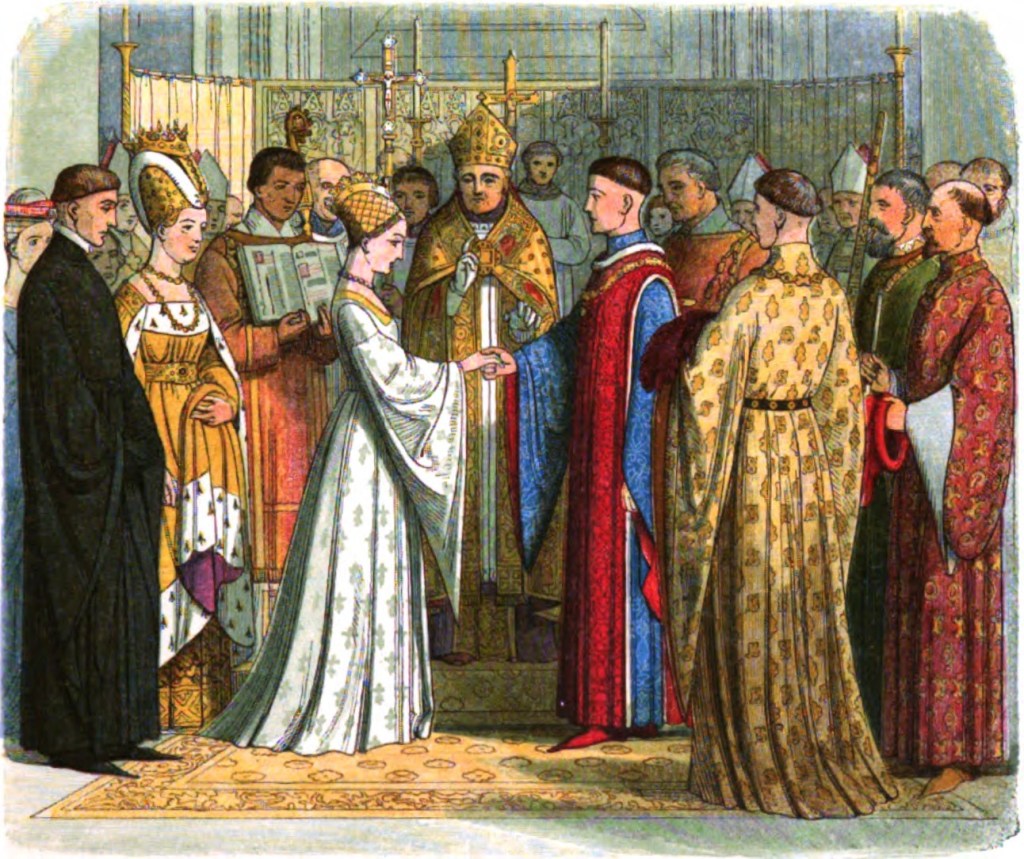
Wedding of King Henvy V and Catherine of Valois

King Henry V and Catherine of Valois were married on June 2, 1420, and Catherine was crowned queen of England in February 1421. The royal couple soon welcomed their only son Henry VI heir to both the English and France thrones. Their marriage proved to be a brief marriage. Henry V died on a battlefield in 1422 leaving a twenty-one-year-old widow and an infant son. Henry VI was only an infant when his father died. His two uncles, the Duke of Gloucester and the Duke of Bedford, controlled the government.

Queen Catherine was sent off to live quietly, at Baynard’s Castle, with only a small household staff. Her brothers-in-laws who were controlling England were concerned that if Catherine were to remarry, any new husband might influence the infant king and they would lose their power over the boy and England.

Forbidden to Love Again

The two dukes and the English parliament had specific ideas on how this young widow should conduct herself. She was also the mother of the boy king Thus they decided how she should be allowed to live her life. Therefore, parliament passed a law that forbade Catherine from establishing romantic relationships and she was forbidden to marry again without parliament’s or her young son’s approval. Any man with a title or lands would lose both his title and his land if he were to marry King Henry V’s widow. No man was willing to take the risk of angering parliament or losing their lands or titles. As her son was only a year old and would not be able to give his consent for years, Catherine’s fate had just been sealed. She would never be allowed to return to France, love again, or have more children to love.

The Queen’s Secret Love

But Catherine was lonely and a very young widow. Catherine was only in her early twenties and wanted to love and marry again. She wanted more children also. However, she was shut away from society in a huge castle with little company other than those who were her servants. She was even deprived of her young son, the future king. Henry had nurses and governesses and was allowed little time with Catherine.

At some time, Catherine met and became involved with a young handsome Welsh gentleman who was in charge of the royal wardrobes. Owen Tudor was in reality a high-ranking Welshman. Thus, the two of them began a secret love affair. Although there seems to be no record of their marriage, and though it was forbidden, Catherine and Owen were secretly married. A marriage that would produce more children for Catherine to love but would also have tragic endings for both Catherine and Owen. When the marriage caught the attention of Parliament, Catherine entered a nunnery and died a short time later. Owen would be captured and imprisoned. Owen eventually escaped prison and served with Catherine’s oldest son King Henry VI but was later captured by the enemies of Henry VI and was beheaded in Hereford marketplace. He was buried in Hereford.

Children of Owen Tudor and Queen Catherine

Owen Tudor an Catherine had several children together but two would play a huge part of English royalty history. Catherine’s oldest son King Henry VI would later make his half brothers and sisters legitimate and bestow them royal titles.

Edmund Tudor 1st Earl of Richmond and father of the future king Henry VII.

Jasper Owen Earl of Pembroke who would help to bring Henry VII the crown of England.

There may have been two daughters and another son named Edward but this is unknown for certain.

Catherine’s grandson would later become king making Catherine the wife of a king, the mother of another king, and the grandmother of the first Tudor king.

References

© 2021 L.M. Hosler

history, Women and History

The Legacy of Elizabeth Blackwell: First Female Doctor

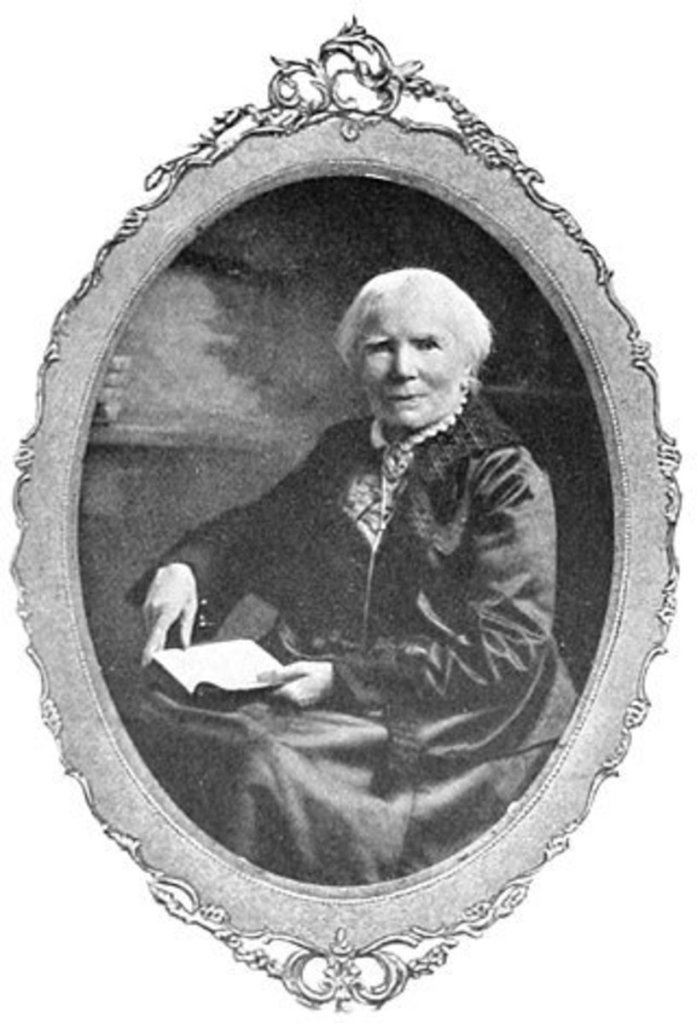
Elizabeth Blackwell Born in England

Elizabeth was born the daughter of Hannah Lane and Samuel Blackwell in 1821, their third child. She was born in Bristol, England. Her family enjoyed a prosperous lifestyle there. However, riots broke out and they lost their business. Her father made the decision to move the family to America while she was still a young girl. Samuel Blackwell felt he would have more job opportunities in America. He also wanted to support the anti-slavery movement and women’s rights movement for his daughters. The Blackwell family settled in New York in 1832.

Education

Samuel Blackwell did not want his children educated by the church. Therefore, they received their education through their parents and private tutors. Elizabeth could speak several languages, including French and German, as well as English. She also received education in music and literature. Elizabeth was fortunate that her father believed in education for his daughters as well as for his sons. This was a time when usually women did not have the same opportunities for education as men. In fact, it was rare for a woman to have access to higher education at all. For Elizabeth to become a doctor, she had to confront entrenched views. She had to challenge preconceived ideas about the roles of women in society.

First Work Experiences

When Elizabeth was eighteen, her father died unexpectedly. He left her mother, Hannah, with nine young children to support for. For some time, Elizabeth, along with her two sisters and mother, worked as teachers to support the family. Teaching was one of the few occupations that society accepted for women at that time. Together, the Blackwell women opened a private academy for young women in Cincinnati, Ohio. Elizabeth also moved to Henderson, Kentucky, to take a teaching position. However, her anti-slavery views clashed with the school’s teachings. She left after her first year.

During this time period, Elizabeth had a close friend who was dying of a disease that affected women only. This friend was the person who most influenced Elizabeth to pursue a career in medicine. She confided to Elizabeth how embarrassing it was for her to let male doctors examine her. Her friend wished that women were allowed to enter the medical field and treat women like her. This was the first time that Elizabeth had ever considered the possibility of studying to become a doctor. She had never considered medicine as a career. In fact, she had found the study of the body, diseases, and sickness to be appalling and disgusting. In honor of her friend’s thoughts and wishes, Elizabeth set her sights on becoming the world’s first woman doctor. It would not be an easy path to forge.

Elizabeth Fights for a Career as a Woman Doctor

At the beginning of her quest to earn a medical degree, many of her friends were against the idea. They tried to discourage her. They didn’t feel she had any chance of becoming a doctor due to being a woman. Elizabeth persisted even though she had no idea where to begin. So she began by studying with private doctors John and Samuel Dickinson, who were willing to teach her. She also spent a lot of time reading and studying on her own. From there, she began to apply to different medical schools. She was always told that they would not accept her because she was a woman.

Geneva Medical College

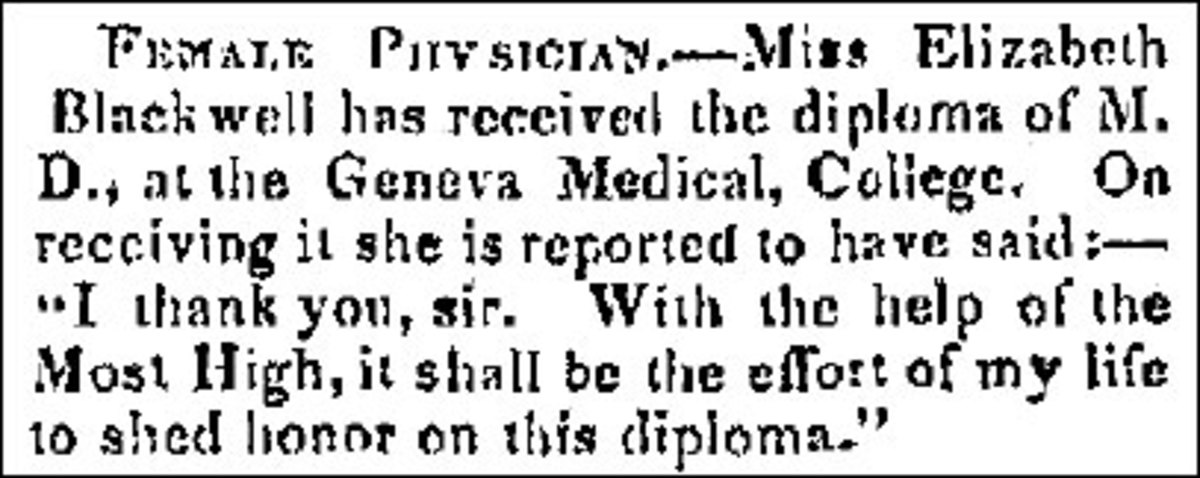
Finally, one school did admit her to their medical program of study. It was the Geneva Medical College in New York. Although she was admitted to the college, it was not going to be an easy road to her medical degree. The male students treated her as an oddity. They joked about her. Some went so far as to bully her. Some professors refused to let her in their classrooms and demonstrations. Elizabeth refused to give up no matter how much abuse she received and just worked and studied even harder. In Jan 1849, it paid off, and she received her medical degree and graduated first in her class. I wonder how chagrined and embarrassed those boys who had bullied her felt.

Elizabeth Blackwell medical degree

Continuing Studies

After graduating with her medical degree, she moved to London and Paris, where she continued studying. Here, she took courses in midwife studies. Unfortunately, it was here that she would be infected with an eye infection from one of her patients. She lost her eye due to the infection and thus ended her ambition of becoming a surgeon.

Doctoring in New York

Upon returning to New York, she set about helping poor women and children. She opened several facilities for women and children to receive medical treatment. She also opened the first medical college for women in New York. Elizabeth helped her younger sister Emily enter the field of medicine. Together, they opened and operated facilities for poor women and children, as well as supported many other causes. Doctor Rebecca Cole would be the first black woman doctor to work with Dr. Elizabeth Blackwell at her Infirmary for women and children.

Civil War

During the Civil War, Elizabeth helped the Union effort with her knowledge of medical practices. This included advocating for clean, sanitary conditions as well as proper personal hygiene in Union hospitals and army camps. She also worked with President Lincoln in establishing The US Sanitary Commission. She trained other nurses in proper sanitary procedures for wartime. These trained nurses helped to reduce diseases from spreading through hospitals and among the men in the army camps.

Elizabeth Blackwell’s Achievements

  • First woman to receive a medical degree
  • Worked and studied at Bartholomew’s Hospital in London
  • Opened a private practice when no hospital would hire her
  • Opened the New York Dispensary for poor women and children
  • Opened the New York Infirmary for indigent women and children
  • First woman listed on the British Medical Register
  • Opened the first medical college for women
  • Worked with President Lincoln during the Civil War to establish the US Sanitary Commission in 1861
  • Lectured at the London School of Medicine for Women
  • Inducted into the National Women’s Hall of Fame 1973
  • Founded the National Health Society in 1871. Its goal was to teach people about the importance of cleanliness and living a healthy lifestyle
  • This is only a short list of the achievements of Elizabeth Blackwell. I am sure there are many others as well.

Books by Elizabeth Blackwell

  • The Religion of Health
  • Essays in Medical Sociology
  • The Human Element in Sex
  • Pioneer Work in Opening the Medical Profession to Women
  • Medicine as a Profession for Women
  • Address on the Medical Education of Women

Again, this is only a short list of books and articles written by Dr. Elizabeth Blackwell. I believe she also wrote many articles about women’s health, as well as articles about sanitation, cleanliness, and hygiene.

Elizabeth Blackwell: A Lasting Legacy

Elizabeth forged a path into the medical field for many other women to follow, including her sister Emily. The two of them together changed perceptions in the medical profession. They worked together or separately to advance the acceptance of women. The field had viewed women as inferior, ignorant, and lacking sense. It also considered women as not having the mental attitude for the medical profession. Elizabeth proved them wrong.

Copyright

L.M. Hosler 2025


history, History, Women and History, writing

The Untold Stories of Women in Vietnam: A Review

The Women

Written by Kristen Hannah

Most of us have either lived through the Vietnam war or had relatives who served in the war. Others have seen movies based on that war. I myself grew up during the sixties and early seventies. I was lucky that none of my brothers were drafted during that era. Two of my brothers had already served and had families so they were not drafted. My other brother was the right age to be drafted but I am not sure how he didn’t get drafted. Maybe it was because he was in college at that time. I also had a brother-in-law who was stationed in Germany and managed to avoid the war in Vietnam.

Many of our young men were drafted and served in Vietnam. Thousands and thousands were killed in that war. But there was little to no mention of the women who served in Vietnam. The nurses, doctors, red cross women and many others all served their country in Vietnam. But those women were not considered to have seen combat.

That is what the book “The Women” is about. It’s about women who served as nurses in Vietnam. It’s particularly about one woman who joins the Army Nurses Corps. Her brother had been given a party in his honor before he left for the war. Frances (Frankie) had always been extremely close to her brother. She considered him her best friend. Frankie decided she would join as a nurse. After being turned down with the Navy and the Air Force, she signed up with the Army Nurses. Ironically, her brother is killed before she leaves and she is devastated by the loss of her brother. Frankie’s enlistment causes a strain with her family. She was raised to get married and have children. She was not raised to go off to war.

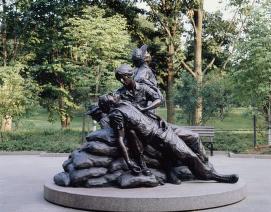
Women’s Memorial Honoring Women Who Served In Vietnam

Frankie experiences things she would never have dreamed as a sheltered young lady. But she soon adapts as well as she can, forms close friendships with other nurses and even falls in love. But in wartime, friendships may last a lifetime but love can be a short lived thing as she finds out.

After doing two tours in Vietnam, she returns home. The country is protesting the war. Veterans are not welcomed. She finds that people including her parents don’t want to talk about the war or her service in the war. Frankie finds that fitting in anywhere after the war is almost impossible for her.

This book details Frankie’s struggles to adjust in the world after the war. She finds it difficult to understand why women are not considered war veterans. Women, like the men she helped to save, also played significant roles. In fact, it was often said that no women ever served in the Vietnam war and many people believed this.

I really enjoyed this book and highly recommend reading this book. Of course, growing up in the Vietnam era, I knew some of what happened to veterans. I understood how hard it was for them to return to a country that had sent them to war. This country then learned to hate veterans who had fought in this war. They were mistreated and called baby killers. I liked the characters very much. It was very interesting to see Frankie change from a spoiled rich girl to a capable nurse who saved lives.

This book was in my book club and at first I wasn’t certain if I was going to read it. I am just really not very much into the Vietnam era when it comes to books and movies. But this book was different and an awesome book. I truly enjoyed reading this one.

Copyright:

Linda Hosler

July2025

history, History, Uncategorized, Women and History

The Inspiring Life of Nellie Bly: Pioneering Female Journalist

Elizabeth Cochran Better Know as Nellie Bly

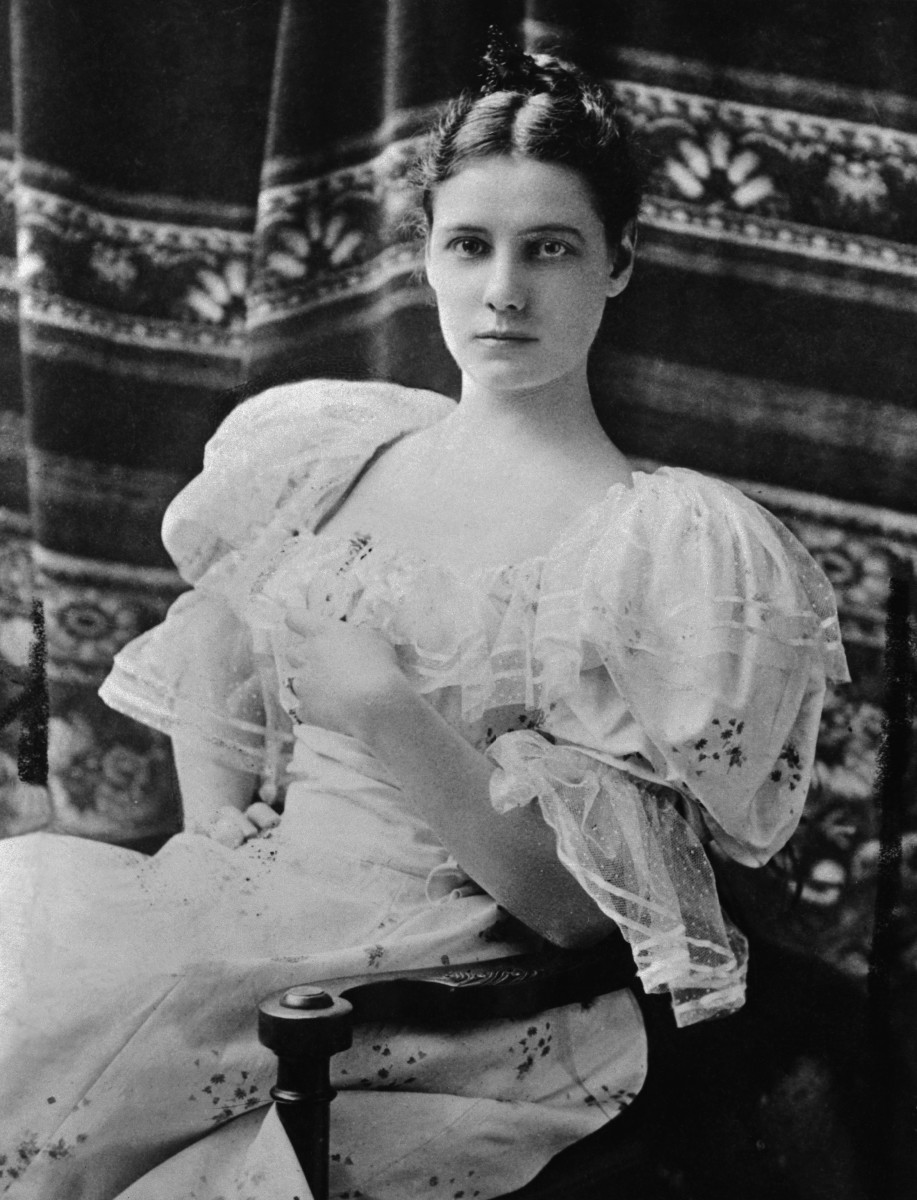
Nellie Bly at twenty one years old while working as a foreign journalist in Mexico

Nellie Bly Early Years

Nellie Bly was born in 1864 in Cochran Mills, Pennsylvania at a time when women were expected to stay at home, have babies, take care of their men and be happy doing that. Women had very few rights at that time, little education and they rarely had good career choices. Nellie was born into a large family of fifteen. Her father had ten children before he married Nellie’s mother, who then gave birth to another five children. Nellie was named Elizabeth Jane but was also nicknamed “Pink or Pinky”. Later when she began her career as a newspaper woman, she changed her name to Nellie Bly as her pen name. Nellie’s father died when she was six years old and the family fell into hard times. Her mother remarried but it is said that her new husband was abusive. Sometime later her mother divorced the stepfather leaving Nellie and her mother to support the family by operating a boarding house just outside of Pittsburgh.

Nellie had wanted to become a teacher and briefly attended the Indiana Normal School, now know as Indiana University of Pennsylvania. However, the family’s finances forced her to give up her teaching dream. It was at this time that Nellie left school to help her mother run the boarding house but she still had dreams of what she wanted to do with her own life.

Nellie Begins Her Career as a Reporter

Nellie began her career as a writer and reporter in 1885 at the Pittsburgh Dispatch newspaper. She had written an angry letter to the paper’s editor in response to an article that she felt disrespected young girls and women. After reading Nellie’s letter, the editor offered her a job working for the paper. Very few women were ever offered opportunities like this and Nellie quickly accepted the offer. She was generally given assignments that were considered of interest to women. Here Nellie could give a voice to issues that concerned women such as poor women who had to support themselves as well as the working conditions these women found themselves in. Of course, some of her articles didn’t sit well with the business class and this was the reason she was reassigned to writing just for the women’s page such as society news. Nellie soon grew tired of these boring assignments and wanted more of a challenge. She found her challenge by going to Mexico as a foreign correspondent for the paper where she spent several months writing about the lives and conditions she found in Mexico. After a few months however, she drew the displeasure of the Mexican dictator Porfirio Diaz when she wrote articles critical of his leadership and government. Nellie was forced to leave the country but later she published her book “Six Months in Mexico”. It seems Nellie’s honesty as a reporter was not always appreciated and tended to get her into trouble.

Nellie Exposes the Insane Asylum Blackwell Island

In 1887 Nellie decided it was time to move to New York where she took a job at The New York World paper as a reporter. Her first real assignment with the New York World paper was to go undercover as an insane girl to the Blackwell Island mental institute. How many of us would willing have ourselves committed to an insane asylum? Not very many of us I am sure. Here she spent ten days living locked up with insane women. She saw and experienced everything that a truly insane person would experience. As a result, she wrote a series of articles exposing the mental health facility and she was able to bring about awareness for the mentally insane and instigate an investigation into Blackwell Island. This brought about much needed reforms for mental health institutions. Her story of her time in the mad house later became the movie, “Ten Days in a Mad House”. It was an awesome movie but I believe it was rather dramatized as they tend to do with movies.

Some of the reforms that were brought about by Nellie’s daring venture into Blackwell Island institute for the mentally insane included:

  • Better food for the patients
  • Better health care
  • Warmer clothing and more blankets
  • More oversight into the doctors and nurses treatment of the patients
  • Warm baths instead of icy cold baths
  • Cleaner clothing, towels and personal care items

Blackwell Island for the Mentally Insane Asylum

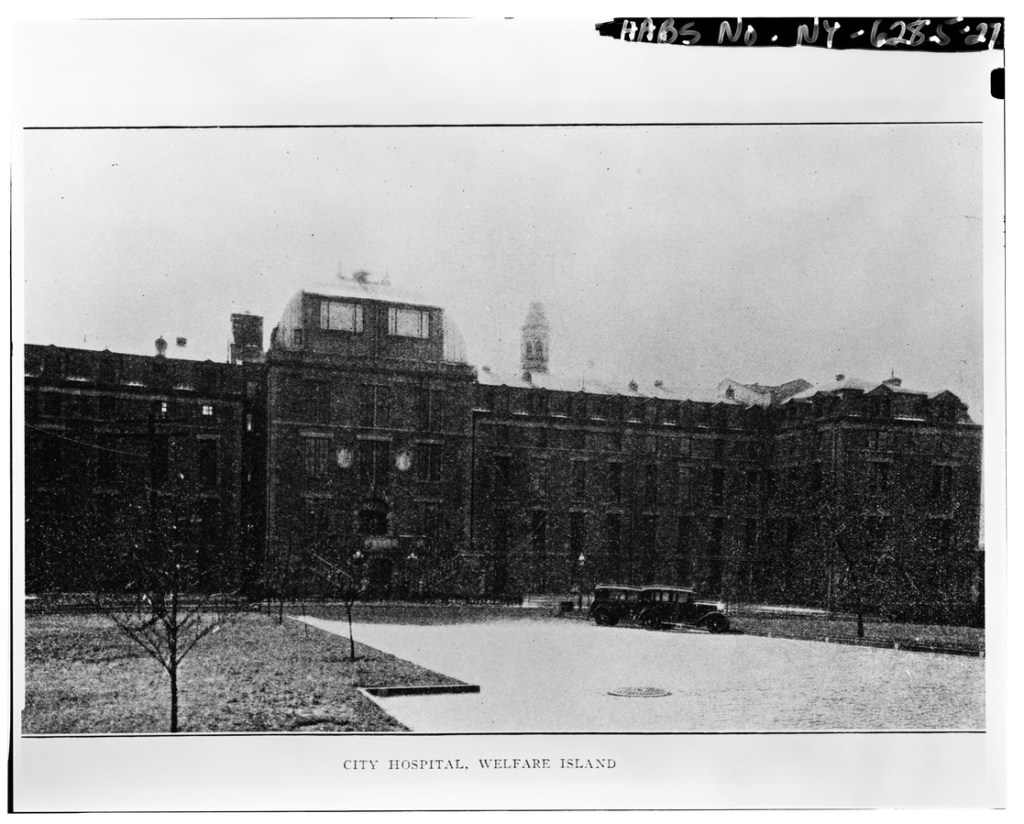
The Blackwell Mental Institute for the insane where Nellie Byl spent confined for ten days

Nellie Travels the World in Seventy Two Days

Nellie also had the opportunity to travel around the world to beat the previous fictional world record of eighty days. When Nellie brought up the idea of beating the old record her editor told her it wasn’t a job for a female so Nellie challenged him to send both her and a man at the same time. Her editor gave her the assignment. She left Hoboken, New Jersey on Nov 14th, 1889 by ship, traveling to London. From London she took trains to Paris and throughout Europe. From there she traveled to Egypt then on to the Suez Canal then headed towards Middle Eastern countries. From there, she next journeyed through Asian countries and into Japan. From Japan she headed home to San Francisco, Ca. Her journey consisted mostly of travel by trains and ocean liners but there are also reports of various other means of transportation such as horses and Asia rickshaws. Nellie completed her journey in record time with a total of twenty one seven hundred and 40 miles in seventy days, six hours and eleven minutes. I am not sure Nellie was aware at the time she began her journey that the Cosmopolitan magazine was also sending another female reporter, Elizabeth Bisland, on the same mission.

During those seventy two days as Nellie traveled the world, the editor of The New York World used her trip to drive up circulation of the newspaper. Nellie would send dispatches to the paper on where she was every day. The newspaper sponsored a contest offering a prize of a trip to the person who made the most accurate guess as to how long her trip would take.

Upon her return arrival in San Francisco on Jan 25th 1890 Nellie was greeted with crowds of admirers and was given a special train to make her trip back to New York. When she arrived in New York she was honored with parades, brass bands and fireworks to celebrate her victory and safe return. She later wrote her book titled “Around the World in Seventy Two Days”.

Nellie’s Many Accomplishments

Nellie Bly was certainly a woman ahead of her time. In a time when women were looked on as nothing more than a wife, mother, housekeeper and laundress, she blazed a path of her own. In 1895 Nellie married Robert Livingston a man quite a bit older than her. After his death, Nellie wrote numerous articles covering the women’s suffrage movement. Her words and her stories were a powerful tool for women everywhere. Nellie also covered the First World War reporting from the Eastern front lines. Nellie received numerous awards for her work throughout her lifetime and she certainly left her mark on the journalist world. In 1998 Nellie Bly was indicted into the National Women’s Hall of Fame.

Nellie Bly was a leader whose work influenced women’s lives in many ways. Her early work exposed factories and influenced changes in safety. She became a role model for young women who dreamed of becoming something more than a wife and mother.

Copyright  2019 L.M. Hosler

history, History, Women and History

Royal Fairy Tale Weddings: Royal Scandals

The Queen Arrives at Royal Wedding

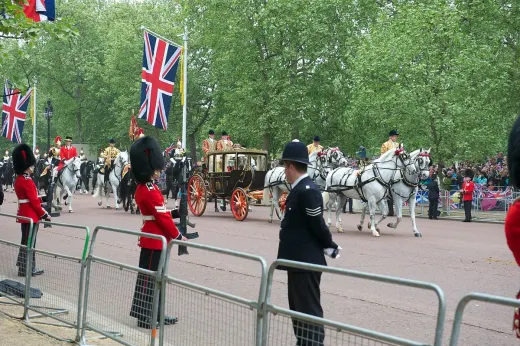
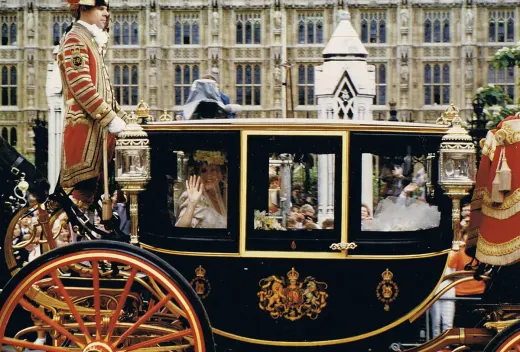
The Queen of England arrives by carriage at a royal wedding.

Times Have Changed Attitudes About Royal Marriage and Divorce

At one time, divorce was not an option to even be considered for the royal British family. It was almost impossible to obtain a divorce among the royal class. But over the years there were some exceptions, probably beginning with King Henry VII and his six wives. In his case, he did manage to divorce his first wife. The other wives had less fortunate endings. But divorce among the royalty was still considered taboo and likewise, they were not allowed to marry a person who was divorced. King Edward VIII gave up the throne to be able to marry the twice divorced Wally Simpson. Things began to change during the reign of Queen Elizabeth II. Her sister and three of her children’s fairy tale weddings ended in divorce. Just recently Prince Charles the heir to the British throne and his son Prince Harry have both been allowed to marry divorced women. It is looking very likely that the fairy tale wedding of Prince Harry and Meghan Markle will quite likely end in another royal scandal. As a matter of fact, this royal fairy tale has already become a major scandal for the British monarchy.

The Prince and Princess of Wales

Prince Charles and Princess Diana marriage begins to crack.

Not long after Prince Harry was born, things began to deteriorate between the young couple. Charles had done his royal duty and produced an heir and a spare heir. By 1986, rumors began that Prince Charles was rekindling his old romance with Camilla Parker Bowles. Then the rumors began about Princess Diana and other men. How much was true may never be fully known, but we do know for certain that Prince Charles did have an affair with Camilla Parker Bowles, and he did marry her several years after Diana’s death. The fairy tale had become a rocky road. In February of 1989, Princess Diana had an occasion to confront Camilla and let her know that she knew what was going on behind her back. By 1990, the marriage was on very shaky ground and at some point, Prince Charles admitted his affair with Camilla Parker Bowles. Diane famously said that there were three people in their marriage.

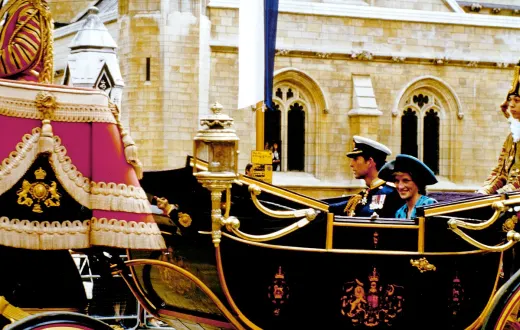
Prince Charles and Princess Diana arrive by carriage to Prince Andrews wedding

Princess Margaret the Queen’s Rebellious Sister

Princess Margaret had a reputation for being a rebellious royal. When she was very young and quite beautiful, she fell in love with Captain Townsend. The two privately planned on being married but the captain who was divorced was not considered a good match for Margaret. He was not of noble birth but even worse he was a divorced man which was not acceptable at that time. Margaret at that time needed both the permission of her sister, the Queen Elizabeth, and parliament to marry Captain Townsend. Privately, her sister would have granted her permission but it was well known that parliament would not give their consent. Eventually Captain Townsend and Margaret called off their romance.

On May 6, 1960, Princess Margaret married a thirty year old photographer and commoner, Anthony Armstrong Jones. It was a lavish fairy tale wedding with thousands of guests, royals and heads of states from other countries. It was also watched by millions around the world on national television. On November 3, 1961, their first child David arrived followed by a sister, Sarah on May 1, 1964. Upon the arrival of the children, it was decided that Anthony Armstrong Jones needed to be given a royal title for the sake of the children. He was given the title of Earl of Snowden and his son the title of Viscount Linley. A few years after the birth of the children, the marriage began to sour. The couple loved partying which ended up involving affairs, drugs and alcohol, all the aspects of the modern 1960s. The two separated and on July 11th 1978, after eighteen years of marriage the fairy tale ended in divorce. Princess Margaret twenty years earlier could not marry a divorced man but 1960s changed attitudes so by 1978 divorce among the royals was not quite so scandalous.

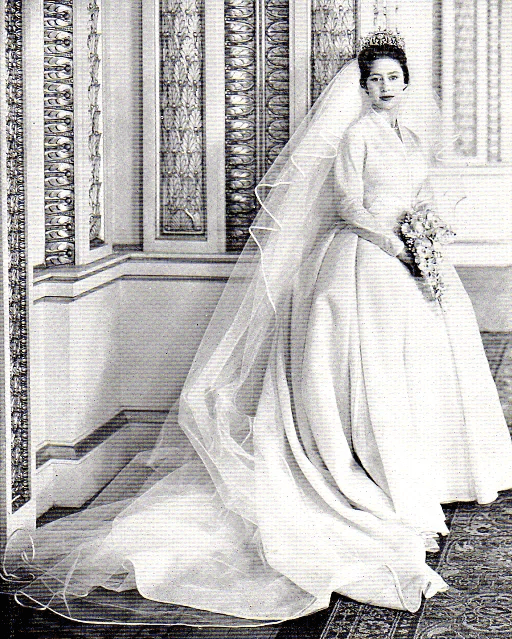
Princess Margaret in her Wedding Dress

Prince Andrew and Sarah Ferguson

Prince Andrew was formally introduced to Sarah Ferguson at a party given by Princess Diana. They immediately hit it off with Prince Andrew falling for the fiery red haired beauty. On March 18th 1986, they announced their engagement. On July 23, 1986, they were married at Westminster Abbey where many of the royal family have been married.

Almost from the start, theirs was a rocky road. Prince Andrew’s position in the Royal Navy kept him from home for long periods of time for the first five years of their marriage. Sarah or (Fergie) as she was known had deep security issues relating back to being abandoned by her mother at an early age. The couple did have two daughters, Beatrice and Eugenie. Sarah was perhaps never fully supported by the royal family. She didn’t fit the royal mold and was bold and outgoing. At any rate, the marriage floundered and the Duke and Duchess of York announced their separation in 1992 and were divorced in May of 1996. Along the way there were scandals and other relationships as was the case in most of the other royal fairy tales. However, their story may yet have a happy ending. Prince Andrew and Sarah have always remained close friends and both were very involved in the raising of their two daughters. It seems that today they live together and there are rumors that the two may remarry someday. Let’s hope that this royal fairy tales ends like fairy tales are supposed to end and they live the rest of their lives happily as fairy tales are meant to end.

Sarah Ferguson on Her Wedding Day

The scandal That Splits The Royal Family

The latest royal scandal is still brewing. This one involves the Duke and Duchess of Sussex, the former Prince Harry and his bride Meghan Markle an American Hollywood actress. The couple married on May 19, 2018. Their son Archie was born the following year on May 6, 2019. In January 2020, they made headlines around the world with their decision to leave the British royal family and move to Canada.

Some Fairy Tales End Happily

Everyone, including me loves a fairy tale. When we see a young beautiful prince or princess marry in a huge fairy tale wedding complete with beautiful white dresses, horse drawn carriages, famous and titled guests, we can’t help but still believe in fairy tales like Cinderella, Snow White and Beauty and the Beast and happy endings. After all, some of the royal family such as Queen Elizabeth II and Prince Phillip and Queen Victoria and Prince Albert somehow managed to live out their fairy tale.

Copyright Linda Hosler March 10, 2014

history, History, Women and History

Mother and Serial Baby Killer Marie Noe

What sort of mother will kill not one but eight of her ten children??

Marie Noe was a young Philadelphia woman who had ten children between 1949 and 1968. Two of those children lived only a short time and died stillborn. Some only lived a short time in the hospital, never making it home. The other eight babies Marie admitted to smothering to death.

Marie was born as Marie Lyddy on Aug 3, 1928, in an area of Philadelphia, Pa. It seems that Marie had been a neglected child who was most likely physically, emotionally and sexually abused as a young child. Marie’s family was certainly a troubled one. And to make matters even worse, Marie contacted scarlet fever which left her with some learning disabilities. She had a very limited education. She most likely only finished the fifth grade. At that time, she started working to earn her keep.

Marie was close to twenty when she married Arthur Noe and he was twenty-seven. Shortly after that the babies started to be born.

  • Ten Babies
  • Richard Allen March 7th, 1949
  • Elizabeth Mary Sept 8, 1950
  • Jacqueline April 23, 1952
  • Arthur Joseph Jr
  • Constance Feb 24, 1958
  • Letita stillborn Aug 24, 1959
  • Mary Lee June 1962
  • Teresa Died in the hospital only hours after her birth
  • Catherine Ellen Dec 3, 1964
  • Arthur Joseph Jr July 1967

Several of these babies spent a few weeks or months in the hospital and seemed healthy. Healthy enough for the doctors to release them to go home. But then dying a few short weeks or days later. Marie was always alone with the baby when they died. But the deaths were all considered to be SID deaths which is (sudden infant death syndrome). After the birth of the second Arthur Joseph JR, Marie was no longer capable of having any more children.

Investigation and Sentencing

In 1999, a newspaper article written by Stephen Fried brought the Noe’s story back into the spotlight. This article triggered an investigation into the deaths of the eight children. That many years later the evidence of course was sketchy. However, Marie Noe was brought in for questioning and eventually confessed to killing four of the children. She was seventy-one years old by that time.