

An Ordinary Day In Boston Turns Deadly
January 15, 1915, started off as a warmer than usual day. People were out on Commercial Street, Boston. They were moving about and enjoying the slightly warm January day. Children were playing outside on the streets and workers were stepping away from their jobs for a brief lunch break.
They did not realize the danger they would soon be facing. Tons of molasses would pour through the streets of Boston around noon. None of them knew that in just a few minutes some of them would be dead. Others would struggle to survive in a city covered in waist-high molasses. It would change quickly from being just an ordinary day to become the most deadly horrifying day in Boston’s history.
First World War Ends, Prohibition Set to Begin
Molasses became an important ingredient in creating ethanol during the First World War. This ethanol was used to create ammunition and explosives. The war ended. The American Congress then sought to make any form of liquor or alcohol illegal. They did this with an act of Congress called Prohibition.
Purity Distilling, therefore, was holding tons of molasses in a large storage tank in Boston. The company sought to make as much liquor as possible before Prohibition took effect. Shifts at Purity Distilling operated around the clock. They produced as much high-grade rum as possible.
Giant Tank Holding Millions of Gallons of Molasses
The molasses storage tank had been built a short time earlier just as the First World War was ending. It was a huge tank measuring fifteen feet high and one hundred sixty feet wide. When filled to the limit it held 2.3 million gallons of molasses.
The tank had been built near the harbor. Ships could dock there to unload the molasses. Railroads were close by to ship the molasses to where it would be made into alcohol. On Jan 15, 1915, it was filled almost to its limit. It was straining to hold the massive amount of molasses.
Tank Explodes, Molasses Flows
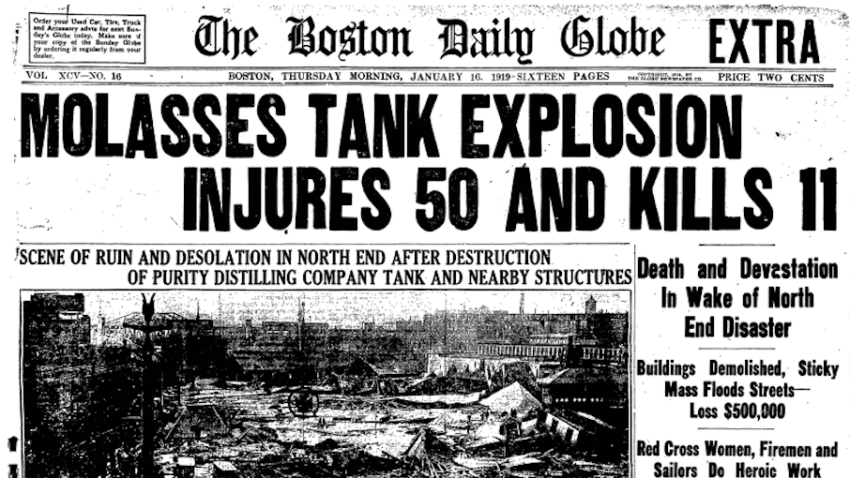
Close to noon people began to hear louder than usual noises coming from the tank. Survivors would later report that they heard loud rumbling noises. These were followed by loud pops which sounded like machine guns being fired. The metal steel rivets caused these noises. They held the sides of the tank together and popped out in rapid succession. Molasses began flowing from the tank at 25 to 35 miles an hour. Anyone in its path had no chance to escape.
Chaos and Destruction and Death Follows
The flood of molasses swept through the streets with such force. It literally slammed buildings off their foundations. It knocked over horses, cars, wagons, people, and anything else that got in its way. Horses and people were caught in the sticky goo. The molasses quickly hardened once it was out in the cooler air. This made it impossible for anyone trapped in it to move.
The molasses (which was a high wave) at that time knocked people and children to the ground where some suffocated to death. Twenty-one people died in the molasses while another one hundred and fifty were Injured. Property damages were enormous and if this had happened in modern times the price tag would be near $100,000,000.
Rescuers, including the police, local volunteers, and the Red Cross, all responded quickly to the disaster. They found it hard to walk through the molasses, which was up to their waists in some places. The molasses would cling to their boots and clothing making it hard to walk as they searched for survivors.
What Caused the Tank to Explode
- No permit was required to build the tank.
- It was poorly designed.
- Poor construction and materials.
- Leaks were not repaired, and molasses dripped.
- The tank was painted brown to hide the leaks and drips.
- Molasses would ferment causing pressure to the inside of the tank. This would be like putting too much air or gas in a balloon, which would cause the balloon to pop.
- It was built very cheaply and quickly built with no safety inspections.
- Was never properly tested by using water to find and repair leaks.
Lawsuits Become the First Class-Action Lawsuits
Victims of the molasses flood and the families who were victims of the flood soon filed lawsuits against Purity Distilling. These lawsuits soon combined to make one massive lawsuit, becoming the first-class action lawsuit for the state of Massachusetts. Finally, in 1926 the victims were awarded $300,000. This resulted in new laws enforcing higher regulations and inspections for new construction.
The tank that held those deadly gallons of molasses would never be rebuilt. Today, a recreational complex has been built in its place. More than a hundred years have passed since the molasses flood. People who live near the site still claim that the smell of molasses lingers on really hot days.
References for Flood of Molasses
Lyons, Chuck. (2009). “A Sticky Tragedy: The Boston Molasses Disaster.” History Today
Bellows, Alan. (2005). “The Monumental Molasses Morass of 1919.” Damn Interesting
Owen, Ryan W. (n.d.) “The Great Boston Molasses Flood, Prohibition and Anarchists.” Forgotten New England
Powell, J. Mark. (2019). “The Sticky Truth: 100 Years Ago, a Molasses Tsunami Caused a Deadly Boston Disaster.” Washington Examiner
Copyright L.M. Hosler 2019

 History Lovers Corner