history, Uncategorized

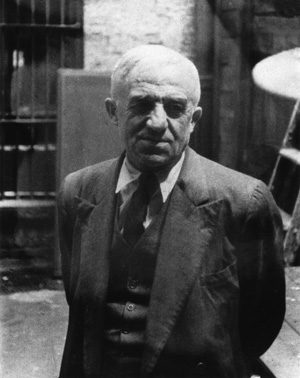
Jack Johnson: The First African American Boxing Champion

Jack Johnson the Boxer

On May 24, 2018, President Donald Trump officially pardoned John Johnson, the former heavyweight boxing champion. Who was Jack Johnson? What crime did he commit? Why did the president grant him a pardon years after Johnson’s death?

Johnson’s Early Years

John Arthur (Jack) Johnson was born on March 31,1878, in Galveston, Texas. This was not many years after the Civil War had freed the slaves in the South. Johnson’s parents, Henry and Tina Johnson, were former slaves. Jack Johnson was one of Henry and Tina’s several children and Jack did not get much of a formal education. He was forced to leave school at a young age to help support the family. He found employment on the docks. But Johnson was a tall, large black man who would not settle for just being a common dock worker. Instead, he set his sights on becoming the first African American heavyweight boxing champion.

At the young age of fifteen, Johnson fought his first fight. Sometime in 1897 he went professional. In his early career, he would fight in private clubs. He realized he loved the money he was making by doing something he loved.

In Johnson’s early career, he fought Joe Choynski, another fighter from the Galveston area. Johnson was knocked out. This type of fighting was illegal in Texas at that time. Both fighters were arrested. Bail was set very high, higher than either man could come up with. The sheriff came up with an arrangement that suited everyone. Both fighters avoided actually going to jail. The sheriff’s arrangement was for both men to meet in a cell and spar every day. Choynski and Johnson became friends. But more important, Choynski became Johnson’s mentor and coach for the time they spent sparring in a jail cell.

Jack Johnson’s List of Major Fights

Jack Johnson (nicknamed the Galveston Giant) formally began his boxing career on Nov 1st, 1898. He had an amazing list of hard-won fights.

  • Nov 1, 1898: Johnson won a fight against Charley Brooks in Galveston, Texas.
  • May 8, 1899: Johnson won against John Hayes in Chicago. The following year, these two matched up again in a tie.
  • Feb 25, 1901: Johnson fought Joe Choynski and lost.
  • 1903: By this time, Johnson had won 50 fights. Johnson fought Denver Martin and won. This fight earned Johnson the World Colored Heavyweight Championship.
  • Dec 1926: Johnson fought Tommy Burns and became the first African American to hold the Heavyweight Boxing Championship title.
  • July 4, 1910: Johnson fought James Jefferies in Reno, Nevada, a fight that was dubbed the fight of the century. Johnson won, which led to race riots.

Racial Tensions Arise

By this time, Johnson had made a name for himself. He was a black man in an era of Jim Crow laws and racial tensions. The Civil War wasn’t that long ago. Johnson soon faced legal problems because he was a colored man who had beaten James Jefferies, a white man. There was much celebrating that Johnson had won against a white man. This victory did not sit well with the white boxing world.

Johnson also liked white women; he had been married to two white women and was involved with white prostitutes. This did not go very well with whites during the time of Jim Crow laws.

Johnson’s White Wives

Johnson’s first wife was Etta Terry Duryea. She was a wealthy white socialist from Brooklyn, and their marriage proved to be a disaster. They were married from January 1911 until September 1912—not even a full year—at the time she committed suicide.
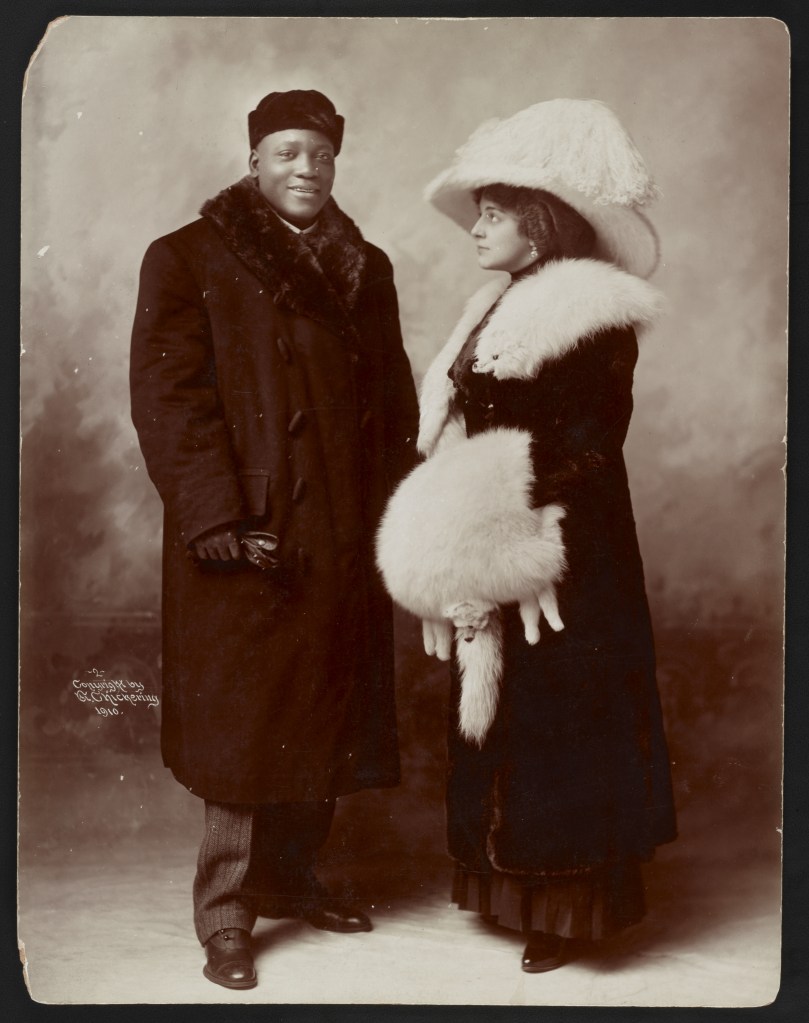
Boxing Champion Jack Johnson and his wealthy wife pose for the cameras

Johnson then met Lucille Cameron, another young, nineteen year-old white girl from Minneapolis. Lucille’s mother was outraged that her daughter was dating a black man. In Oct 1912, she accused Johnson of kidnapping her daughter. The case went to trial. Lucille stood up for Johnson. She refused to say that she had been kidnapped. As a result, the charges were dismissed. Lucille and Johnson were then married on Dec 4th 1912 and later divorced in 1924.

The Mann Act 1910

The Department of Justice failed to convict Johnson in the Lucille Cameron case. They quickly found another woman who was willing to testify that Johnson had taken her over state lines several times. This woman was Belle Schreiber, another white woman he met in May 1913. She was a prostitute in a house that refused black men. However, Johnson persuaded Belle to travel with him several times, crossing the state lines. This violated the 1910 Mann Act. The 1910 Mann Act stated that it was a federal offense to travel over a state line with a woman or young girl with the intention of prostitution or any immoral act. Belle was convinced to testify against Johnson. As a result, he was convicted of violating the Mann Act and sentenced to one year in prison.

Evading the Law

Johnson was let out on bail as he appealed the court’s decision, but he quickly decided that he was going to disappear. He eluded the police and headed for Canada, where he joined up with his wife Lucille. From Canada, they headed to France where Johnson managed to book some fights. However, World War I was on the verge of hitting Europe so Johnson and Lucille headed south to South America.

Jack Johnson Loses His Heavyweight Title

In 1914, another fight was scheduled for the world boxing title. Johnson would face Jess Willard in the ring in Havana. Willard was younger and well trained for the fight, but Johnson was favored to win. However, Willard managed to wear out Johnson and won the fight, thus taking the Heavyweight Boxing title from Johnson. It would be years before the boxing world would let another black man fight for any boxing titles.

After losing to Willard, Johnson returned to the USA in 1920 and turned himself in to law enforcement to serve out a 10-month prison sentence. After his release, he returned to boxing and continued fighting until he was 50 years old. In 1920, Johnson and Lucille were divorced. He later married Irene Pineau. He remained married to her until his death in a car accident in 1946 in North Carolina.

Jack Johnson the Legend

Jack Johnson was a boxing legend. He fought hard, loved white women, and at times lived a life of luxury. He paved the way for other great African American boxers who would become world boxing legends. He was inducted into the Boxing Hall of Fame in 1954 and the International Boxing Hall of Fame in 1993.

Jack Johnson’s Grave Graceland Cemetery, Chicago

https://easttexashistory.org/items/show/333 There’s a picture of Jack Johnson and his third wife who is also a white woman.

© 2019 L.M. Hosler

history, Women and History

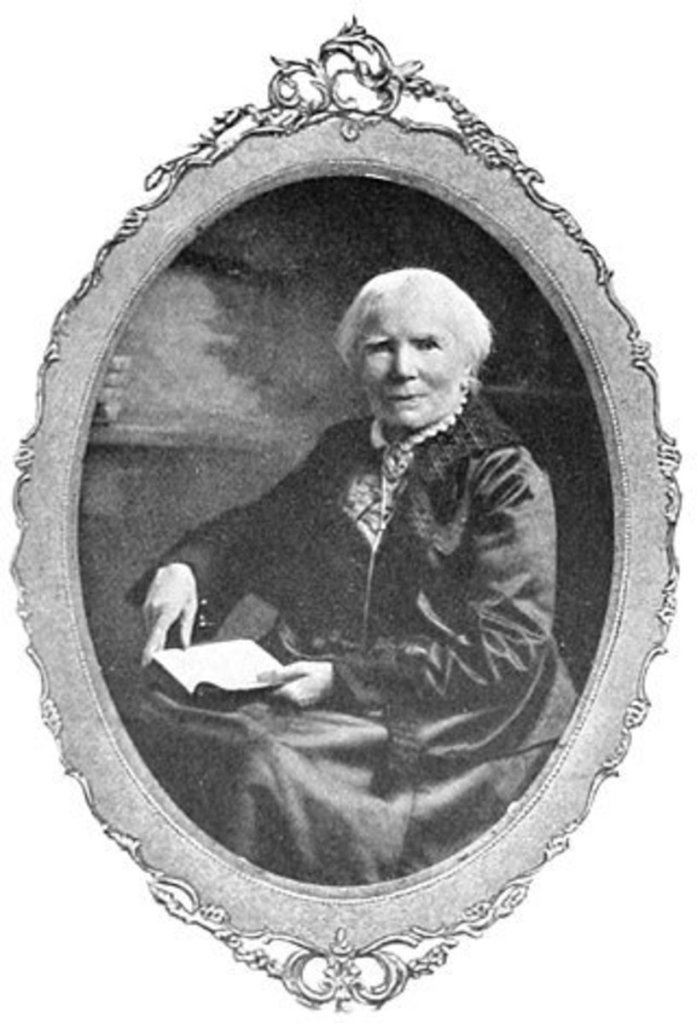
The Legacy of Elizabeth Blackwell: First Female Doctor

Elizabeth Blackwell Born in England

Elizabeth was born the daughter of Hannah Lane and Samuel Blackwell in 1821, their third child. She was born in Bristol, England. Her family enjoyed a prosperous lifestyle there. However, riots broke out and they lost their business. Her father made the decision to move the family to America while she was still a young girl. Samuel Blackwell felt he would have more job opportunities in America. He also wanted to support the anti-slavery movement and women’s rights movement for his daughters. The Blackwell family settled in New York in 1832.

Education

Samuel Blackwell did not want his children educated by the church. Therefore, they received their education through their parents and private tutors. Elizabeth could speak several languages, including French and German, as well as English. She also received education in music and literature. Elizabeth was fortunate that her father believed in education for his daughters as well as for his sons. This was a time when usually women did not have the same opportunities for education as men. In fact, it was rare for a woman to have access to higher education at all. For Elizabeth to become a doctor, she had to confront entrenched views. She had to challenge preconceived ideas about the roles of women in society.

First Work Experiences

When Elizabeth was eighteen, her father died unexpectedly. He left her mother, Hannah, with nine young children to support for. For some time, Elizabeth, along with her two sisters and mother, worked as teachers to support the family. Teaching was one of the few occupations that society accepted for women at that time. Together, the Blackwell women opened a private academy for young women in Cincinnati, Ohio. Elizabeth also moved to Henderson, Kentucky, to take a teaching position. However, her anti-slavery views clashed with the school’s teachings. She left after her first year.

During this time period, Elizabeth had a close friend who was dying of a disease that affected women only. This friend was the person who most influenced Elizabeth to pursue a career in medicine. She confided to Elizabeth how embarrassing it was for her to let male doctors examine her. Her friend wished that women were allowed to enter the medical field and treat women like her. This was the first time that Elizabeth had ever considered the possibility of studying to become a doctor. She had never considered medicine as a career. In fact, she had found the study of the body, diseases, and sickness to be appalling and disgusting. In honor of her friend’s thoughts and wishes, Elizabeth set her sights on becoming the world’s first woman doctor. It would not be an easy path to forge.

Elizabeth Fights for a Career as a Woman Doctor

At the beginning of her quest to earn a medical degree, many of her friends were against the idea. They tried to discourage her. They didn’t feel she had any chance of becoming a doctor due to being a woman. Elizabeth persisted even though she had no idea where to begin. So she began by studying with private doctors John and Samuel Dickinson, who were willing to teach her. She also spent a lot of time reading and studying on her own. From there, she began to apply to different medical schools. She was always told that they would not accept her because she was a woman.

Geneva Medical College

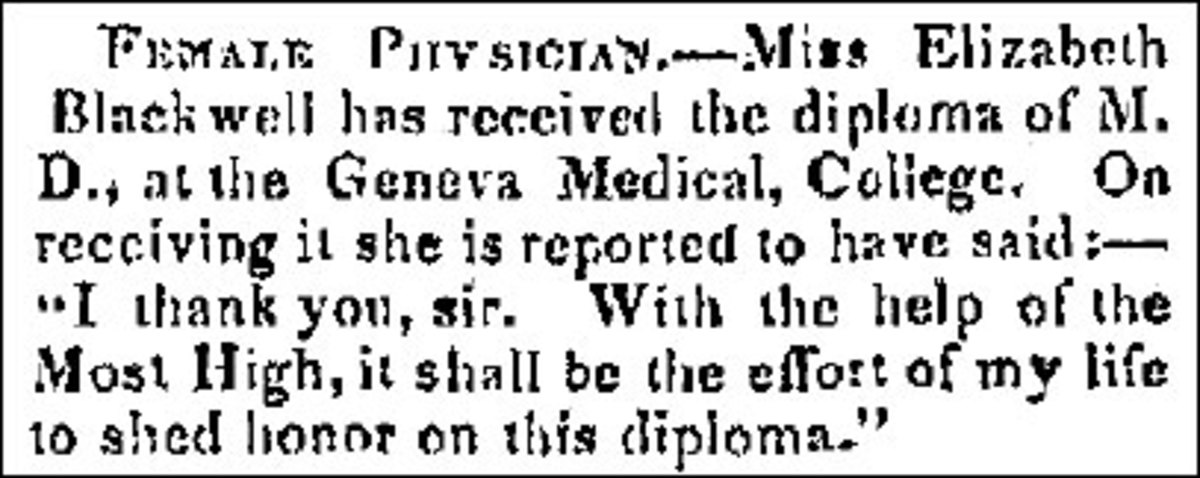
Finally, one school did admit her to their medical program of study. It was the Geneva Medical College in New York. Although she was admitted to the college, it was not going to be an easy road to her medical degree. The male students treated her as an oddity. They joked about her. Some went so far as to bully her. Some professors refused to let her in their classrooms and demonstrations. Elizabeth refused to give up no matter how much abuse she received and just worked and studied even harder. In Jan 1849, it paid off, and she received her medical degree and graduated first in her class. I wonder how chagrined and embarrassed those boys who had bullied her felt.

Elizabeth Blackwell medical degree

Continuing Studies

After graduating with her medical degree, she moved to London and Paris, where she continued studying. Here, she took courses in midwife studies. Unfortunately, it was here that she would be infected with an eye infection from one of her patients. She lost her eye due to the infection and thus ended her ambition of becoming a surgeon.

Doctoring in New York

Upon returning to New York, she set about helping poor women and children. She opened several facilities for women and children to receive medical treatment. She also opened the first medical college for women in New York. Elizabeth helped her younger sister Emily enter the field of medicine. Together, they opened and operated facilities for poor women and children, as well as supported many other causes. Doctor Rebecca Cole would be the first black woman doctor to work with Dr. Elizabeth Blackwell at her Infirmary for women and children.

Civil War

During the Civil War, Elizabeth helped the Union effort with her knowledge of medical practices. This included advocating for clean, sanitary conditions as well as proper personal hygiene in Union hospitals and army camps. She also worked with President Lincoln in establishing The US Sanitary Commission. She trained other nurses in proper sanitary procedures for wartime. These trained nurses helped to reduce diseases from spreading through hospitals and among the men in the army camps.

Elizabeth Blackwell’s Achievements

  • First woman to receive a medical degree
  • Worked and studied at Bartholomew’s Hospital in London
  • Opened a private practice when no hospital would hire her
  • Opened the New York Dispensary for poor women and children
  • Opened the New York Infirmary for indigent women and children
  • First woman listed on the British Medical Register
  • Opened the first medical college for women
  • Worked with President Lincoln during the Civil War to establish the US Sanitary Commission in 1861
  • Lectured at the London School of Medicine for Women
  • Inducted into the National Women’s Hall of Fame 1973
  • Founded the National Health Society in 1871. Its goal was to teach people about the importance of cleanliness and living a healthy lifestyle
  • This is only a short list of the achievements of Elizabeth Blackwell. I am sure there are many others as well.

Books by Elizabeth Blackwell

  • The Religion of Health
  • Essays in Medical Sociology
  • The Human Element in Sex
  • Pioneer Work in Opening the Medical Profession to Women
  • Medicine as a Profession for Women
  • Address on the Medical Education of Women

Again, this is only a short list of books and articles written by Dr. Elizabeth Blackwell. I believe she also wrote many articles about women’s health, as well as articles about sanitation, cleanliness, and hygiene.

Elizabeth Blackwell: A Lasting Legacy

Elizabeth forged a path into the medical field for many other women to follow, including her sister Emily. The two of them together changed perceptions in the medical profession. They worked together or separately to advance the acceptance of women. The field had viewed women as inferior, ignorant, and lacking sense. It also considered women as not having the mental attitude for the medical profession. Elizabeth proved them wrong.

Copyright

L.M. Hosler 2025


Uncategorized

Exploring Scotland: An Ideal Week of Castle Tours

I love English, Ireland and Scottish history. There’s so many great stories in that history. History of battles and countries at war. There’s stories of kings, queens and princesses. Some of those stories are sad and heartbreaking, others are inspiring. I particularly liked the stories of Margaret, and her granddaughter Mary Queen of Scots. Both of them had tragic endings. But one thing the royalty of those countries all had was beautiful castles.

I would love to spend a week traveling through any of them. But, I think Scotland would be my first choice to visit. Perhaps, because I know someone who did visit Scotland and I was impressed with their photos they shared.

My ideal week would be spent in Scotland at a luxury hotel. I would choose The Balmoral Hotel in Edinburgh, the capital of Scotland. I would then plan to visit the Royal Residence of Balmoral which the British Royals own. The Balmoral royal estate was bought by Queen Victoria and Prince Albert in 1852. The public can now tour the royal castle.

The rest of my week I would spend touring other old castles with rich histories. I would enjoy spending some time outdoors at a seashore in Scotland. There are marvelous castles and museums to visit in Scotland.

Some of the museums I would enjoy visiting during my week in Scotland include the following.

  • National Museum of Scotland in Edinburgh
  • Edinburgh Castle
  • National War Museum of Scotland
  • Glenfinna Monument in the Scottish Highlands
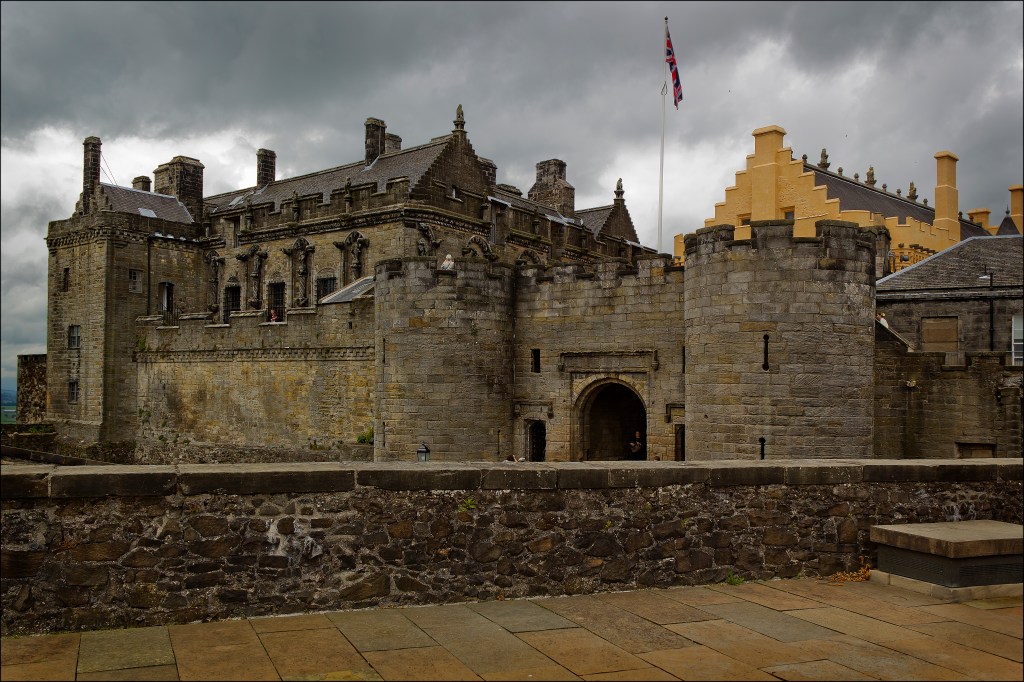
  • Stirling Castle where the Stuarts lived at times

Stirling Castle
Scotland https://flickr.com/photos

So this is my idea of an ideal week spent soaking up Scottish history in Edinburgh, Scotland. Visiting old castles and enjoying good Scottish food and beautiful green hills and gardens. Too bad it can only be for one week.

Daily writing prompt
Describe your ideal week.

Uncategorized

Visit Harrisburg’s Capitol: Tours, Museums, and More

Harrisburg, Pennsylvanian is a good place to take children for fun and a great learning experience. It offers entertainment and educational opportunities.

In 1897, the capital building in Harrisburg, Pennsylvania burnt. This left the Pennsylvania government with no building for the government to conduct the business of government.

The new capital building which was built between 1902 and 1906 is one of the most admired in the USA. It is a beautiful work of Architectural and artistic while also full of history. The building is full of art, beautiful paintings, murals, sculptures and history. The new capital building was designed by a young and upcoming architect, Joseph Huston. it is designed in American Renaissance style. Huston’s vision was to build a building that was a palace full of art and he accomplished that. There was a lot of competition for the rights to build the capital building. Joseph Huston won the contract and completed the building. After the completion of the capital building Huston was accused of taking bribes and conspiracy to defraud the Pennsylvania government. He was convicted and spent six months in prison. The building reflects many different types of styles throughout the building. Italian, Greek, Roman and French are all part of the buildings charm and beauty.

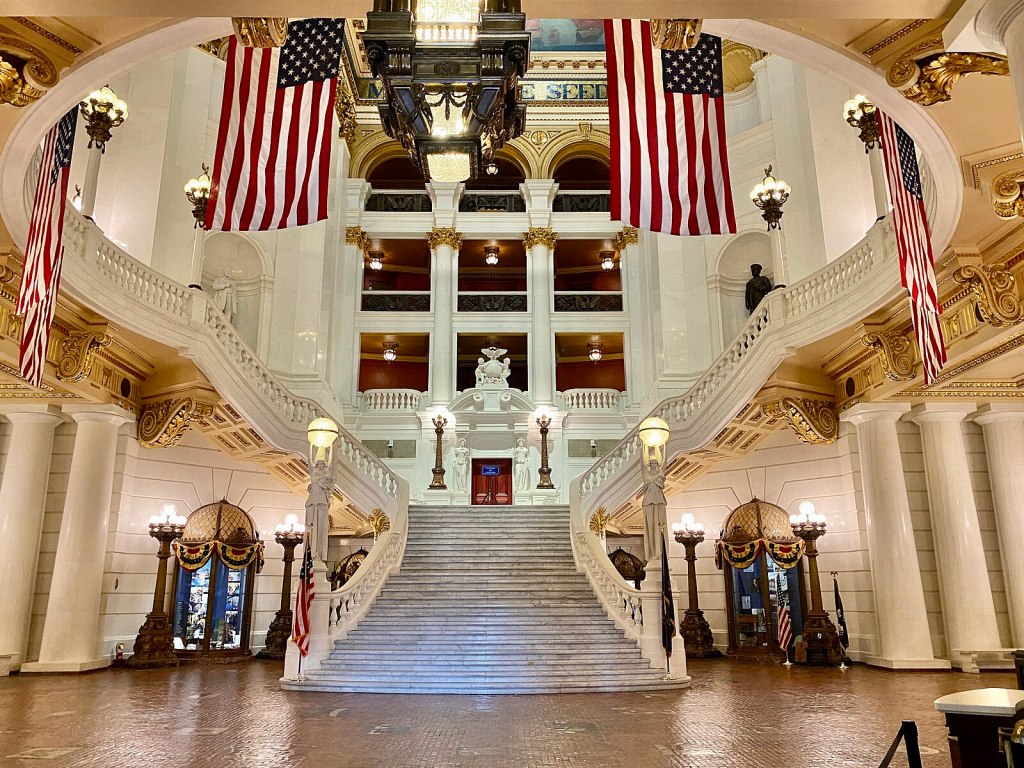
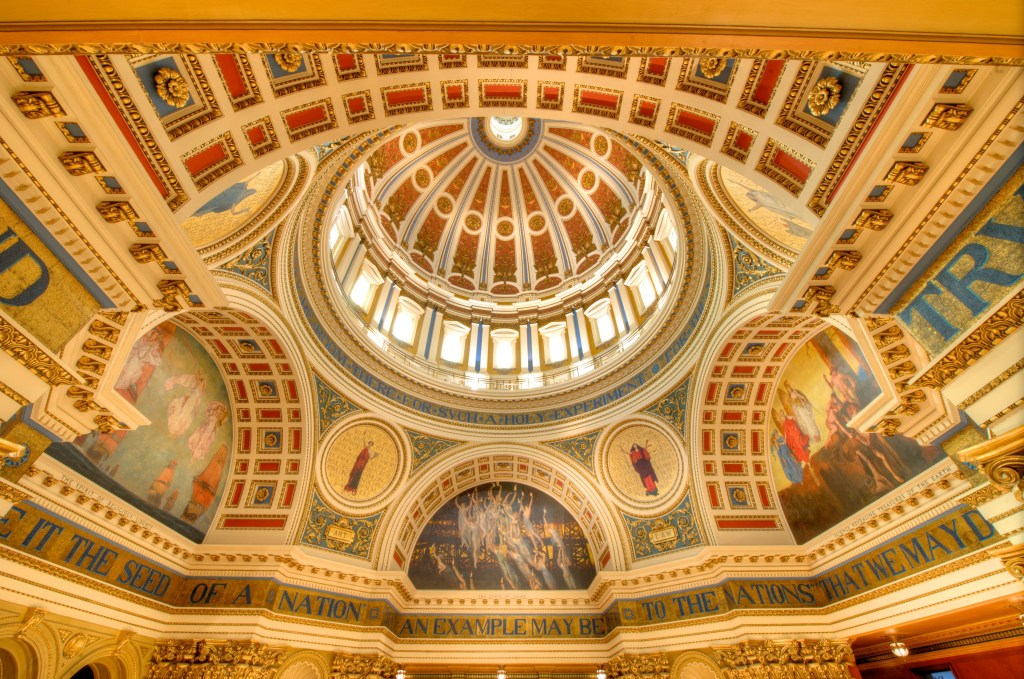
As you first enter the capital building, the first thing you will notice is the marvelous centerpiece staircase. It is often the source of group photos. Schools plan class trips to tour the building and have their class photos taken on these steps. Above the staircase is a 52 million pound dome. At the top of the staircase, it turns to both the left and the right.

The Rotunda Of The Pennsylvania Capital building in Harrisburg showcases a beautiful staircase.

The 52 Million Pound Dome Over The Rotunda

The Welcome Center in the Capital Building

The welcome center in the capital building is fun for the adults and children. There are interesting and educational trivia games to play. There is also a gift shop and places to grab a quick bite to eat near the Welcome Center. Children and adults can learn how laws are passed.

Children and adults can take free tours through the capital. The tours are popular and fill up quickly. It is best to call in advance and schedule a tour. Afterwards, they can find the Welcome Center of the building. Here, there’s trivia games and different learning experiences for everyone.

These are only a few of the highlights of visiting the Capital Building of Pennsylvania. Guided tours are offered by guides familiar with the history of the building.

The Pennsylvania Museum The Pennsylvania Museum is located near the capital building, within easy walking distance for most people. It is located at 300 North Street, Harrisburg. The museum has three floors full of interesting exhibits that families can enjoy.

The ground floor is where you enter, pay for your tickets and you are given a map of the museum. You can then choose which floors and exhibits you want to visit.

Ticket prices

  • Adults $7
  • Senior Citizens $6
  • Children $5

The first floor in the museum exhibits artifacts exhibits featuring old dishes, some broken or cracked. It also displays items that some of us senior citizens still remember from our childhood. There are also a lot of exhibits and a video which emphasizes the civil rights movement throughout Pennsylvania’s history. The exhibits on the first floor are sometimes changed to add new exhibits.

Second Floor

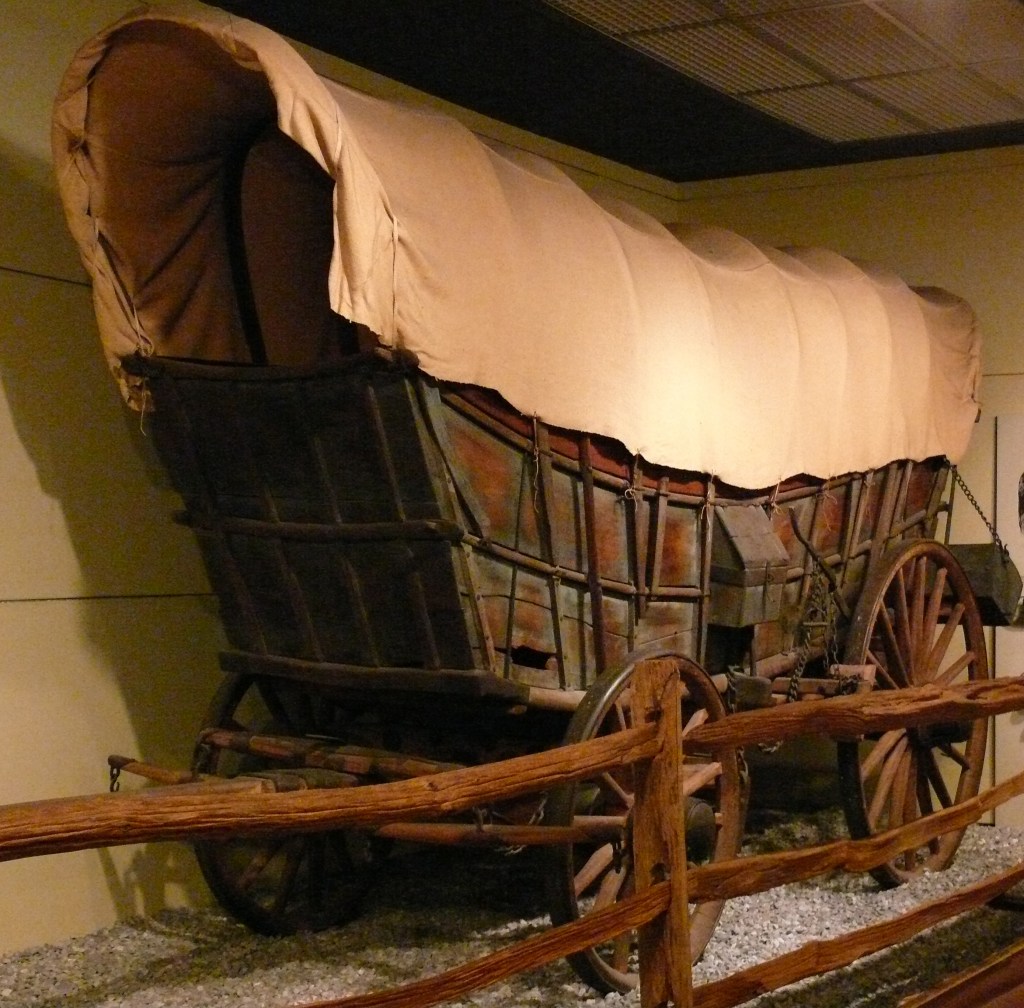
The second floor of the museum is my personal favorite. This floor has Native American exhibits, civil war exhibits, and industry and transportation exhibits. The Native American longhouses were pretty neat. Here there are old covered wagons, old stagecoaches and a turnpike display. The turnpike display shows an old car paying its toll at the tollbooth. On this floor there’s also one of the first tiny campers for campers.

An old covered wagon from early American exhibited at the State Museum of Pennsylvania

 Attribution:  Ad Meskens  Creative Commons Attribution-Share Alike 3.0 Unported license.

Third Floor

While the third floor wasn’t my favorite there’s a lot of interesting exhibits. Those who are interested in nature, ecology, animals, birds will enjoy these exhibits. There’s also a planetarium on this floor.

Make the Most of Your Trip

Both the capital building and the State Museum of Pennsylvania can take several hours to explore thoroughly. You may want to visit everything so be sure to plan ahead. Schedule your tour of the capital in advance and plan to spend a few hours at the museum. Make a plan that includes lunch whether it’s in the capital building or a restaurant nearby. Then enjoy a day of fun and education with your family.

Copyright

Aug 30, 2025

Linda Hosler

history, History, Women and History, writing

The Untold Stories of Women in Vietnam: A Review

The Women

Written by Kristen Hannah

Most of us have either lived through the Vietnam war or had relatives who served in the war. Others have seen movies based on that war. I myself grew up during the sixties and early seventies. I was lucky that none of my brothers were drafted during that era. Two of my brothers had already served and had families so they were not drafted. My other brother was the right age to be drafted but I am not sure how he didn’t get drafted. Maybe it was because he was in college at that time. I also had a brother-in-law who was stationed in Germany and managed to avoid the war in Vietnam.

Many of our young men were drafted and served in Vietnam. Thousands and thousands were killed in that war. But there was little to no mention of the women who served in Vietnam. The nurses, doctors, red cross women and many others all served their country in Vietnam. But those women were not considered to have seen combat.

That is what the book “The Women” is about. It’s about women who served as nurses in Vietnam. It’s particularly about one woman who joins the Army Nurses Corps. Her brother had been given a party in his honor before he left for the war. Frances (Frankie) had always been extremely close to her brother. She considered him her best friend. Frankie decided she would join as a nurse. After being turned down with the Navy and the Air Force, she signed up with the Army Nurses. Ironically, her brother is killed before she leaves and she is devastated by the loss of her brother. Frankie’s enlistment causes a strain with her family. She was raised to get married and have children. She was not raised to go off to war.

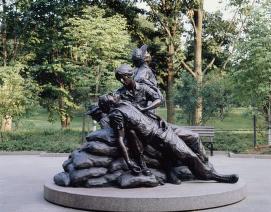
Women’s Memorial Honoring Women Who Served In Vietnam

Frankie experiences things she would never have dreamed as a sheltered young lady. But she soon adapts as well as she can, forms close friendships with other nurses and even falls in love. But in wartime, friendships may last a lifetime but love can be a short lived thing as she finds out.

After doing two tours in Vietnam, she returns home. The country is protesting the war. Veterans are not welcomed. She finds that people including her parents don’t want to talk about the war or her service in the war. Frankie finds that fitting in anywhere after the war is almost impossible for her.

This book details Frankie’s struggles to adjust in the world after the war. She finds it difficult to understand why women are not considered war veterans. Women, like the men she helped to save, also played significant roles. In fact, it was often said that no women ever served in the Vietnam war and many people believed this.

I really enjoyed this book and highly recommend reading this book. Of course, growing up in the Vietnam era, I knew some of what happened to veterans. I understood how hard it was for them to return to a country that had sent them to war. This country then learned to hate veterans who had fought in this war. They were mistreated and called baby killers. I liked the characters very much. It was very interesting to see Frankie change from a spoiled rich girl to a capable nurse who saved lives.

This book was in my book club and at first I wasn’t certain if I was going to read it. I am just really not very much into the Vietnam era when it comes to books and movies. But this book was different and an awesome book. I truly enjoyed reading this one.

Copyright:

Linda Hosler

July2025

Uncategorized

Discover Pennsylvania’s Historical and Fun Attractions for Kids Part 2

Two Historic Cities In Pennsylvania

Philadelphia is certainly one great city full of America’s exciting history and historic buildings. Nevertheless, we can add some other interesting places in Pennsylvania. These are marvelous places for families to visit. Gettysburg is a historic battlefield and full of history about the Civil War. Lancaster is a charming city where many Amish live and many great places to explore.

Gettysburg, Pa

Gettysburg has been called the turning point of the Civil War. The south had been winning the war up to the point of Gettysburg. It was at Gettysburg that the Union Army stopped the southern army’s march to the north. It was at Gettysburg that President Lincoln gave his famous Gettysburg Address Speech. Gettysburg is dedicated to all the great men who died there.

Gettysburg National Military Park

Your first stop at Gettysburg might be at the Museum and visitor center where there are plenty of parking spots. Inside the 2200 square foot museum there are cold drinks, snacks and bathrooms. The museum offers exhibits, a gift shop and a ranger to answer questions. There plenty of historic exhibits from the Civil War including guns, uniforms and even a large cannon.

Tour The Battle Field

There are various ways of touring the Gettysburg Battlefield and learning about Gettysburg and the famous battlefield.

  • By Car. Using your car, you are free to go at your own pace. You can view what you are most interested in seeing.
  • Guided car tour: An experienced tour guide accompanies you. They are there to answer questions. They know the best places to show you. These tours have varying fees.
  • On horseback: Tour the battlefield on horseback like the soldiers who fought at Gettysburg. Horse rental fees are generally charged.
  • Walking the trails if you are a hiker.
  • Car and Walking: This is a great option as the park has 6000 acres. Driving on your own allows you to stop and view whatever you what to see.

Significant Spots To Visit At Gettysburg

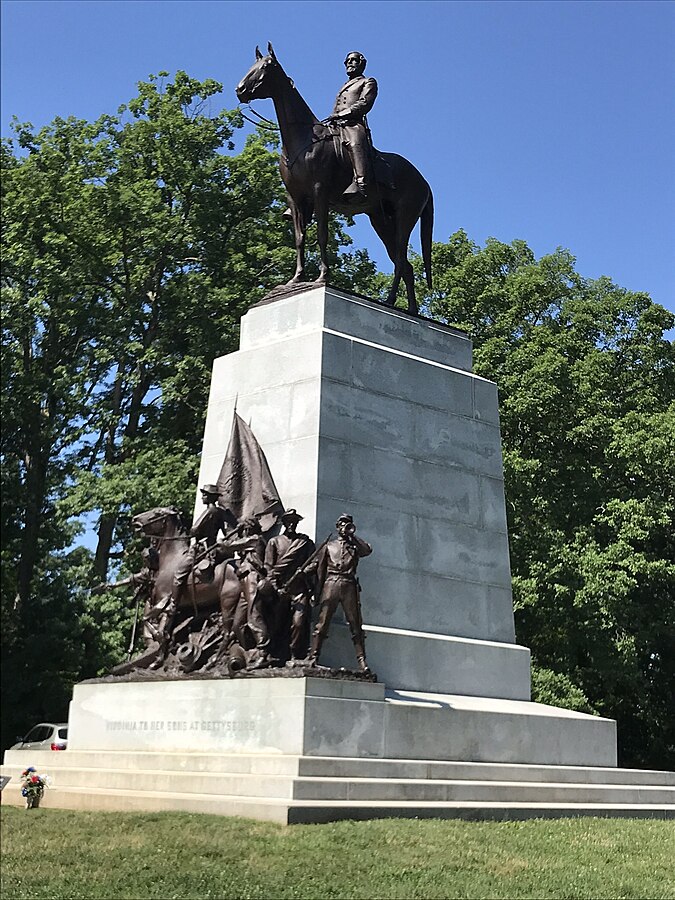
Confederate General E Lee Memorial at Gettysburg Battlefield
  • Little Round Top was a significant area where fierce fighting took place with Union soldiers eventually winning the hill.
  • Cemetery Ridge which was the headquarters for General Meade and the Union soldiers made camp.
  • Big Round Top which is the highest point of the Gettysburg Battlefield. There are five monuments at the top of the ridge.
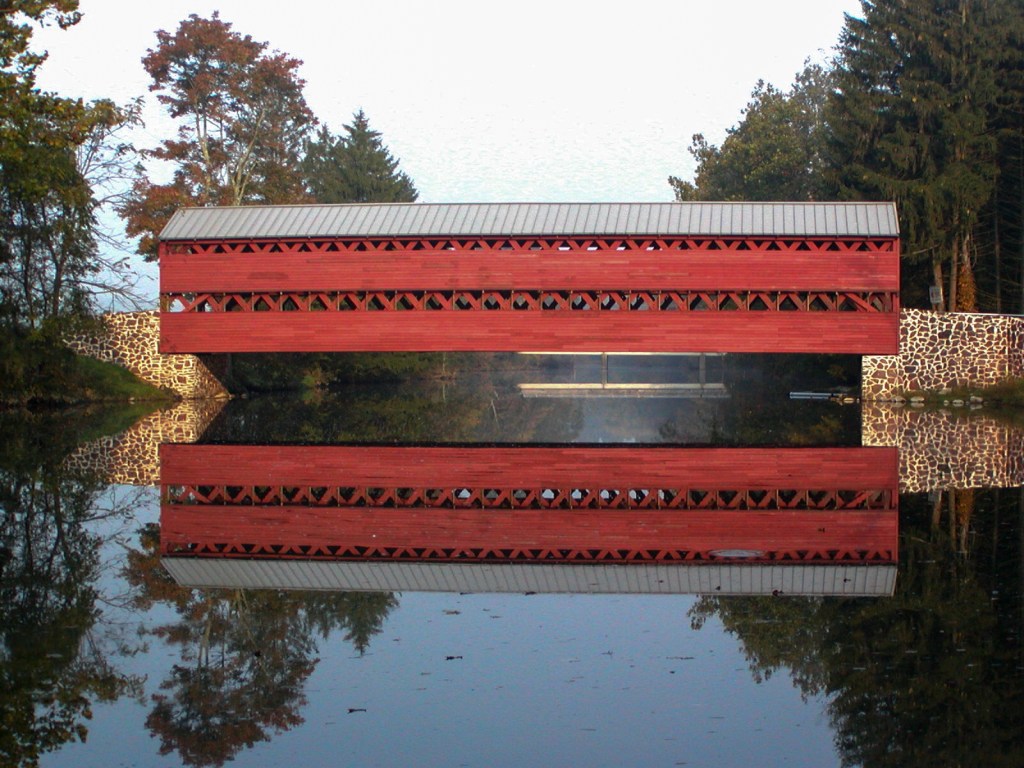
  • Sachs covered bridge which some say is haunted by confederate soldiers who were hung from the bridge.
  • There are multiple museums throughout Gettysburg that are worth checking out.
  • Jennie Wade house. Jennie Wade, a civilian was killed by a confederate bullet while she was making bread to feed the Union Army.
Little Round Top Gettysburg Battlefield
Sachs Covered Bridge Gettysburg Pa

Lancaster, Pa

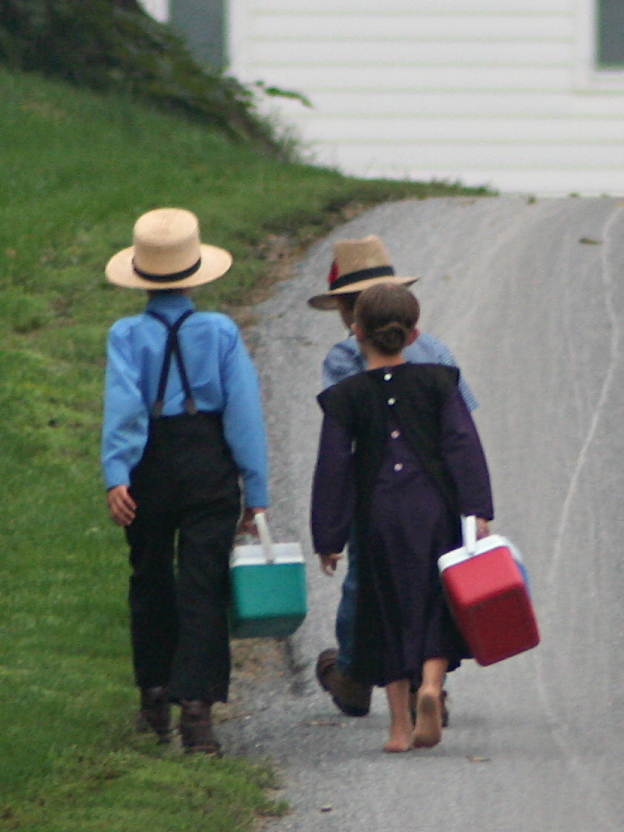
Amish children on the way to school

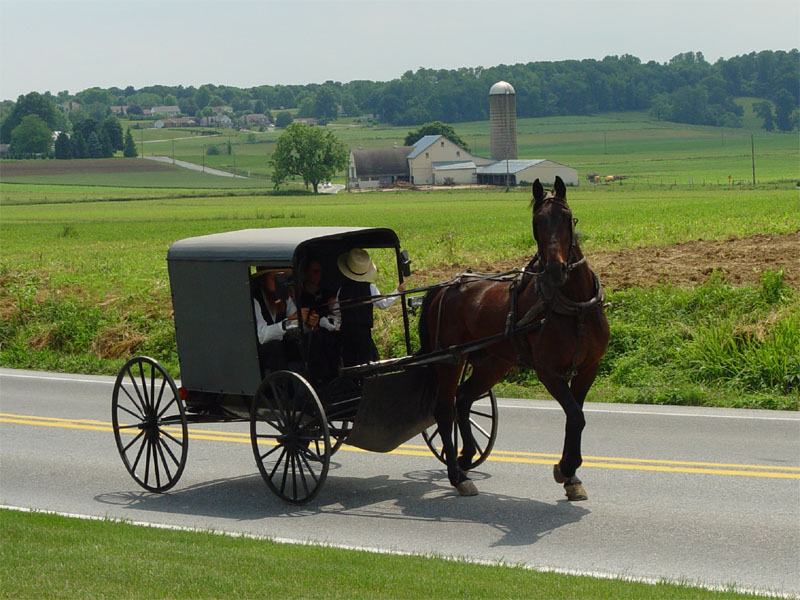
Lancaster is famous for it Amish population. It’s the largest Amish community in America. The Amish are famous for still living without electricity, cars, and modern technology. Most Amish still dress in traditional clothing and use horse and buggies. They are well known for their country cooking, quilting, religion and furniture building. Let’s check out some interesting things you can find in Amish country.

  • Amish farms which can offer tours and buggy rides.
  • Kitchen Kettle is an outdoor type of market but with about forty indoor shops. These include shops that sell canned goods, jams & relishes, and leather goods. There is a yarn shop that also offers free classes and workshops. You can also find sweet shops and cheese shops. There’s also a restaurant and homemade ice cream. I was here once and would love to go back.
  • Green Dragon Flea Market is 60 acres of a local farm market and flea market combination. It has indoor and outdoor shopping. It boasts seven large buildings with some one hundred vendors showing their crafts and wares.
  • Amish quilt shops: There are many quilting shops throughout Lancaster. No trip to Lancaster would be complete without shopping for a quilt. Make sure you have plenty of money or a credit card. These beautiful handmade quilts can be quite expensive.
  • Amish restaurants are the place you will want to eat at in Lancaster. The Amish are famous for their home cooking. Two well know restaurants are “Bird in Hand Restaurant and Smorgasbord” and “Shady Maple Smorgasbord.
An Amish family traveling by horse and buggy

Entertainment in Lancaster Pa

  • Sight and Sound Theater: This theater is for young and old. It does plays based on Bible stories using live animals. I have seen Joseph, David, and Samson at this theater and enjoyed every one of them. Currently the story of Noah is playing.
  • Dutch Apple Dinner Theater offers a great dinner and a musical. It also has a children’s theater for the little ones.
  • Dutch Wonderland is a smaller version of Disney Land. It features over thirty rides and a show. Duke’s Lagoon is a small water pad to keep the kids cool on a hot summer afternoon. There’s also fifteen acres of campgrounds for family camping.

These are two cities in Pennsylvania which offer a lot to families. They offer history lessons for the children as well as a fun time. Warm weather and summer vacations are just around the corner. You might want to consider visiting the great state of Pennsylvania and having the time of your life.

Uncategorized

Discover Pennsylvania’s Historical and Fun Attractions for Kids Part 1

Vacation in Pennsylvania and Bring The Children

Pennsylvania is the place to bring your children on a fun filled and educational vacation. Here in Pa, children can visit a working farm. They can learn about the Amish. They can see sites where history was made. Children can also visit zoos and wildlife parks. They will have fun learning every day.

History in Pennsylvania

Philadelphia, Pa is full of history for the whole family from children to grandparents, there’s lots to learn and enjoy. Philadelphia, Pa was the site of the first Continental Congress and the first capital of the new country, America. In 1776 The Declaration Of Independence was read by John Nixon from the steps of what is now Independence Hall. This document was the beginning of the separation of the thirteen colonies from England.

Also in Philadelphia, you can visit several museums. These include the Ben Franklin Museum and Museum of Art. There is also The Franklin Institute, which deals with science. Additionally, the Betsy Ross Museum and The National Constitution Center are also museums worth checking out. Some of these museums charge admission fees, while others are free. There are many more museums in the Philadelphia area worth visiting.

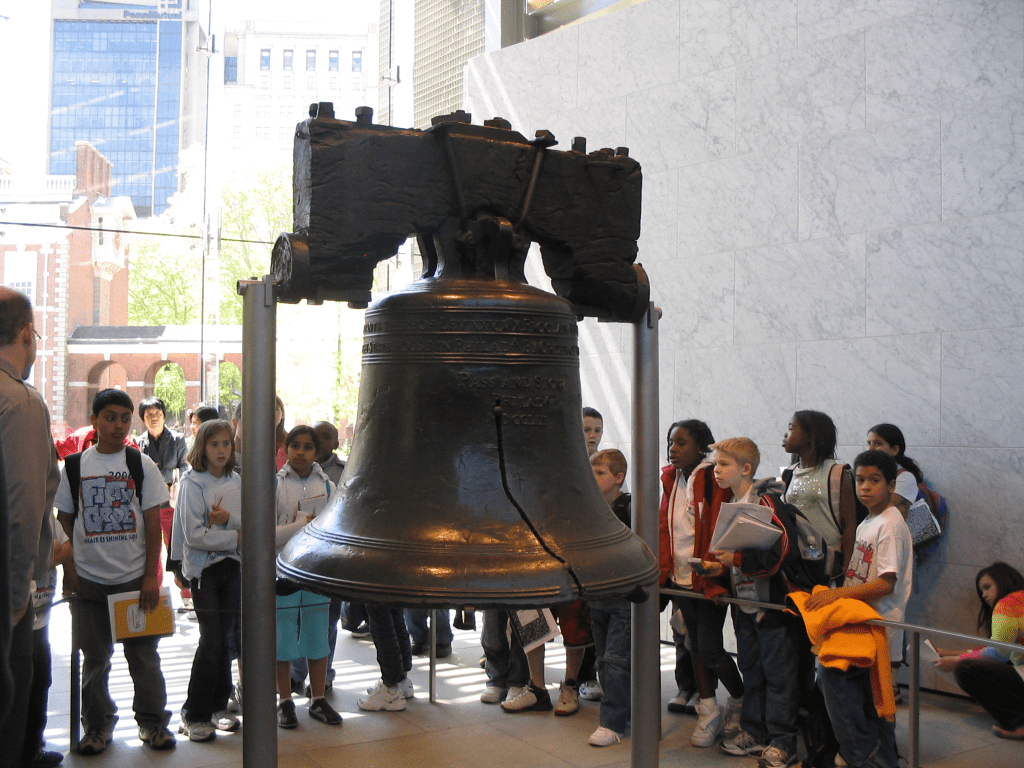
Visiting the Liberty Bell is a must see.

Students viewing the Liberty Bell in Philadelphia, Pa

The Liberty Bell is another piece of American history. It can be seen in Independence Hall sporting its famous crack. The Liberty Bell was ordered by the Pa Assembly in 1751 from White Chapel Foundry located in London.

Pennsylvania Zoos

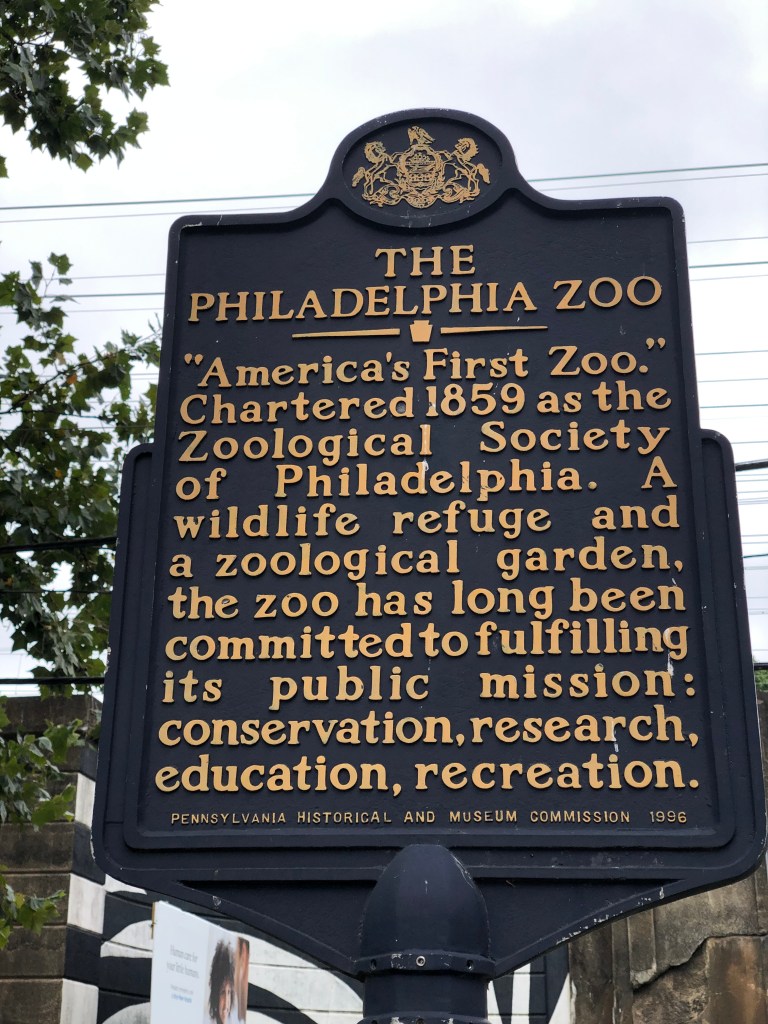
Historical marker for the Philadelphia Zoo in Philadelphia, Pennsylvania

There are several nice zoos around the state of Pennsylvania.

  • ZooAmerica located in Hershey Pa is eleven acres which is actually a part of Hershey Park. ZooAmerican showcases some 200 species of North American wildlife
  • Tobias Lake is a wildlife park which was began in 1965. It features a Safari tour, where you can view most animals in their natural habitat. There’s an African lion, a Bengal tiger, an a giraffe. There’s also a reptile building where kids can learn about reptiles. There’s exotic birds, monkeys and a petting zoo. Take a picnic lunch and the children will love it.
  • While you are in Philadelphia don’t forget to visit the famous Philadelphia Zoo. The Philadelphia Zoo was the first Zoo in America. It covers forty two acres and has nearly 1300 animals. The zoo also features a great collection of botanical plants.
  • Penn’s Cave & Wildlife encompasses sixteen hundred acres. You can take a guided tour in a flat bottom boat through the caverns. Additionally, you can take a ninety-minute tour through the wildlife park. There are about fifty steps to the main entrance of the cavern. This is not suitable if you are handicapped.
  • T & D’S Cats of The World is located in Penns Creek, Pa. It is a refuge organization that takes in abused and mistreated animals. Starting mostly with wild cats, it now has bears, foxes, parrots and a bird Aviary.

The above is just a small list of family-friendly and educational places in and around Pennsylvania. Kids would enjoy these places and have fun learning. These places are great for home schooled students.

Discover Pennsylvania’s Historical and Fun Attractions for Kids Part 2

Uncategorized

Remembering the Boston Molasses Flood: Tragedy of 1915

An Ordinary Day In Boston Turns Deadly

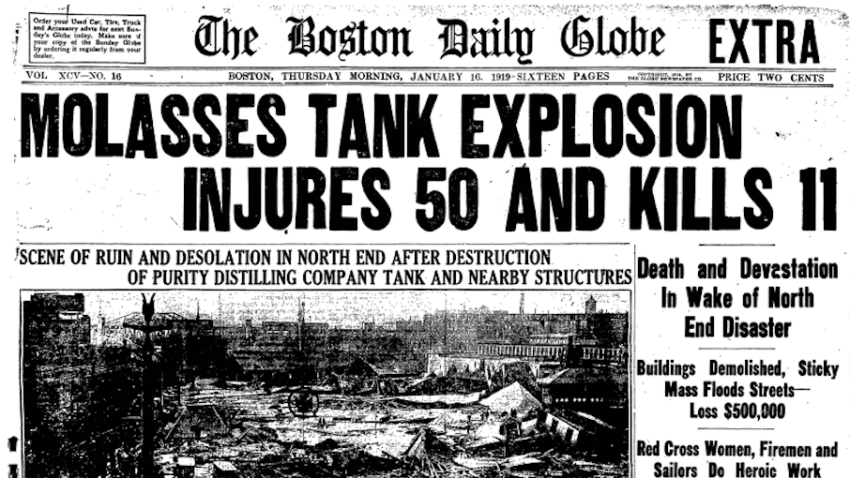
January 15, 1915, started off as a warmer than usual day. People were out on Commercial Street, Boston. They were moving about and enjoying the slightly warm January day. Children were playing outside on the streets and workers were stepping away from their jobs for a brief lunch break.

They did not realize the danger they would soon be facing. Tons of molasses would pour through the streets of Boston around noon. None of them knew that in just a few minutes some of them would be dead. Others would struggle to survive in a city covered in waist-high molasses. It would change quickly from being just an ordinary day to become the most deadly horrifying day in Boston’s history.

This is the news headline the day after the flood. 11 are announced dead in the headline, but 10 more bodies would be found later.

First World War Ends, Prohibition Set to Begin

Molasses became an important ingredient in creating ethanol during the First World War. This ethanol was used to create ammunition and explosives. The war ended. The American Congress then sought to make any form of liquor or alcohol illegal. They did this with an act of Congress called Prohibition.

Purity Distilling, therefore, was holding tons of molasses in a large storage tank in Boston. The company sought to make as much liquor as possible before Prohibition took effect. Shifts at Purity Distilling operated around the clock. They produced as much high-grade rum as possible.

Giant Tank Holding Millions of Gallons of Molasses

The molasses storage tank had been built a short time earlier just as the First World War was ending. It was a huge tank measuring fifteen feet high and one hundred sixty feet wide. When filled to the limit it held 2.3 million gallons of molasses.

The tank had been built near the harbor. Ships could dock there to unload the molasses. Railroads were close by to ship the molasses to where it would be made into alcohol. On Jan 15, 1915, it was filled almost to its limit. It was straining to hold the massive amount of molasses.

Tank Explodes, Molasses Flows

Close to noon people began to hear louder than usual noises coming from the tank. Survivors would later report that they heard loud rumbling noises. These were followed by loud pops which sounded like machine guns being fired. The metal steel rivets caused these noises. They held the sides of the tank together and popped out in rapid succession. Molasses began flowing from the tank at 25 to 35 miles an hour. Anyone in its path had no chance to escape.

Chaos and Destruction and Death Follows

The flood of molasses swept through the streets with such force. It literally slammed buildings off their foundations. It knocked over horses, cars, wagons, people, and anything else that got in its way. Horses and people were caught in the sticky goo. The molasses quickly hardened once it was out in the cooler air. This made it impossible for anyone trapped in it to move.

The molasses (which was a high wave) at that time knocked people and children to the ground where some suffocated to death. Twenty-one people died in the molasses while another one hundred and fifty were Injured. Property damages were enormous and if this had happened in modern times the price tag would be near $100,000,000.

Rescuers, including the police, local volunteers, and the Red Cross, all responded quickly to the disaster. They found it hard to walk through the molasses, which was up to their waists in some places. The molasses would cling to their boots and clothing making it hard to walk as they searched for survivors.

What Caused the Tank to Explode

  • No permit was required to build the tank.
  • It was poorly designed.
  • Poor construction and materials.
  • Leaks were not repaired, and molasses dripped.
  • The tank was painted brown to hide the leaks and drips.
  • Molasses would ferment causing pressure to the inside of the tank. This would be like putting too much air or gas in a balloon, which would cause the balloon to pop.
  • It was built very cheaply and quickly built with no safety inspections.
  • Was never properly tested by using water to find and repair leaks.

Lawsuits Become the First Class-Action Lawsuits

Victims of the molasses flood and the families who were victims of the flood soon filed lawsuits against Purity Distilling. These lawsuits soon combined to make one massive lawsuit, becoming the first-class action lawsuit for the state of Massachusetts. Finally, in 1926 the victims were awarded $300,000. This resulted in new laws enforcing higher regulations and inspections for new construction.

The tank that held those deadly gallons of molasses would never be rebuilt. Today, a recreational complex has been built in its place. More than a hundred years have passed since the molasses flood. People who live near the site still claim that the smell of molasses lingers on really hot days.

References for Flood of Molasses

Lyons, Chuck. (2009). “A Sticky Tragedy: The Boston Molasses Disaster.” History Today

Bellows, Alan. (2005). “The Monumental Molasses Morass of 1919.” Damn Interesting

Owen, Ryan W. (n.d.) “The Great Boston Molasses Flood, Prohibition and Anarchists.” Forgotten New England

Powell, J. Mark. (2019). “The Sticky Truth: 100 Years Ago, a Molasses Tsunami Caused a Deadly Boston Disaster.” Washington Examiner

Copyright L.M. Hosler 2019
history, History, Uncategorized

The Tragic Johnstown Flood of 1889: A Historical Overview

Johnstown, PA

Johnstown, PA, is a small town in Cambria County in the southwestern area of the state. Pittsburgh is about seventy miles to the east of Johnstown, which lies in a small valley of the Laurel Mountains. Pittsburgh and nearby Johnstown were once booming steel towns.

A Day Starts Like Any Other Day In Johnstown, Pa

On May 31, 1889, heavy rains had been falling, and as the people of Johnstown rose and went about their daily lives, they had no idea that by that afternoon, their small town would be hit with twenty million tons of water, which reached nearly thirty-seven feet high.

As many as twenty-two thousand would lose their lives and properties. The flood that was about to hit them would devastate their small town and their families and leave behind millions of dollars of damage.

A Dam Built for Canals

It all started in 1852, when the state of Pennsylvania built a huge water reservoir about eight miles east of Johnstown. The dam was built in connection with the Pennsylvania canal system, but within a few years, railroads became the more modern way of shipping, and the canal system became obsolete. In 1863, the canal which had connected Johnstown and Blairsville was shut down, eliminating any further use of the water reservoir.

The dam sat there with very little maintenance, and one portion began to erode in 1862, just ten years after the dam had been built. What repairs were done were done using inferior materials to fix holes and leaks. The workmanship was also done in a sloppy manner.

Rich Business Men Buy The Dam

The dam was first sold to the Pennsylvania Railroad as trains at that time ran on steam, so this was a good place for a water stop. In 1875, a one-term Pennsylvania congressman named John Reilly bought the dam and surrounding areas for $2500.

In 1879, Reilly resold the dam to a real estate salesman named Benjamin Ruff, who intended to turn the reservoir into a lake and a resort for the wealthy. He became the first president of an exclusive club known as the South Fork Fishing and Hunting Club. This club’s members would include wealthy doctors, dentists, lawyers and rich businessmen such as Andrew Carnegie and Henry Frick.

After a busy week in nearby Pittsburg, these gentlemen and their families could take the train and enjoy a weekend of relaxing at a private resort area. Some cottages and cabins were built, as well as a gentlemen’s clubhouse.

Lack of Oversight and Management

When Benjamin Ruff and the South Fork Fishing and Hunting Club took over the dam, they did attempt to do much-needed repairs on the dam. However, the repairs needed were probably much more extensive than Mr. Ruff and the South Fork Fishing and Hunting Club had anticipated, and I would guess that some of those repairs were put on hold.

The club also installed fish screens which, due to the heavy rains, ended up catching debris and forcing the water over the top of the dam. So basically, the heavy rains on May 31, 1889, combined with the lack of proper repairs and maintenance, were the culprits of the Johnstown Flood in 1889.

The Monster Flood Roars Toward Johnstown, PA

The heavy rains on May 31, 1899, put too much strain on the dam, and that afternoon workers at the dam saw that it was not going to hold the water back. Telegrams were sent to the small communities and to Johnstown. Most people paid little attention to the flood warnings, while others did move their belongings to second stories. None had any idea of the monster that was about to hit their small town and take their homes and lives.

At sometime around three o’clock in the afternoon, the dam gave way and the water came roaring furiously down into Johnstown. It was a roaring wall of water that took everything in its path. Houses, animals, cars, railroad cars and humans, the water showed no mercy. Thousands were trapped with no way out. Some were swept away, while others were caught in the tangled mess of houses, trees, and debris that backed up at the Stone Bridge.

For some reason, this debris at the bridge ignited and killed the people who had been clinging to wood boards or whatever they could manage to hang on to.

Relief Efforts

Just like today, when disasters of this nature strikes, Americans rally for each other and the flood of 1889 was no exception. Donations, volunteers and help came pouring in from all over the United States. Donations came from major cities in the United States such as Boston, Cincinnati and donations came from overseas as well. Money came from other countries such as London, Ireland and from Australia and there were numerous donations from many other places. Various businesses donated materials to help rebuild homes and shelters for those who had lost their homes.

Clara Barton arrived within days of the flood, and along with her American Red Cross organization set up headquarters in one of the few buildings that had survived the flood. Here the Red Cross sat up regular food areas to feed the homeless. Clothing areas were set up to distribute needed shoes, clothing, blankets and personal care items. This was one of the first biggest disasters to hit in America with such force that it proved to be training for disasters that would occur in the future. Lessons learned during the Johnstown flood of 1889, have carried over to modern day disasters.

Clara Barton set up headquarters in Johnstown, PA, after the historic flood of 1889.

Andrew Carnegie Library

Andrew Carnegie was one of the richest members of the South Fork Fishing and Hunting Club although it is thought that he spent very little time there. Carnegie was also well known as a kind and generous man.

Shortly after the flood he visited Johnstown and donated $10,000 toward building a library there. More money was later needed to finish building the library and Carnegie donated an additional $45,000 toward its completion.

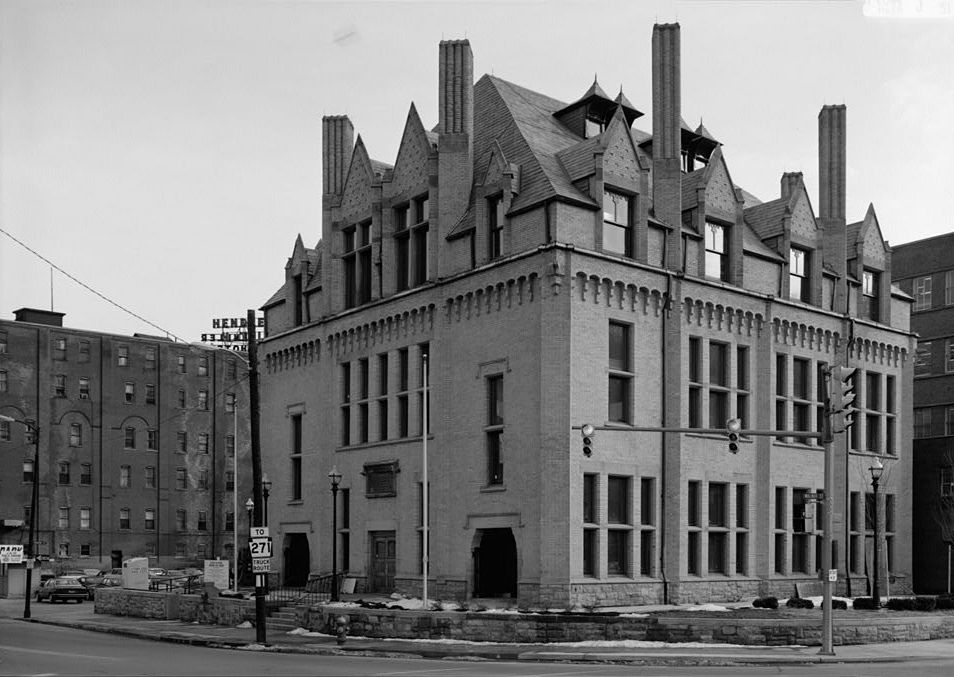
The Cambria Public Library built in Johnstown with donations from Andrew Carnegie

A Flood for the History Books

The Johnstown Flood was an historical event that people still talk about today. Stories and pictures of the flood have been preserved and handed down to new generations. There are still different theories of just who or what was responsible for such a horrific event that caused so much damage and took so many lives, many of them children. Johnstown has an interesting museum dedicated to the flood where the history of the Johnstown Flood is kept alive. The museum features a short film about the flood. After the flood, there were very tiny homes brought into Johnstown, much like FEMA trailers today, for families who had lost their homes. One of these tiny homes is also part of the museum.

The South Fork Hunting and Fishing Club and some of its members were sued in court but were never held responsible. Today life goes on in Johnstown, PA, and the town has been rebuilt but the memories and stories live on.

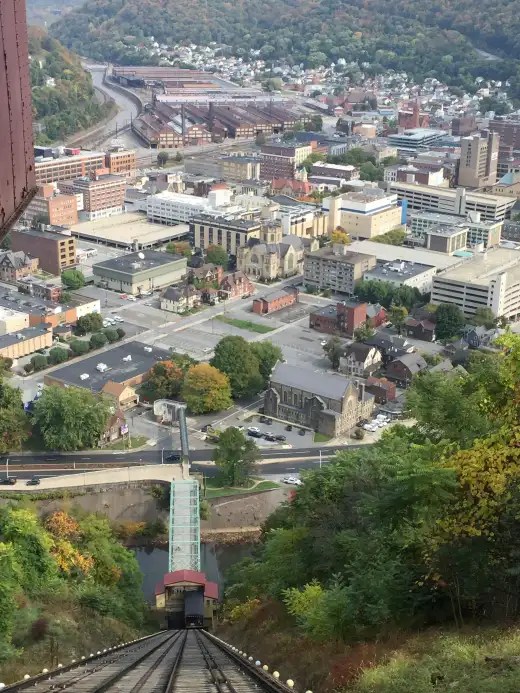
Johnstown has come back from the famous flood of 1889. This is a photo of Johnstown in November of 2020. Photo Credit L.M. Hosler
Copyright L.M. Hosler 2019

Uncategorized

Achievements of Dorothy Day: A Legacy of Service

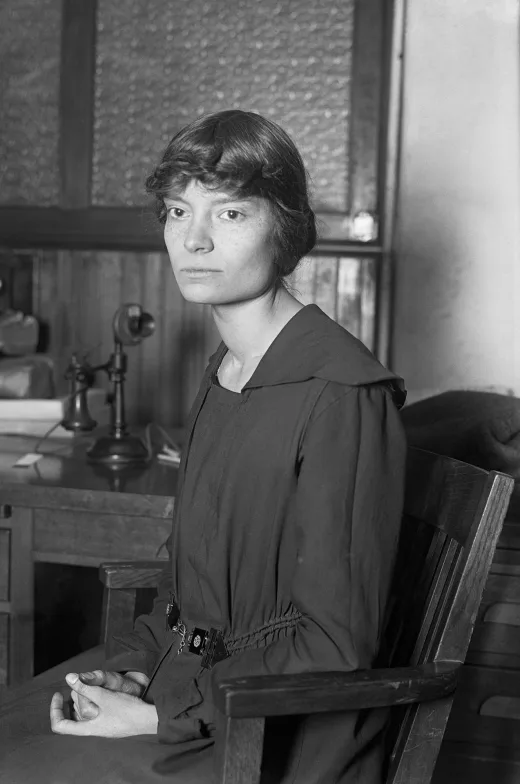
Dorothy Day as a young woman

Dorothy’s Early Years

Dorothy Day was born as one of five children to John and Grace Day in Brooklyn, New York on November 8,1897. Her father was a sports writer and later became a sports editor. A few years after Dorothy’s birth he moved the family to San Francisco, California to take a better job. The Days family lived in California until the Great Earthquake in 1906 which destroyed her father’s place of employment. Before they left California Dorothy and her mother tried to help those who had been left homeless from the earthquake. This probably influenced Dorothy in such a way that years later it became her life’s work to help others in need.

The Day family then moved to Chicago, Illinois and lived in one of the poorer sections of Chicago until her Father found work that allowed him to move his family to a better neighborhood. Dorothy never seemed to forget what it was like to be poor and perhaps that is what led her to make the choice of helping the poor and less fortunate.

College Years

While still living in Chicago Dorothy won a scholarship which allowed her to go to The University of Illinois and she attended there for two years from 1914 until 1916. Dorothy loved reading and learning and she especially enjoyed reading the works of Dickens and Poe as well as others. It was at the university that her journalistic career began when she went to work for a small local paper. The friends she chose while in college were generally socialists who influenced her to join the Socialist Party. With her friends she became involved with radical causes concerning poor working people.

Life as a New York Reporter

Two years later, she gave up her studies at the university and moved to New York. She was just eighteen years old at the time. Here she found her first real job as a reporter working for the New York Call where she worked for a few months before leaving The Call to work for The Masses. As a reporter she covered labor meetings, protests and riots as well as other social causes. Here in New York, she made friends with other journalists, liberals, socialists, labor collaborators and communist that she met through her work. During this time, Dorothy was like most young women, enjoying life, her first relationships with men and love. She also became pregnant during this time period and she chose to have an abortion rather than raise the child

Occoquan Prison: The Night of Terror

While working as a reporter for The Masses, Dorothy traveled to Washington, DC to join with a women’s suffrage protest organized by Alice Paul, Lucy Burns and The National Women’s Party. As a result, Dorothy and several of the other women were arrested and spent several weeks in jail. Dorothy asked for and was given a Bible which she took much comfort from. After being arrested and sentenced to thirty days in jail, Dorothy and the other women went on a hunger strike which drew the attention of President Woodrow Wilson who ordered the women to be released from jail. Later these women dubbed their time in the Occoquan Prison as “The Night of Terror”.

Love and Heartbreak

n 1918, Dorothy thought it was time to look for a possible new career and tried nursing by enrolling at Kings County Hospital in New York. It was while she was in nurse’s training that she met and fell in love with a fellow newspaper associate, Lionel Moise. She became pregnant with his baby which he insisted that she abort, so in an attempt to keep the man she thought she loved she had the abortion. She was only 21 at the time. Dorothy often stated how deeply she regretted making that decision because within a short period of time Lionel had walked out and left her anyway.

After Lionel walked out Dorothy was heartbroken and she married Berkely Tobey on the rebound. The two of them traveled for some time together but the marriage was a brief one and ended in divorce shortly afterwards. After divorcing Berkely Tobey, Dorothy entered into a relationship with Forster Batterham for several years and became pregnant for the second time. To Dorothy, this was a miracle because she had believed that she could not have children after having the abortion. She gave birth to a daughter she named Tamar Theresa on March 4,1926. This was the beginning of the end of her relationship with Forster who had not wanted either marriage or children and soon after the two went their separate ways.

The Beginning of a Lifetime of Serving God

Between 1932 and 1933, Dorothy met Peter Maurin an illegal immigrant who was also a scholar with leanings toward the catholic faith. On May 1,1933 the two of them published their first issue of The Catholic Worker and began focusing on their mission of promoting Biblical teachings, morals, mercy and justice, which was also committed to forming a nonviolence peaceful society. Together these two would work for social change, better working conditions for workers and help and comfort for the poor.

Achievements of Dorothy and Peter

  1. Started the newspaper (The Catholic Worker
  2. Opened the first House of Hospitality in 1933
  3. Started farming communes for people in need who could live on the commune and help to raise food and animals to meet their needs
Peter Maurin, Dorothy’s close friend and co-founder of the Catholic Worker’s Movement

Books Written by Dorothy Day

  1. The Eleventh Virgin
  2. From Union Square to Rome
  3. House of Hospitality
  4. On Pilgrimage
  5. The Long Loneliness
  6. Selected Writings
  7. Loaves and Fishes
  8. The Reckless Way of Love (notes on following Jesus)
  9. The Duty of Delight
  10. All the way to Heaven
  11. Peter Maurin Apostle to the World
  12. Dorothy Day and the Catholic Worker
  13. Meditations
  14. In My Own Words

This is a short list of the books that Dorothy Day wrote. She also wrote over three hundred articles for various newspapers that she worked for over her lifetime. Many of her books are books of faith and stories of how she spent her lifetime and her faith in service to others.

Dorothy Day Honors and Achievements

Dorothy achieved so much that it is hard to comprehend everything this woman did but this is a short list of some of the most memorable events of her life.

  • Dorothy had the honor of meeting Mother Teresa in 1970. It’s believed that Mother Theresa gave Dorothy one of her crosses
  • Received Communion with the Pope 1967
  • Received birthday wishes from the Pope on her 80th birthday in 1977
  • University of Notre Dame honored her with the Laetare Medal which is given for outstanding service to the Catholic church and society
  • Dorothy had a long and deep impact on the Catholic church

This is only a few of the achievements and honors that Dorothy received during her lifetime.

In Conclusion

Dorothy Day was a determined and courageous woman who found her faith and her strength in the Catholic Church. Upon finding her faith, she worked hard and tirelessly for the poor. She gave more of herself than most of us are capable of. She was jailed several times in her efforts to help women fight for their rights in addition to other causes that she felt strongly about. She spent most of her adult life serving her God, her church and her fellow human beings. Let us all strive a bit harder to be more like Dorothy Day and make the world a better place. A world more like Dorothy Day’s vision of caring and loving our fellow human beings.

Copyright L.M.Hosler 2019