

They Left It All Behind
Would you be willing to leave your home country, your family, friends and everything you are familiar with to follow your faith? Would you sell everything you own to take a ship to a new country without knowing what might lie ahead of you? Relying only on faith, could you walk thirteen hundred miles in extreme heat, rain and freezing snow while pushing and pulling a heavy cart up steep mountains and across raging, freezing rivers? As you watched your fellow brothers and sisters fall sick and die along the way, do you think your faith might falter along the way?
This is exactly what an estimated fifteen hundred Mormon saints did in the year 1856. In 1856 the Mormons had sent missionaries to several European countries and converted thousands to the Mormon faith. Brigham Young, a dynamic Mormon church leader encouraged these converts to immigrate to the United States to an area in the Salt Lake City Territory. Here they were promised life would be better than Europe.
The problem was that many of the new converts were also too poor to meet the expenses necessary to pay for the entire journey. Expenses included the cost of passage on a ship to America, then taking the railroad to Iowa, then buying a covered wagon with a good team of oxen, as well as provisions along the way. Attempting to cut expenses to make it more affordable, Brigham Young and the Mormon Church had come up with the handcart companies.
This would allow the converts to make it to Iowa where they would be outfitted with a handcart which they would each be allowed to take seventeen pounds of bedding, clothing and a few personal items. Each company would have close to five hundred members and experienced leaders would lead each company west to Salt Lake City. Several covered wagons and teams of oxen would carry provisions and would carry those who became sick or were too old or injured.
Handcart Regulations
- One family for each cart
- Up to five people were assigned to a cart
- Each person was allowed a total of seventeen pounds
Tents which held twenty people and provisions were carried on wagons with teams of oxen
The Test Of Faith Begins
Several handcart companies with hundreds of converts left Europe and made it to Iowa early enough that even with the hardships of the trail, the first companies made it safely to their new home in the Salt Lake Valley. However, two of the later companies were not as fortunate.
The Willie Company left Liverpool, England in mid May and would not reach the New York Harbor until Mid June. As they approached the New York Harbor there was much rejoicing, excitement and giving of thanks for a safe journey. During the trip, there had been a few deaths, births and a wedding or two. In general though, the saints were in good spirits and they spent a lot of their time on board in worship meetings and prayer.
After landing in New York they were allowed a few days of rest before they would proceed by train through the state of New York to Lake Erie. A steamboat would carry the converts across the lake, where they would board trains to take them as far as Iowa City, Iowa.
The Willie Company left Iowa City in Mid July and the Martin Company left almost two weeks later close to the end of July. It would be a four month trip and both companies were getting a late start. By the time they made it to Wyoming, it was possible they could encounter early winter weather.
The Journey Becomes A Disaster
In Iowa City, the immigrants were awaken by the sound of the bugle calling them to worship services after which time the handcarts lined up and they started one of the longest walks in history. They left Iowa City in high spirits, singing songs of praise and full of hope for their new destiny, having no real idea of what horrors and trials might lay ahead of them.
In July, they suffered through the intense heat of the summer each day and managed to walk between twelve and twenty miles a day depending on the trail conditions. They stopped only for brief periods for lunch and camped each evening along a creek or river so there was water for the saints as well as the livestock. As the days wore on, the elderly began to take sick and die along the way. Few of the elderly would live to see their new homeland. They would be buried along the trail.
By early August, they had reached the Missouri River and by mid to late August they had reached Florence, Nebraska. Here, each company held meetings to discuss whether they should spend the winter in Florence or continue onward to the Salt Lake Valley. Although some, including one of the more experienced leaders Levi Savage, voiced the opinion of staying due to the coming onset of winter, pointing out the lack of warm clothing, pregnant women, children and the elderly. However, the saints were anxious to reach their destination and the final decision was made to try to reach Salt Lake City before winter.
Throughout September things went well but in October the weather began to change rapidly and became much colder. Provisions began scare and were rationed. The saints began to lose weight and strength needed to pull their carts. More and more of the elderly and the children became sick and deaths increased almost on a daily basis.
The journey had become a nightmare but through all the terrible hardships the saints held fast to their amazing faith in God that he would deliver them safely to their new homeland.
Both the Willie and the Martin companies got caught in October with an early snowstorm. Both companies ran low on supplies and had to ration supplies causing many to die of starvation. They crossed rivers in the freezing cold water and many suffered from frostbite and had limbs amputated. Some simply could not go any further and froze to death.
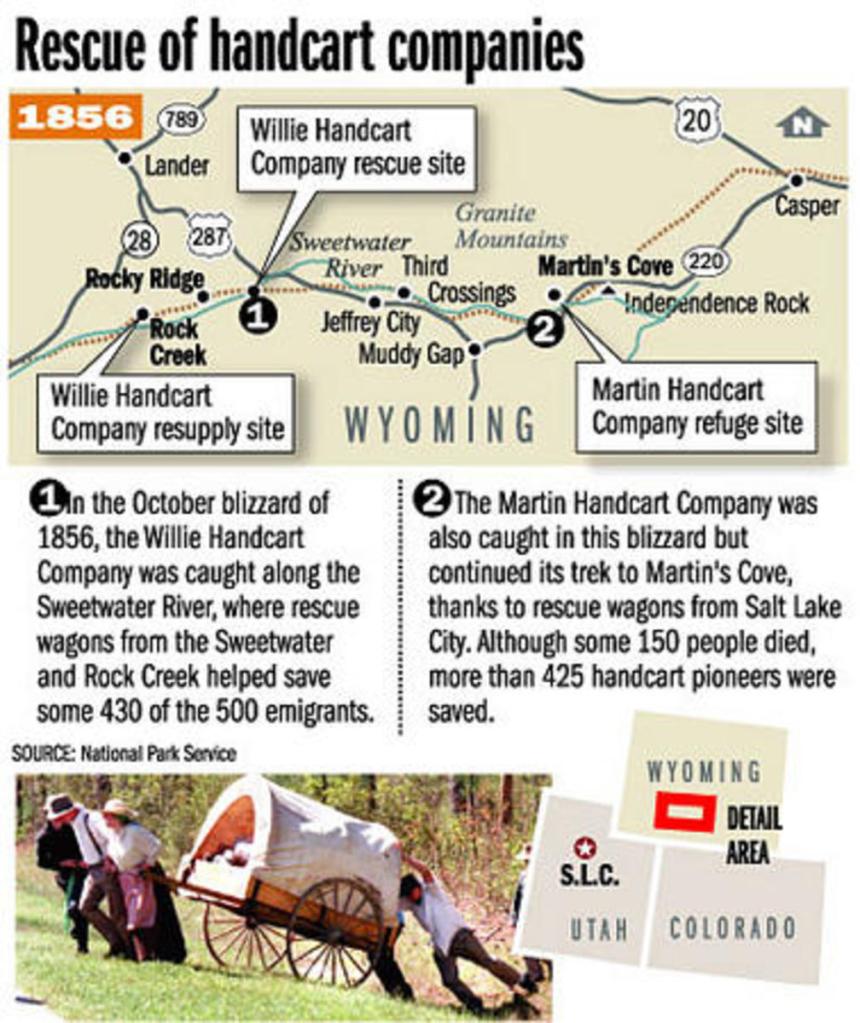
Rescue of the Mormon Handcarts
The Rescue
At the end of their endurance, rescue teams sent out from the church began to reach both companies but not before both companies had terrible losses. Even with the rescuers arrival, supplies were still limited and the freeing conditions continued to hamper their progress.
Through all the hardships and sorrows one thing endured and that was their faith in God. As one gentleman who survived said: The journey was one of the hardest that anyone would ever experience. However, in spite of everything, the hardships, death and sorrows along the way, the journey had made them one with God because at the end they had nothing else.


 History Lovers Corner