Writers are important but so are readers. Readers and writers need each other. Writers provide their audiences with news, valuable information as well as entertainment.
In 1974, the government required that steel companies hire women and minorities. This included the Eveleth Iron Mining co. This was the immediate start of the first class action suit by women claiming sexual harassment, abuse, and violence against women in the workplace. The case was Jenson v. Eveleth Taconite Co.
As women who were looking for good paying jobs to support their families, some brave women went to work for Eveleth Taconite Co. These women had no idea of the stress, harassment, humiliation and intimidation they were going to face. The men who worked for the mining company highly resented women taking good paying jobs from men. In their view, women should be staying at home, cooking, cleaning and raising children. These women really had no choice. Some were single mothers or the main breadwinner of the household. They needed good paying jobs every bit as much as the men.
Lois Jenson was one of the first women to go to work for the Eveleth Taconite Co. and became a member of the union workers. Right from the start she was a target of sexual harassment. Lois and the other women were victims of stalking, groping, and threats of rape and physical violence. Another problem that the women faced was the lack of bathroom facilities. They often weren’t near a bathroom and some developed urinary problems from holding their urine for extended periods of time.
Lois Jenson filed numerous complaints with management, the union and the mine owners regarding the abuse the women were subjected to. All wanted these women to quit, so all of her complaints were ignored or even sneered at. Eventually, Jenson filed a complaint to the Human Rights of Minnesota office. The state ordered Ogelby Norton to pay $11,000 to Jenson and form sexual harassment policies. The Eveleth Taconite Co. refused to follow the states orders.
Finally, in desperation, in 1988 Jenson hired private attorneys Paul Springer and Jean Boler to file a complaint. Jenson was joined by Pat Kosmach and one other woman to make it a class action lawsuit. Unfortunately, Pat Kosmach would die from Lou Gehrig’s disease before the lawsuit was settled.
Not all women supported the lawsuit. They feared for their jobs and the intimidation on the job became even worse. It became so unbearable that Jenson was under so much mental stress that she quit working at the mine.
During the trial the women were subjected to intensive and invasion of their privacy. Questions were asked about their pasts regarding former relationships. Their former sexual pasts were put on display. There were accusations that their behavior had caused the problems of harassment. They were accused of lying about the effects the harassment had on their physical and mental health.
After years of fighting in court the women finally got their verdict. Their case was settled on Dec 31, 1988 for $3.5 million. Not all women received the same amount. Each case was judged separately with some receiving more than others. But most important for the women was that the company had to have and enforce a no harassment policy. This policy protected the women from the abuse they had been dealing with. They could keep their jobs without the fear of harassment and violence. They had won the right to be respected.
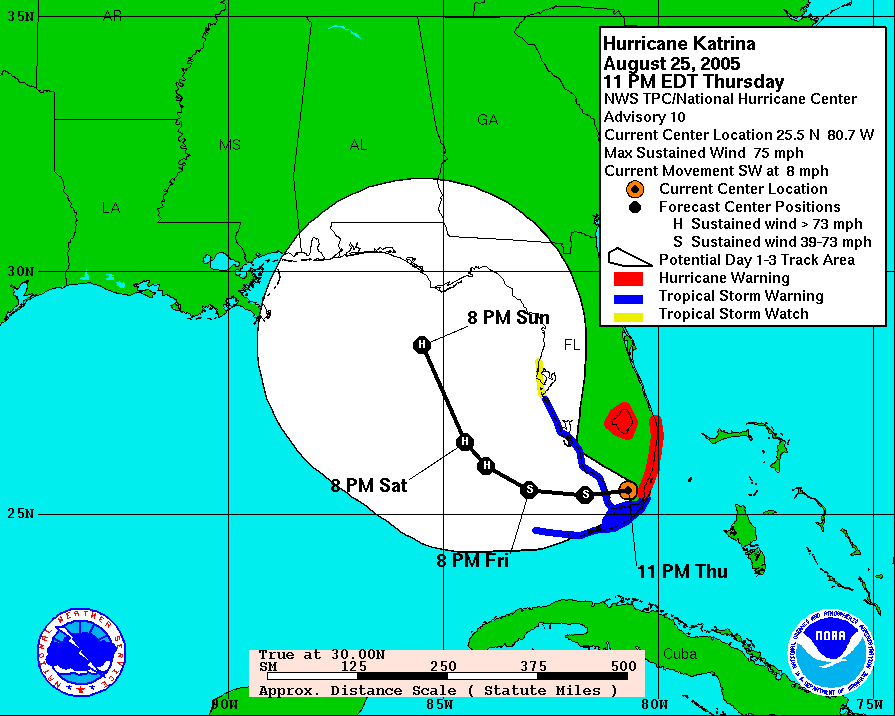
Hurricanes have always been a part of history. Hurricanes are severe storms of high winds and rain. They can be deadly and at best are destructive storms. Hurricanes like Katrina and the 1900 Galveston hurricane will forever live in the history of deadly hurricanes.
Hurricane Carol 1954
Hurricane Season Has Started
Hurricanes can be very dangerous and can often be deadly. This is why it is important to plan ahead and be well prepared. Planning ahead for a hurricane can help to save lives. It can reduce potential damage to valuable property. It can also reduce the stress of surviving a hurricane. On average, five hurricanes strike the United States coastline every three years. This period is known as the hurricane season.
I lived in a hurricane area for several years. During those years, I was very lucky to experience only one major hurricane, Hurricane Ivan. But those years did teach me that being prepared was essential for those living in hurricane zones.
Before Hurricane Season
If there is anything good about hurricanes, it’s that they can usually be tracked with great accuracy. Residents living in hurricane areas will have several days to prepare and to evacuate if necessary. There are even some things you can do to prepare well before hurricane season begins. Here is a list of things you can do to get ready long before there’s any threat of a hurricane.
Important Things to Do When Living in Hurricane Zones
Make sure that all your trees and shrubbery are kept well trimmed.
Make sure the outside of your home is clear of clutter. This clutter will need to be put away in case of a hurricane. Outdoor furniture (such as patio sets, chairs and umbrellas) and garbage cans will need to be easily placed inside. Prepare room indoors for these items. Doing this ensures they can be quickly moved inside if there’s a possibility of a hurricane occurs.
During a hurricane, you will want your windows boarded with plywood to protect them from flying objects. Plywood should be purchased in advance and then cut to fit each window. Mark the plywood so you know which window each piece of plywood fits. These should then be stored in a safe place for the next hurricane because eventually there will be another hurricane.
Chances are good that after a hurricane your home will have at least some roof damage. It is a good idea to buy tarps and store them with the plywood for the windows. After a hurricane, tarps are in great demand. Tarps will be needed to protect your home from further damage due to rain.
If you can afford to buy one, get a generator. A good generator can run a few lights, the refrigerator, and the freezer which will save your frozen foods.
One of the most important things you should do is make sure your home insurance is adequate. Check to be certain that it will cover your home and exterior buildings, structures and fences.
Be Aware Of Where The Hurricane Is Headed
I remember watching hurricane coverage for days. If there was a hurricane prediction we stayed tuned to the news. Even workplaces had the news on and we all spent as much time watching the news as we did working.
Important Documents
Store all important documents in plastic in a fireproof and waterproof safe. If you need to evacuate, you can simply grab this quickly and have your important documents with you. It may be wise to make copies of important documents. Keeping them in a bank or with relatives who are outside the hurricane area is a good idea. Documents that you should keep in a safe place include the following:
All insurance policies
Birth certificates
Marriage Certificates
Property deeds
Credit Card Information
Medical Information
Social Security Cards
Vehicle Information
Health Information
All financial paperwork, checks and all savings and investment records
Make Sure Your Car Is Ready
Make sure your car is well maintained. Ensure it has a full tank of gas in the event that you will have to leave the area. Those that do have gas will also have a long line of people waiting to fill their cars. If possible, try to buy several five gallon cans of extra gas. After the hurricane, gas stations will take some time to fully function. You will need that extra gas for the car. If you have a garage, put your car in it. This will protect it from flying objects. You can even use your car to brace the garage doors. Park it as tight to the garage door as possible.
Supplies You Will Need
As previously mentioned, you should have a generator. It is more than likely you will not have power for several days after the hurricane. A generator can keep your refrigerator and lights working as well as some small appliances such as the coffee pot.
You should also have a supply of canned foods, bread, and various drinks including bottled water. A radio or battery-operated television is essential to stay updated on events. Ensure you have all different types of batteries available. Flashlights are essential, so make sure they are in working order with good batteries. You can also purchase headlamps which you can wear on your head while keeping your hands free. These lights can also let you read, play cards or games when there is no television. Kerosene lights and kerosene may be kept on hand or battery powered lanterns.
A grill or a camp stove is important. These will allow you to use any meat in your freezer. Otherwise, the meat may spoil. Without electric, you will need an alternative way of cooking. You will also need to keep several bottles of propane for the gas grill.
As I mentioned, you will need a good supply of water on hand, both for drinking and for washing. Before a hurricane hits, it is a good idea to fill as many containers of water as possible. Filling the bathtub is also a good idea. For drinking water, have several gallons for each person. It is important to ensure there’s enough on hand.
Money Matters
Having cash on hand after a hurricane is something you might not think about till later. Many of us have gotten used to carrying very little cash on us. We just pull out that convenient little plastic bank card. But after a hurricane, banks are not going to be operating for a few days till the power is restored. The same thing goes for most places where you might use your bank card. So it is important to have a fair amount of cash on hand. So don’t forget to visit your bank before a hurricane closes down everything.
Essential Food Supplies
The following items are often items you might already have in your cupboards. However, check to make sure you will have enough food on hand for at least a week. Before and after a hurricane the shelves in most stores will be empty so stock up early.
Canned items
Crackers and cereal bars
Pudding cups and fruit cups
Dried fruits
Nuts
Anything that is easy to open and won’t perish
Bread
Peanut Butter
Canned milk or dried milk
Bread and lunch meats
Manual can opener
Additional Precautions to Stay Safe and Healthy
Anyone who is taking medications on a daily basis should have at least a week’s supply. Also make certain to check your first aid kit to make certain you have first aid cream, bandages and antiseptics.
It would be a wise idea to discuss your hurricane plans with your family. Everyone should know what the plan is. If you plan to evacuate, each person should know what items they will be allowed to take with them. They should each know the destination you will be heading for. This will help if anyone gets separated along the way. You will need to make sure everyone has a fully charged cell phone. This ensures all family members are able to stay in touch at all times.
These are some of the major things that you will need to do. These are items you should purchase to be prepared for a hurricane. You should also listen to your local Emergency Management office for local information. They can keep you informed where local shelters will be located, emergency evacuation routes and other safety issues.
Nothing can stop the stress, loss and heartbreak that hurricanes can cause. Lost personal items such as photos can never be replaced. But hurricanes can be survived by preparing in advance.
On May 24, 2018, President Donald Trump officially pardoned John Johnson, the former heavyweight boxing champion. Who was Jack Johnson? What crime did he commit? Why did the president grant him a pardon years after Johnson’s death?
Johnson’s Early Years
John Arthur (Jack) Johnson was born on March 31,1878, in Galveston, Texas. This was not many years after the Civil War had freed the slaves in the South. Johnson’s parents, Henry and Tina Johnson, were former slaves. Jack Johnson was one of Henry and Tina’s several children and Jack did not get much of a formal education. He was forced to leave school at a young age to help support the family. He found employment on the docks. But Johnson was a tall, large black man who would not settle for just being a common dock worker. Instead, he set his sights on becoming the first African American heavyweight boxing champion.
At the young age of fifteen, Johnson fought his first fight. Sometime in 1897 he went professional. In his early career, he would fight in private clubs. He realized he loved the money he was making by doing something he loved.
In Johnson’s early career, he fought Joe Choynski, another fighter from the Galveston area. Johnson was knocked out. This type of fighting was illegal in Texas at that time. Both fighters were arrested. Bail was set very high, higher than either man could come up with. The sheriff came up with an arrangement that suited everyone. Both fighters avoided actually going to jail. The sheriff’s arrangement was for both men to meet in a cell and spar every day. Choynski and Johnson became friends. But more important, Choynski became Johnson’s mentor and coach for the time they spent sparring in a jail cell.
Jack Johnson’s List of Major Fights
Jack Johnson (nicknamed the Galveston Giant) formally began his boxing career on Nov 1st, 1898. He had an amazing list of hard-won fights.
Nov 1, 1898: Johnson won a fight against Charley Brooks in Galveston, Texas.
May 8, 1899: Johnson won against John Hayes in Chicago. The following year, these two matched up again in a tie.
Feb 25, 1901: Johnson fought Joe Choynski and lost.
1903: By this time, Johnson had won 50 fights. Johnson fought Denver Martin and won. This fight earned Johnson the World Colored Heavyweight Championship.
Dec 1926: Johnson fought Tommy Burns and became the first African American to hold the Heavyweight Boxing Championship title.
July 4, 1910: Johnson fought James Jefferies in Reno, Nevada, a fight that was dubbed the fight of the century. Johnson won, which led to race riots.
Racial Tensions Arise
By this time, Johnson had made a name for himself. He was a black man in an era of Jim Crow laws and racial tensions. The Civil War wasn’t that long ago. Johnson soon faced legal problems because he was a colored man who had beaten James Jefferies, a white man. There was much celebrating that Johnson had won against a white man. This victory did not sit well with the white boxing world.
Johnson also liked white women; he had been married to two white women and was involved with white prostitutes. This did not go very well with whites during the time of Jim Crow laws.
Johnson’s White Wives
Johnson’s first wife was Etta Terry Duryea. She was a wealthy white socialist from Brooklyn, and their marriage proved to be a disaster. They were married from January 1911 until September 1912—not even a full year—at the time she committed suicide.
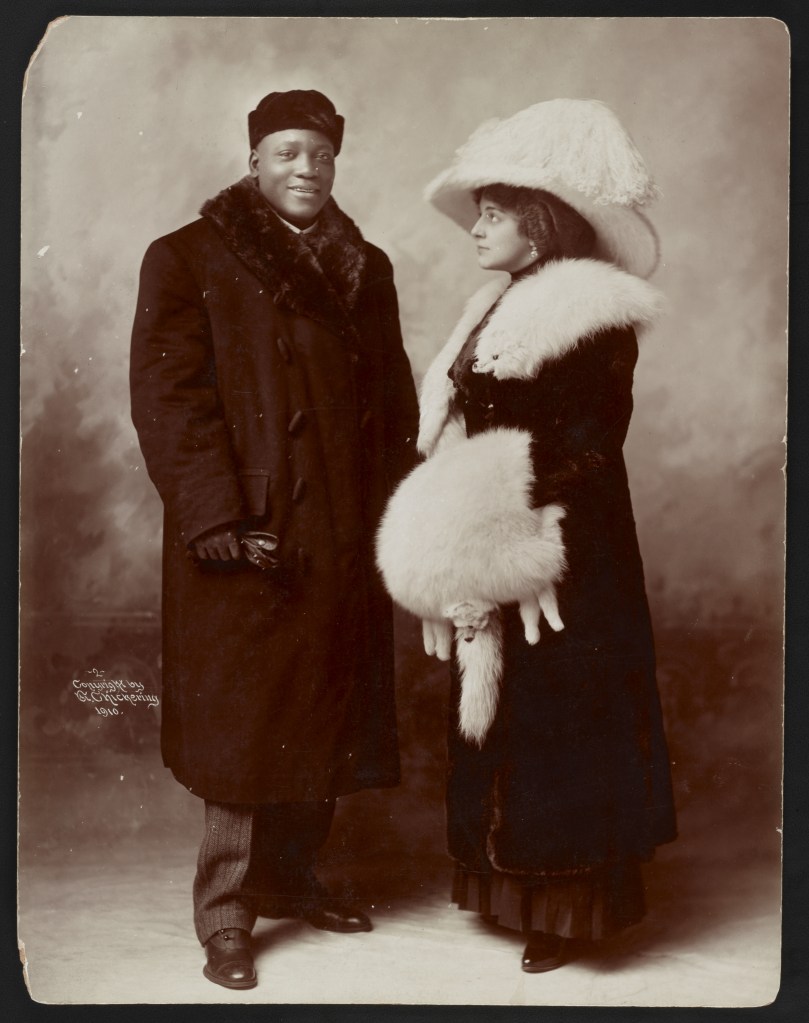
Boxing Champion Jack Johnson and his wealthy wife pose for the cameras
Johnson then met Lucille Cameron, another young, nineteen year-old white girl from Minneapolis. Lucille’s mother was outraged that her daughter was dating a black man. In Oct 1912, she accused Johnson of kidnapping her daughter. The case went to trial. Lucille stood up for Johnson. She refused to say that she had been kidnapped. As a result, the charges were dismissed. Lucille and Johnson were then married on Dec 4th 1912 and later divorced in 1924.
The Mann Act 1910
The Department of Justice failed to convict Johnson in the Lucille Cameron case. They quickly found another woman who was willing to testify that Johnson had taken her over state lines several times. This woman was Belle Schreiber, another white woman he met in May 1913. She was a prostitute in a house that refused black men. However, Johnson persuaded Belle to travel with him several times, crossing the state lines. This violated the 1910 Mann Act. The 1910 Mann Act stated that it was a federal offense to travel over a state line with a woman or young girl with the intention of prostitution or any immoral act. Belle was convinced to testify against Johnson. As a result, he was convicted of violating the Mann Act and sentenced to one year in prison.
Evading the Law
Johnson was let out on bail as he appealed the court’s decision, but he quickly decided that he was going to disappear. He eluded the police and headed for Canada, where he joined up with his wife Lucille. From Canada, they headed to France where Johnson managed to book some fights. However, World War I was on the verge of hitting Europe so Johnson and Lucille headed south to South America.
Jack Johnson Loses His Heavyweight Title
In 1914, another fight was scheduled for the world boxing title. Johnson would face Jess Willard in the ring in Havana. Willard was younger and well trained for the fight, but Johnson was favored to win. However, Willard managed to wear out Johnson and won the fight, thus taking the Heavyweight Boxing title from Johnson. It would be years before the boxing world would let another black man fight for any boxing titles.
After losing to Willard, Johnson returned to the USA in 1920 and turned himself in to law enforcement to serve out a 10-month prison sentence. After his release, he returned to boxing and continued fighting until he was 50 years old. In 1920, Johnson and Lucille were divorced. He later married Irene Pineau. He remained married to her until his death in a car accident in 1946 in North Carolina.
Jack Johnson the Legend
Jack Johnson was a boxing legend. He fought hard, loved white women, and at times lived a life of luxury. He paved the way for other great African American boxers who would become world boxing legends. He was inducted into the Boxing Hall of Fame in 1954 and the International Boxing Hall of Fame in 1993.
January 15, 1915, started off as a warmer than usual day. People were out on Commercial Street, Boston. They were moving about and enjoying the slightly warm January day. Children were playing outside on the streets and workers were stepping away from their jobs for a brief lunch break.
They did not realize the danger they would soon be facing. Tons of molasses would pour through the streets of Boston around noon. None of them knew that in just a few minutes some of them would be dead. Others would struggle to survive in a city covered in waist-high molasses. It would change quickly from being just an ordinary day to become the most deadly horrifying day in Boston’s history.
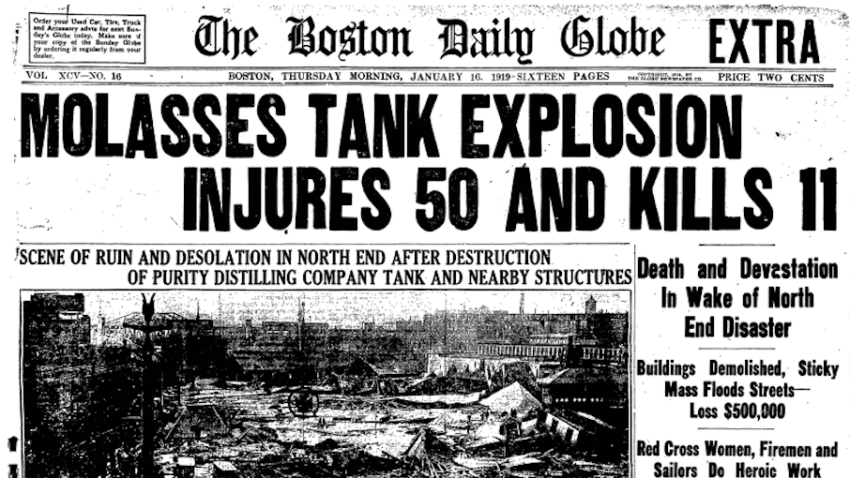
This is the news headline the day after the flood. 11 are announced dead in the headline, but 10 more bodies would be found later.
First World War Ends, Prohibition Set to Begin
Molasses became an important ingredient in creating ethanol during the First World War. This ethanol was used to create ammunition and explosives. The war ended. The American Congress then sought to make any form of liquor or alcohol illegal. They did this with an act of Congress called Prohibition.
Purity Distilling, therefore, was holding tons of molasses in a large storage tank in Boston. The company sought to make as much liquor as possible before Prohibition took effect. Shifts at Purity Distilling operated around the clock. They produced as much high-grade rum as possible.
Giant Tank Holding Millions of Gallons of Molasses
The molasses storage tank had been built a short time earlier just as the First World War was ending. It was a huge tank measuring fifteen feet high and one hundred sixty feet wide. When filled to the limit it held 2.3 million gallons of molasses.
The tank had been built near the harbor. Ships could dock there to unload the molasses. Railroads were close by to ship the molasses to where it would be made into alcohol. On Jan 15, 1915, it was filled almost to its limit. It was straining to hold the massive amount of molasses.
Tank Explodes, Molasses Flows
Close to noon people began to hear louder than usual noises coming from the tank. Survivors would later report that they heard loud rumbling noises. These were followed by loud pops which sounded like machine guns being fired. The metal steel rivets caused these noises. They held the sides of the tank together and popped out in rapid succession. Molasses began flowing from the tank at 25 to 35 miles an hour. Anyone in its path had no chance to escape.
Chaos and Destruction and Death Follows
The flood of molasses swept through the streets with such force. It literally slammed buildings off their foundations. It knocked over horses, cars, wagons, people, and anything else that got in its way. Horses and people were caught in the sticky goo. The molasses quickly hardened once it was out in the cooler air. This made it impossible for anyone trapped in it to move.
The molasses (which was a high wave) at that time knocked people and children to the ground where some suffocated to death. Twenty-one people died in the molasses while another one hundred and fifty were Injured. Property damages were enormous and if this had happened in modern times the price tag would be near $100,000,000.
Rescuers, including the police, local volunteers, and the Red Cross, all responded quickly to the disaster. They found it hard to walk through the molasses, which was up to their waists in some places. The molasses would cling to their boots and clothing making it hard to walk as they searched for survivors.
What Caused the Tank to Explode
No permit was required to build the tank.
It was poorly designed.
Poor construction and materials.
Leaks were not repaired, and molasses dripped.
The tank was painted brown to hide the leaks and drips.
Molasses would ferment causing pressure to the inside of the tank. This would be like putting too much air or gas in a balloon, which would cause the balloon to pop.
It was built very cheaply and quickly built with no safety inspections.
Was never properly tested by using water to find and repair leaks.
Lawsuits Become the First Class-Action Lawsuits
Victims of the molasses flood and the families who were victims of the flood soon filed lawsuits against Purity Distilling. These lawsuits soon combined to make one massive lawsuit, becoming the first-class action lawsuit for the state of Massachusetts. Finally, in 1926 the victims were awarded $300,000. This resulted in new laws enforcing higher regulations and inspections for new construction.
The tank that held those deadly gallons of molasses would never be rebuilt. Today, a recreational complex has been built in its place. More than a hundred years have passed since the molasses flood. People who live near the site still claim that the smell of molasses lingers on really hot days.
Johnstown, PA, is a small town in Cambria County in the southwestern area of the state. Pittsburgh is about seventy miles to the east of Johnstown, which lies in a small valley of the Laurel Mountains. Pittsburgh and nearby Johnstown were once booming steel towns.
A Day Starts Like Any Other DayIn Johnstown, Pa
On May 31, 1889, heavy rains had been falling, and as the people of Johnstown rose and went about their daily lives, they had no idea that by that afternoon, their small town would be hit with twenty million tons of water, which reached nearly thirty-seven feet high.
As many as twenty-two thousand would lose their lives and properties. The flood that was about to hit them would devastate their small town and their families and leave behind millions of dollars of damage.
A Dam Built for Canals
It all started in 1852, when the state of Pennsylvania built a huge water reservoir about eight miles east of Johnstown. The dam was built in connection with the Pennsylvania canal system, but within a few years, railroads became the more modern way of shipping, and the canal system became obsolete. In 1863, the canal which had connected Johnstown and Blairsville was shut down, eliminating any further use of the water reservoir.
The dam sat there with very little maintenance, and one portion began to erode in 1862, just ten years after the dam had been built. What repairs were done were done using inferior materials to fix holes and leaks. The workmanship was also done in a sloppy manner.
Rich Business Men Buy The Dam
The dam was first sold to the Pennsylvania Railroad as trains at that time ran on steam, so this was a good place for a water stop. In 1875, a one-term Pennsylvania congressman named John Reilly bought the dam and surrounding areas for $2500.
In 1879, Reilly resold the dam to a real estate salesman named Benjamin Ruff, who intended to turn the reservoir into a lake and a resort for the wealthy. He became the first president of an exclusive club known as the South Fork Fishing and Hunting Club. This club’s members would include wealthy doctors, dentists, lawyers and rich businessmen such as Andrew Carnegie and Henry Frick.
After a busy week in nearby Pittsburg, these gentlemen and their families could take the train and enjoy a weekend of relaxing at a private resort area. Some cottages and cabins were built, as well as a gentlemen’s clubhouse.
Lack of Oversight and Management
When Benjamin Ruff and the South Fork Fishing and Hunting Club took over the dam, they did attempt to do much-needed repairs on the dam. However, the repairs needed were probably much more extensive than Mr. Ruff and the South Fork Fishing and Hunting Club had anticipated, and I would guess that some of those repairs were put on hold.
The club also installed fish screens which, due to the heavy rains, ended up catching debris and forcing the water over the top of the dam. So basically, the heavy rains on May 31, 1889, combined with the lack of proper repairs and maintenance, were the culprits of the Johnstown Flood in 1889.
The Monster Flood Roars Toward Johnstown, PA
The heavy rains on May 31, 1899, put too much strain on the dam, and that afternoon workers at the dam saw that it was not going to hold the water back. Telegrams were sent to the small communities and to Johnstown. Most people paid little attention to the flood warnings, while others did move their belongings to second stories. None had any idea of the monster that was about to hit their small town and take their homes and lives.
At sometime around three o’clock in the afternoon, the dam gave way and the water came roaring furiously down into Johnstown. It was a roaring wall of water that took everything in its path. Houses, animals, cars, railroad cars and humans, the water showed no mercy. Thousands were trapped with no way out. Some were swept away, while others were caught in the tangled mess of houses, trees, and debris that backed up at the Stone Bridge.
For some reason, this debris at the bridge ignited and killed the people who had been clinging to wood boards or whatever they could manage to hang on to.
Relief Efforts
Just like today, when disasters of this nature strikes, Americans rally for each other and the flood of 1889 was no exception. Donations, volunteers and help came pouring in from all over the United States. Donations came from major cities in the United States such as Boston, Cincinnati and donations came from overseas as well. Money came from other countries such as London, Ireland and from Australia and there were numerous donations from many other places. Various businesses donated materials to help rebuild homes and shelters for those who had lost their homes.
Clara Barton arrived within days of the flood, and along with her American Red Cross organization set up headquarters in one of the few buildings that had survived the flood. Here the Red Cross sat up regular food areas to feed the homeless. Clothing areas were set up to distribute needed shoes, clothing, blankets and personal care items. This was one of the first biggest disasters to hit in America with such force that it proved to be training for disasters that would occur in the future. Lessons learned during the Johnstown flood of 1889, have carried over to modern day disasters.
Clara Barton set up headquarters in Johnstown, PA, after the historic flood of 1889.
Andrew Carnegie Library
Andrew Carnegie was one of the richest members of the South Fork Fishing and Hunting Club although it is thought that he spent very little time there. Carnegie was also well known as a kind and generous man.
Shortly after the flood he visited Johnstown and donated $10,000 toward building a library there. More money was later needed to finish building the library and Carnegie donated an additional $45,000 toward its completion.
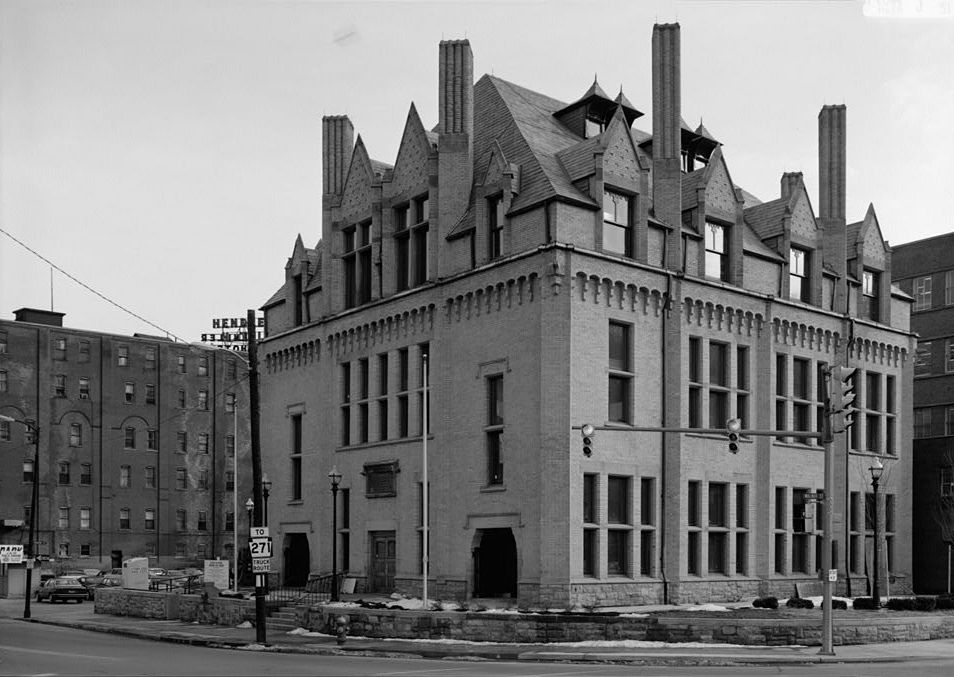
The Cambria Public Library built in Johnstown with donations from Andrew Carnegie
A Flood for the History Books
The Johnstown Flood was an historical event that people still talk about today. Stories and pictures of the flood have been preserved and handed down to new generations. There are still different theories of just who or what was responsible for such a horrific event that caused so much damage and took so many lives, many of them children. Johnstown has an interesting museum dedicated to the flood where the history of the Johnstown Flood is kept alive. The museum features a short film about the flood. After the flood, there were very tiny homes brought into Johnstown, much like FEMA trailers today, for families who had lost their homes. One of these tiny homes is also part of the museum.
The South Fork Hunting and Fishing Club and some of its members were sued in court but were never held responsible. Today life goes on in Johnstown, PA, and the town has been rebuilt but the memories and stories live on.
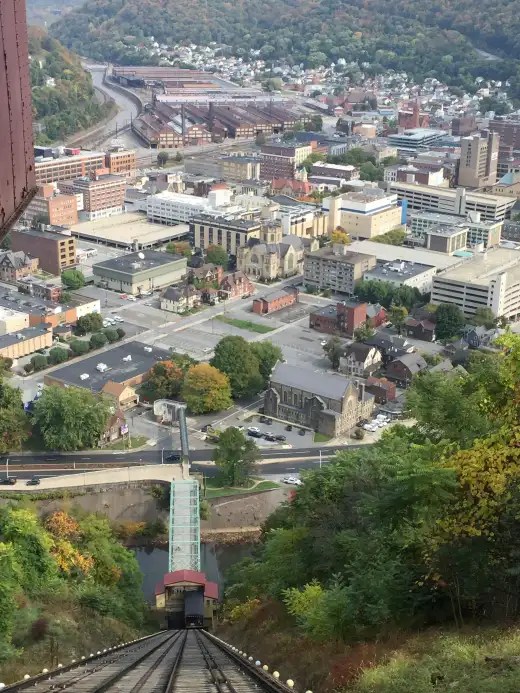
Johnstown has come back from the famous flood of 1889. This is a photo of Johnstown in November of 2020. Photo Credit L.M. Hosler
There is no doubt about it, everyday we hear so much violence on the news. It seems our society is becoming more violent with each passing generation. We, as parents, grandparents and society in general have an obligation to try to stem the tides of violence. So where do we start? Our government wants to take away our rights to own firearms. They also want to remove our ability to protect ourselves. They think the solution is gun control. But most of us, know that if a criminal wants to inflict violence on others, they will find a way. They may choose to steal guns. Recently, there have been cases where they used various other weapons. These include knives, ropes, bricks, hammers or rocks.
We know that mental illness plays a role in most cases of violence. But, here again, there are many who suffer from some form of mental illness, who would never harm someone else. But suppose a slightly mentally ill young person grows up viewing violence every day. They see this violence in their television programs, movies, and video games. Would that make the chances of that person committing a violent act increase? If they view this every day, does it not distort their thinking and reasoning ability? If a mentally ill person views violence as a way of life, do they choose violence? Do they use it when they have issues with others? Is violence their method of resolving conflicts?
Children Learn Violence
Most children are not born with violent tendency, except for certain mental illnesses. They learn what their surroundings and those people around them teach them. A National Television Violence Study project was done by the government nearly twenty years ago. The studies results showed the following.
Children learn aggressive behaviors
Children who watched a lot of violent television and movie content seemed to lose their empathy towards others
Some children would develop fears of becoming victims of violence
Yes, children do learn from watching violence on television. A friend of mine has the scar to prove it. Her brother, after watching cowboy and Indian shows decided to try to scalp my friend with his pocket knife. Of course, in this case, the child was punished and made sure he knew what he had done was wrong. My own son, after watching a show called Circus of The Stars, decided to try to ride his bike over his younger brother. These are just two example of how children react to what they see on Television.
Hero Or Nasty Villain
We have all watched movies where the hero did some very extreme acts of violence himself. However, the hero is shown as being glamorized and his actions are excusable in his efforts to destroy the villain. The villain is portrayed as so evil, that any violent acts the hero does is justifiable even if the hero has killed, harmed or damaged just as many people as the villain.
Now movies, and television drama shows would be very dull without some sort of conflict, I agree. But, do they have to show in graphic detail, blood and body parts flying? I think not. Movies were just as good years ago, without having to see blood smeared and detached limbs and heads.Some of these shows, movies and video games are so graphic that children are growing up seeing blood splatter that it has no effect on them and it doesn’t seem to bother them. In fact, to them this is exciting and normal. Some movies I have watched recently have shown people being tortured or being beaten so badly, that I had to turn off what might have otherwise been a good movie. In fact, it was a remake of Bonnie and Clyde, but it was so much more violent than the original, which was quite violent enough.
Everyone Can Help Change The Violence
All of us have the ability to help to curb violence in the media and protect our young people from its harmful effects. Here are some tips that may help parents or caregivers of young children.
Know what programs your child is viewing and what video games they are playing.
Watch with your child the games they are playing and the television programs they are watching
Limit the amount of time the child is allowed to play games or watch television
Make use of the time you spend watching television programs by discussing how this is not what reality is
Talk about the violence and let your child know it is not reality and there are consequences to violent behavior
Change the channel and explain why you are doing so
Refuse to watch overly violent shows or movies
Talk with other parents and encourage them to avoid violent games, movies and television programs
Also discuss with other parents if there are violent games or shows you do not wish your child to be exposed to. Chances are they may agree with you.
There are groups that try to curb violence that children are exposed to. Join one and make a difference
Most televisions have parental controls which can be used to help eliminate viewing violent and sexual content. Be sure to use these controls
Join groups that work towards curbing violent games and television
The Good Things
Yes, there are good programs on television and good movies. It is just getting harder to find good family type movies. There are some good educational channels, such as the History Channel, and some good family movies can be found on the Hallmark Channel. Teach your children to look for the good and protect them from being overly exposed to the violence. Hopefully, our society may change its course amid all the violence and eventually hold the entertainment industry accountable for what it produces.












 History Lovers Corner