Writers are important but so are readers. Readers and writers need each other. Writers provide their audiences with news, valuable information as well as entertainment.
In 1974, the government required that steel companies hire women and minorities. This included the Eveleth Iron Mining co. This was the immediate start of the first class action suit by women claiming sexual harassment, abuse, and violence against women in the workplace. The case was Jenson v. Eveleth Taconite Co.
As women who were looking for good paying jobs to support their families, some brave women went to work for Eveleth Taconite Co. These women had no idea of the stress, harassment, humiliation and intimidation they were going to face. The men who worked for the mining company highly resented women taking good paying jobs from men. In their view, women should be staying at home, cooking, cleaning and raising children. These women really had no choice. Some were single mothers or the main breadwinner of the household. They needed good paying jobs every bit as much as the men.
Lois Jenson was one of the first women to go to work for the Eveleth Taconite Co. and became a member of the union workers. Right from the start she was a target of sexual harassment. Lois and the other women were victims of stalking, groping, and threats of rape and physical violence. Another problem that the women faced was the lack of bathroom facilities. They often weren’t near a bathroom and some developed urinary problems from holding their urine for extended periods of time.
Lois Jenson filed numerous complaints with management, the union and the mine owners regarding the abuse the women were subjected to. All wanted these women to quit, so all of her complaints were ignored or even sneered at. Eventually, Jenson filed a complaint to the Human Rights of Minnesota office. The state ordered Ogelby Norton to pay $11,000 to Jenson and form sexual harassment policies. The Eveleth Taconite Co. refused to follow the states orders.
Finally, in desperation, in 1988 Jenson hired private attorneys Paul Springer and Jean Boler to file a complaint. Jenson was joined by Pat Kosmach and one other woman to make it a class action lawsuit. Unfortunately, Pat Kosmach would die from Lou Gehrig’s disease before the lawsuit was settled.
Not all women supported the lawsuit. They feared for their jobs and the intimidation on the job became even worse. It became so unbearable that Jenson was under so much mental stress that she quit working at the mine.
During the trial the women were subjected to intensive and invasion of their privacy. Questions were asked about their pasts regarding former relationships. Their former sexual pasts were put on display. There were accusations that their behavior had caused the problems of harassment. They were accused of lying about the effects the harassment had on their physical and mental health.
After years of fighting in court the women finally got their verdict. Their case was settled on Dec 31, 1988 for $3.5 million. Not all women received the same amount. Each case was judged separately with some receiving more than others. But most important for the women was that the company had to have and enforce a no harassment policy. This policy protected the women from the abuse they had been dealing with. They could keep their jobs without the fear of harassment and violence. They had won the right to be respected.
All my life I have been coming up with new skills I would like to learn. It’s a long list because I never have enough time to pursue learning new skills.
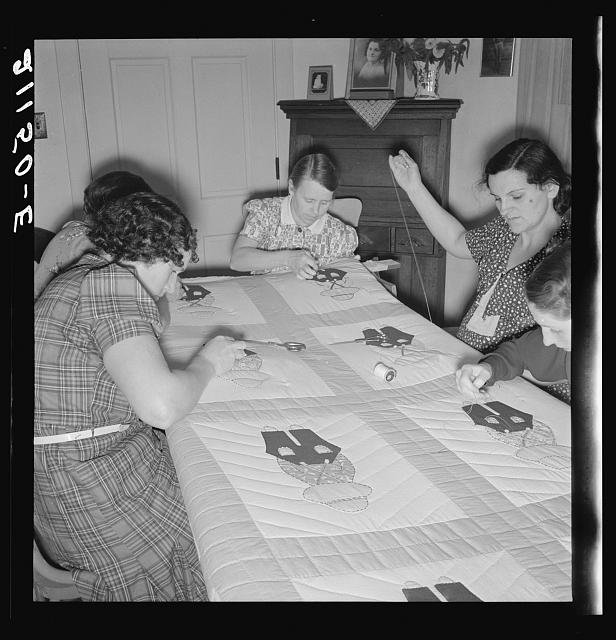
Woman During The Depression Time Quilting Dorothea Lange
List of skills I am interested in learning:
Writing
Pottery
Candle Making
Soap Making
Weaving
Quilting
Learning new languages
Organization
I am not the most organized person although I try to be. So top of the list of skills I would like to learn is how to be more organized. That could give me more time for writing and learning some of those new skills. Learning to clean my house in an organized manner would help. It would give me more time for all those other hobbies I would enjoy learning.
Annie and Josie Bassett were the daughters of Herbert and Elizabeth Basset. Herbert was an educated man who had been a teacher and then later served in the Union Army. During the gold rush years, his brother Samuel headed west. Herbert decided to move his family west because of his health. The family ended up settling in Brown’s Hole, Colorado. Brown’s Hole also had close borders to Utah and Wyoming. His wife, Elizabeth, renamed it “Brown’s Park” because of its natural beauty. The family settled down there and built a small cabin, started ranching, and their family grew to four children.
The Basset Family
Herbert tended to be quieter and calmer than his beautiful, wild wife. The Bassett family was very social and welcomed everyone into their home. Strangers, church-going neighbors, travelers, and many times even outlaws hiding from the law. Butch Cassidy was one of those famous outlaws. He was romantically involved with both Anne and Josie Bassett at different times. Members of the Butch Cassidy gang, the Wild Bunch, were welcome visitors.
Elizabeth Bassett, Anne, and Josie’s, mother was a beautiful woman. She could ride rope, shoot, and rustle cattle as well as the men who were devoted to the family. These men would do anything Elizabeth or her daughters asked them to do. Even if it meant breaking the law. Her two daughters took after her. After Elizabeth’s death when she was only 37, the sisters took over running the ranch. By this time, there was a feud starting between the small ranches and the big cattle barons. This feud was particularly between the Bassets and the Two Bars Ranch.
Butch Cassidy and The Wild Bunch
Anne Basset
Anne was involved with several of the outlaws that hung out at the ranch. But then she did become engaged to Matt Rash. Before they were married, though, the owner of the Two Bar Ranch brought in a hired gun. Tom Horn was hired to hunt down cattle rustlers, and Matt Rash was shot and died. After this, things escalated between the two families. Anne would drive many of the Two Bar Ranch cattle over a cliff in revenge. At one point, she stood trial for cattle rustling but was acquitted. Both Anne and her sister were admired and respected. The cowhands they worked with had a great respect for these two women. They admired them for their ability to run a ranch and work right along with the cowboys. Queen Anne, as she was often referred to was well-liked. On the other side the cattle rancher was so disliked that Queen Anne was given a parade in honor of her acquittal.
Josie Bassett’s cabin in Cub Creek
Josie Basset
While Anne was the more daredevil of the two girls, Josie was more domesticated. However, she could hold her own on the ranch, riding, roping, shooting, and rustling cattle. Josie was married five times. She divorced four of those husbands, and the fifth was rumored that he died of poisoning. Josie was charged with his murder but was acquitted. The fifth husband actually died from alcoholism. In her later years, she was asked if she poisoned her fifth husband. Her answer was a smile, and she just said that some husbands are harder to get rid of. Josie also stood trial for cattle rustling, but she also was acquitted. In her later years, close to forty years old she built a cabin in Cub Creek. During the years Prohibition Laws were in effect, Josie made her own whiskey, wine and brandy. Here at her cabin she lived off the land for the next fifty years. Josie died in May 1964. She had lived long enough to see automobiles, electricity, television and phones and two world wars.
Anne and Josie Bassett were an interesting pair of sisters. They grew up running wild and were friends with known outlaws. They were women who were before their time, women who took control of their own destinies. They were liked and respected for their independent natures. They did what women weren’t supposed to do. They became women legends of the old west.
The Civil War was finally over on April 9, 1865. The slaves were set free, but there were few jobs or opportunities for anyone, especially an African American woman.
Cathay Williams was one of those young African American women. She had been born the daughter of a slave and a free man in Jackson County, Missouri. In her teen years, she worked as a house slave in Jefferson, Missouri. When the Union took possession of the state of Missouri, the Union army often employed freed slaves. They were used in positions such as cooks or for doing other domestic work. At just the age of seventeen, she worked for the army as a cook and did laundry for the army. This enabled her to travel all over the country under General Philip Sheridan.
Cathay Williams in the United States Army
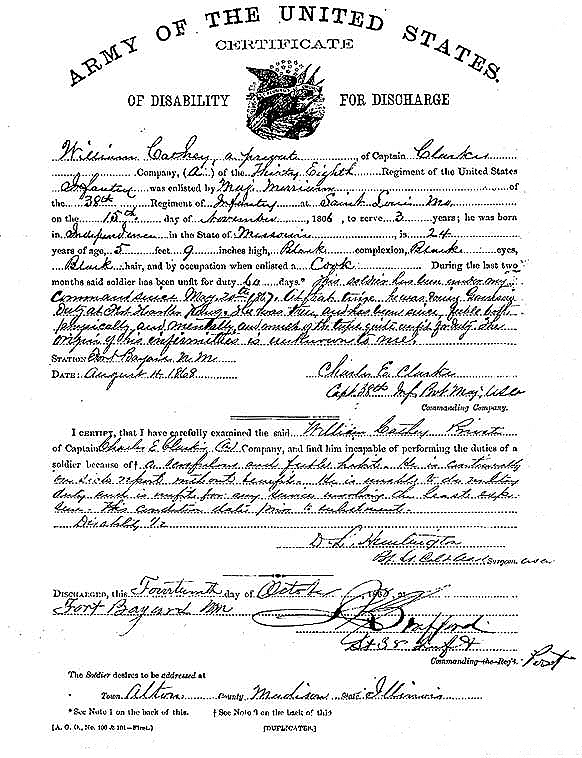
After the war ended, Cathay made the decision to join the army. Since women were not allowed to enlist, she disguised herself as a young man. She was described as being tall with dark skin and short dark hair. So it wasn’t all that hard for her to be mistaken for a man. What was hard was passing the physical exam. But somehow, the army doctor did just a very quick exam and passed her. She enlisted using the name William Cathay. She served with the 38th U.S. Infantry Regiment. Cathay served for about two years until repeated illness sent her to the hospital several times, where eventually, a doctor discovered her gender. She was given an honorable discharge on Oct 14, 1868.
Cathy Willaims also known as William Cathay Army discharge papers
After her discharge from the army, Cathay joined what came to be known as “the Buffalo Soldiers.” She was the first official female African American to serve in the United States Army. Years later, the St. Louis Times wrote about the story of Cathay Williams. She was the first African American woman to serve in the military. When asked what motivated her decision to enlist in the army, she replied. She said it was her desire to be independent.
Cathay Williams left the Buffalo Soldiers when she became disabled and was no longer able to carry out her duties. Although she had some severe disabilities linked to her service in the military she was denied disability from the U.S. Army. The reason given was that she had enlisted under the wrong name and gender. Cathay died in 1893 in Trinidad, Colorado.
Women who lived in the 19th century, in the western states had to grow up to be tough. There were limited options for women in the 19th century. Women were generally confined to traditional roles. School teacher, wife, mother or possibility cooking or cleaning jobs were the acceptable role expected of women. But some women, like Calamity Jane, had to learn to shoot, ride horses and defend themselves. They had to learn to be as rough and tough as the men in the West in order to survive.
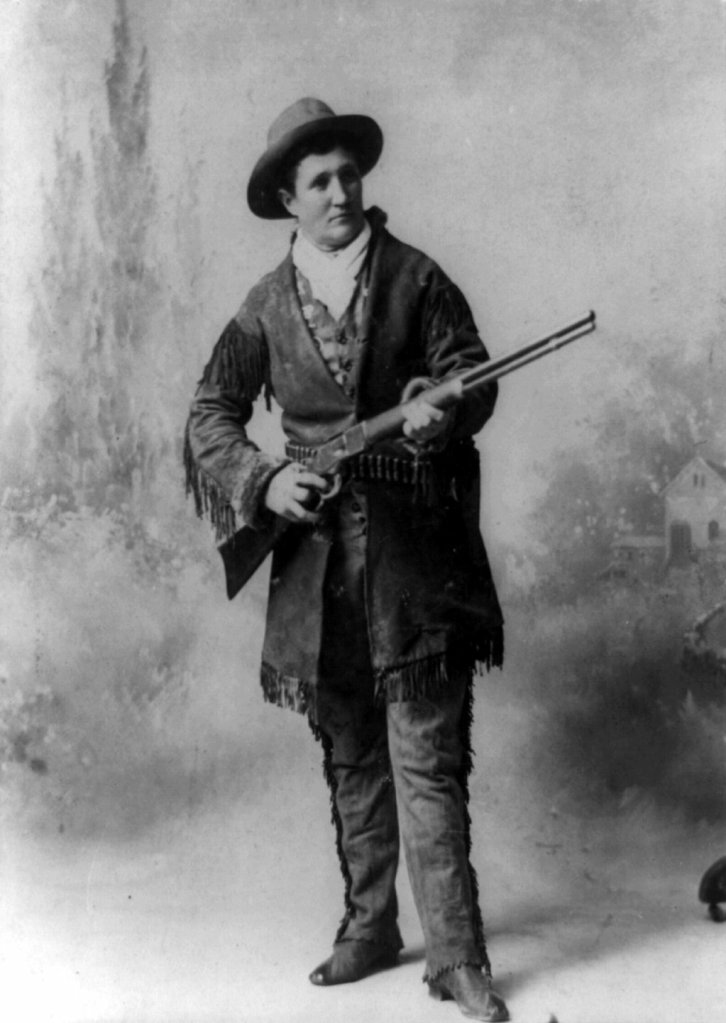
Calamity Jane
Calamity Jane was born May 1, 1852, as Martha Jane Cannary. Her parents were Robert and Charlotte Cannary, and she was the eldest of six children. Her parents were a rather rough and hard-living couple who moved the family from place to place looking for work. They died when Martha Jane was still very young, only 12 years old. Martha Jane was quickly forced into doing whatever she could to survive and keep the family together. As she grew into a tall, stocky woman, she often did the work that men usually performed.
The Legend of Calamity Jane
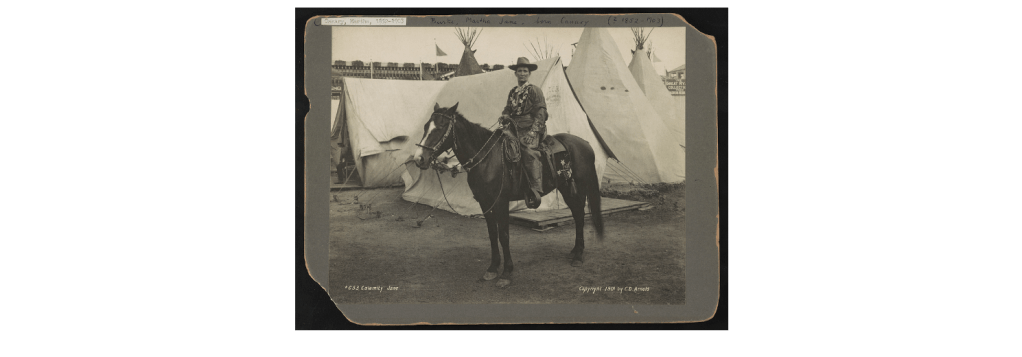
She moved to Deadwood, South Dakota, and this is when the legend of Calamity Jane really began. Here, she met Wild Bill Hickok, and rumors flew that they were romantically involved, although this is questionable. She worked, dressed, swore, and drank just like the men did. She worked as an army scout and was a sharpshooter with a rifle. Soon, Martha became known as Calamity Jane and became a Western legend. She made history by touring with Buffalo Bill’s famous Wild West Show in 1895, showcasing her sharpshooting skills. In 1901, The Buffalo Bill Wild West show appeared in Buffalo, New York at the Pan-American Exposition. The Pan American Exposition was opened by Vice President Theodore Roosevelt. The Exposition was in many ways analogous to the World’s Fair. One of its attractions was the Indian exhibits. These showcased TeePees and the sharpshooting Buffalo Bill Wild West show.
Calamity Jane in 1901 at the Pan American Exposition
Calamity Jane was quite a character of the old wild west. How much of her legend is true is debatable because Calamity Jane was a known storyteller. Her tales were often not just colorful but highly exaggerated. Martha Jane’s legacy taught women that they were capable of more than being cast in traditional roles.
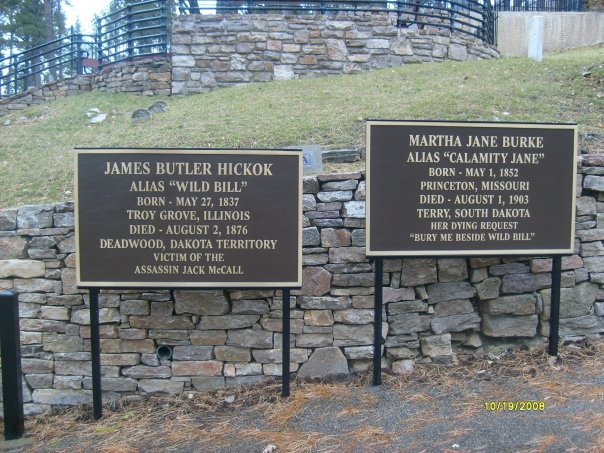
Calamity Jane, despite her fame, I believe, did not have a very happy or easy life. Calamity Jane was a heavy drinker and died an early death. She is buried next to Wild Bill Hickok in Deadwood, South Dakota.
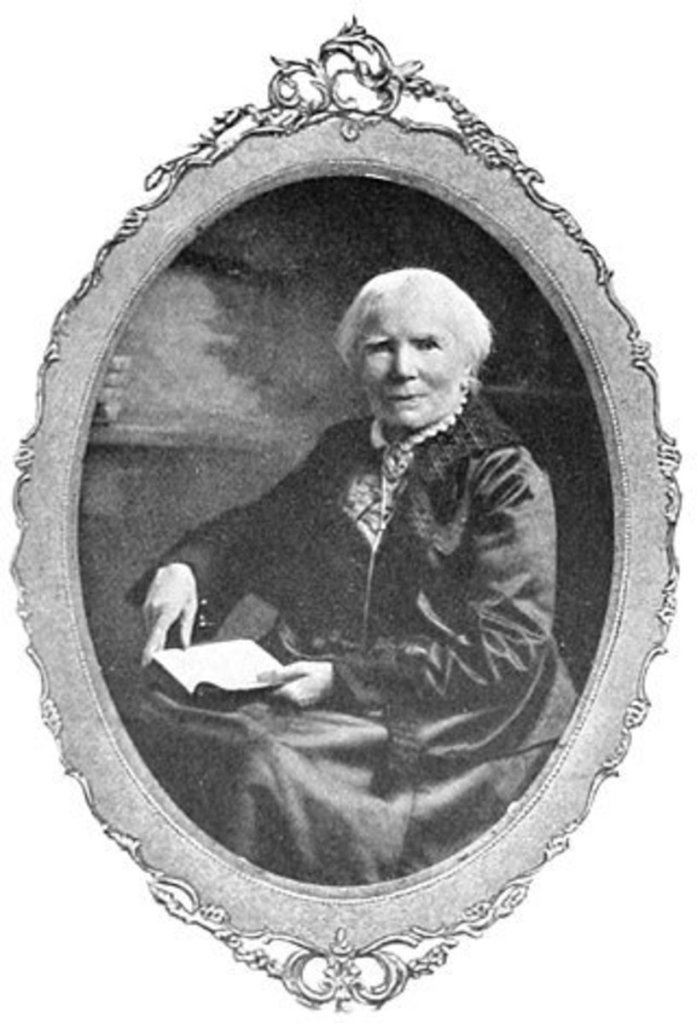
Elizabeth was born the daughter of Hannah Lane and Samuel Blackwell in 1821, their third child. She was born in Bristol, England. Her family enjoyed a prosperous lifestyle there. However, riots broke out and they lost their business. Her father made the decision to move the family to America while she was still a young girl. Samuel Blackwell felt he would have more job opportunities in America. He also wanted to support the anti-slavery movement and women’s rights movement for his daughters. The Blackwell family settled in New York in 1832.
Education
Samuel Blackwell did not want his children educated by the church. Therefore, they received their education through their parents and private tutors. Elizabeth could speak several languages, including French and German, as well as English. She also received education in music and literature. Elizabeth was fortunate that her father believed in education for his daughters as well as for his sons. This was a time when usually women did not have the same opportunities for education as men. In fact, it was rare for a woman to have access to higher education at all. For Elizabeth to become a doctor, she had to confront entrenched views. She had to challenge preconceived ideas about the roles of women in society.
First Work Experiences
When Elizabeth was eighteen, her father died unexpectedly. He left her mother, Hannah, with nine young children to support for. For some time, Elizabeth, along with her two sisters and mother, worked as teachers to support the family. Teaching was one of the few occupations that society accepted for women at that time. Together, the Blackwell women opened a private academy for young women in Cincinnati, Ohio. Elizabeth also moved to Henderson, Kentucky, to take a teaching position. However, her anti-slavery views clashed with the school’s teachings. She left after her first year.
During this time period, Elizabeth had a close friend who was dying of a disease that affected women only. This friend was the person who most influenced Elizabeth to pursue a career in medicine. She confided to Elizabeth how embarrassing it was for her to let male doctors examine her. Her friend wished that women were allowed to enter the medical field and treat women like her. This was the first time that Elizabeth had ever considered the possibility of studying to become a doctor. She had never considered medicine as a career. In fact, she had found the study of the body, diseases, and sickness to be appalling and disgusting. In honor of her friend’s thoughts and wishes, Elizabeth set her sights on becoming the world’s first woman doctor. It would not be an easy path to forge.
Elizabeth Fights for a Career as a Woman Doctor
At the beginning of her quest to earn a medical degree, many of her friends were against the idea. They tried to discourage her. They didn’t feel she had any chance of becoming a doctor due to being a woman. Elizabeth persisted even though she had no idea where to begin. So she began by studying with private doctors John and Samuel Dickinson, who were willing to teach her. She also spent a lot of time reading and studying on her own. From there, she began to apply to different medical schools. She was always told that they would not accept her because she was a woman.
Geneva Medical College
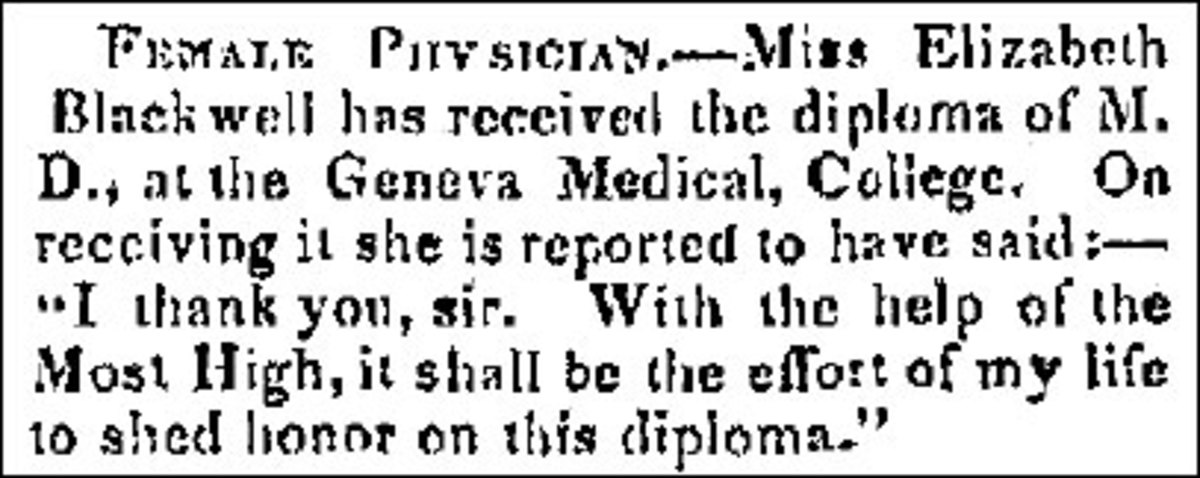
Finally, one school did admit her to their medical program of study. It was the Geneva Medical College in New York. Although she was admitted to the college, it was not going to be an easy road to her medical degree. The male students treated her as an oddity. They joked about her. Some went so far as to bully her. Some professors refused to let her in their classrooms and demonstrations. Elizabeth refused to give up no matter how much abuse she received and just worked and studied even harder. In Jan 1849, it paid off, and she received her medical degree and graduated first in her class. I wonder how chagrined and embarrassed those boys who had bullied her felt.
Continuing Studies
After graduating with her medical degree, she moved to London and Paris, where she continued studying. Here, she took courses in midwife studies. Unfortunately, it was here that she would be infected with an eye infection from one of her patients. She lost her eye due to the infection and thus ended her ambition of becoming a surgeon.
Doctoring in New York
Upon returning to New York, she set about helping poor women and children. She opened several facilities for women and children to receive medical treatment. She also opened the first medical college for women in New York. Elizabeth helped her younger sister Emily enter the field of medicine. Together, they opened and operated facilities for poor women and children, as well as supported many other causes. Doctor Rebecca Cole would be the first black woman doctor to work with Dr. Elizabeth Blackwell at her Infirmary for women and children.
Civil War
During the Civil War, Elizabeth helped the Union effort with her knowledge of medical practices. This included advocating for clean, sanitary conditions as well as proper personal hygiene in Union hospitals and army camps. She also worked with President Lincoln in establishing The US Sanitary Commission. She trained other nurses in proper sanitary procedures for wartime. These trained nurses helped to reduce diseases from spreading through hospitals and among the men in the army camps.
Elizabeth Blackwell’s Achievements
First woman to receive a medical degree
Worked and studied at Bartholomew’s Hospital in London
Opened a private practice when no hospital would hire her
Opened the New York Dispensary for poor women and children
Opened the New York Infirmary for indigent women and children
First woman listed on the British Medical Register
Opened the first medical college for women
Worked with President Lincoln during the Civil War to establish the US Sanitary Commission in 1861
Lectured at the London School of Medicine for Women
Inducted into the National Women’s Hall of Fame 1973
Founded the National Health Society in 1871. Its goal was to teach people about the importance of cleanliness and living a healthy lifestyle
This is only a short list of the achievements of Elizabeth Blackwell. I am sure there are many others as well.
Books by Elizabeth Blackwell
The Religion of Health
Essays in Medical Sociology
The Human Element in Sex
Pioneer Work in Opening the Medical Profession to Women
Medicine as a Profession for Women
Address on the Medical Education of Women
Again, this is only a short list of books and articles written by Dr. Elizabeth Blackwell. I believe she also wrote many articles about women’s health, as well as articles about sanitation, cleanliness, and hygiene.
Elizabeth Blackwell: A Lasting Legacy
Elizabeth forged a path into the medical field for many other women to follow, including her sister Emily. The two of them together changed perceptions in the medical profession. They worked together or separately to advance the acceptance of women. The field had viewed women as inferior, ignorant, and lacking sense. It also considered women as not having the mental attitude for the medical profession. Elizabeth proved them wrong.
I know very little about professional athletes. I am not into football, golf, basketball or any other sports. If I had to choose a sport to follow it would be baseball. I also don’t watch much of the Olympics although I can enjoy figure skating and gymnastics. Actually, I would rather read a good book, have some chocolate chip cookies and chips. Television and sports for many of us have ended with some of the athletes kneeling and disrespecting our country.
But if I had to choose a professional athlete that I respect it would be Riley Gaines, the swimmer. And it’s not her swimming ability that I respect and admire. I admire her for her courage. She raises awareness about the unfairness faced by women in sports. These are women who have spent their lives training in their sport. Now, they have to compete with men who aren’t capable of competing against other men. During the last Olympics I watched a man punch a woman in the face and take the gold medal. I stand with Riley Gaines against men competing in women’s sports.
Riley Gaines has spent the last several years advocating for women’s sports to be for women only. I respect her because this hasn’t been an easy position for her to take in a WOKE society.
Daily writing prompt
Name the professional athletes you respect the most and why.
This is a true story. The story of the dead woman in the bathroom. Two of the ladies who were there told it to me. Years later all but one of these women have passed on.
In our small town, just about everyone knew each other. They worked together, went to church together, or had some social events they were involved in. This led to close friendships for these four women, Gertie, Maggie, Ginny, and Martha. All of them were retired. Their friendship included afternoons of getting together and playing cards. All of them had been married, raised children, and assisted each other when they lost their husbands.
Martha was a retired elementary school teacher, greatly loved by her former students and the community. She was in her seventies but continued to be very active and healthy. She still continued donating a lot of her time to church activities and helped any children with schoolwork difficulties. She had recently started a part-time job in a small restaurant. This helped fill her time after her husband’s death.
Maggie had worked as a secretary and clerk until retirement. She was the one who was full of laughs and told some off color jokes in private. She usually kept the card group laughing at some of her stories she liked to tell. She also was still active in church and community activities.
Ginny was the quiet serious one. But like Maggie she had a few good stories of her own. She had worked for the local doctor for years and still occasionally filled in when he needed her. She was the oldest member of the ladies card club, but still stayed busy with various activities.
Gertrude (Gertie) was a combination of all the ladies. She had been quite popular with the gentlemen in her youth and she had some wild tales of her own. Gertie had been a nurse at the nearby hospital. After retiring she had worked as a private nurse in some of the wealthiest homes in the surrounding area. When anyone really needed her help she would still step up and help.
One day in early September the four friends gathered in Martha’s spacious dining room. The house smelled of freshly baked bread, and cookies. Moreover, each of the other three women had brought food and snacks for lunch. The smells gave the promise of an awesome lunch. Good food was as important as friendship, gossip and card games.
The four women quickly settled in the dining room. They began playing cards. They laughed and caught up with the latest news and gossip around town. There wasn’t much news or gossip and the conversation lagged as each lady focused on winning the card game. After the first game had been completed they took a break.
Maggie announced that she was going to use the bathroom and disappeared down the hallway. The other three ladies continued chatting and shuffling the cards, getting ready for the next game. Ten minutes passed and still Maggie hadn’t returned from the bathroom. Gertie, Martha, and Ginny looked at each other and wondered what was keeping Maggie so long in the bathroom. They patiently waited another five minutes, then Martha was sent to check on Maggie. The others were getting anxious to start the new game.
Suddenly Martha came rushing back into the dining room. She said there was something wrong with Maggie in the bathroom. Maggie wasn’t responding when Martha attempted to wake her. Maggie was just sitting on the toilet with her head resting on her chest. They needed to call the doctor right away. Gertie, the nurse, promptly went to check on Maggie while Martha made the call to the doctor.
Several minutes later Gertie returned. The other three women were stunned and unbelieving as Gertie said that Maggie had died in the bathroom. Martha and Ginny were confused and frightened by the sudden death of their good friend, Maggie. They clung to each other, cried and grappled to understand how this happened. It just wasn’t possible they said, Maggie had just been sitting at the table with them. They found this too hard to be believable.
The doctor’s office was close by and he arrived within a short time. After a quick examination he confirmed Gertie”s verdict that Maggie was indeed dead. She had suffered a massive heart attack. The funeral director was called, who also lived a short distance away. He arrived and transported Maggie to the funeral home, leaving behind three very shocked and shaken card players.
This story sounds like it could have been an episode of (The Golden Girls). I assure you this is a true story.
Maggie’s death ended the card game that day for the women. It would be some time before any of them recovered from the shocking death of their friend. As they say, life does go on. In the small town where the four friends lived, life went on. However, not one of them ever forgot the day that a friend died in one of their bathrooms.
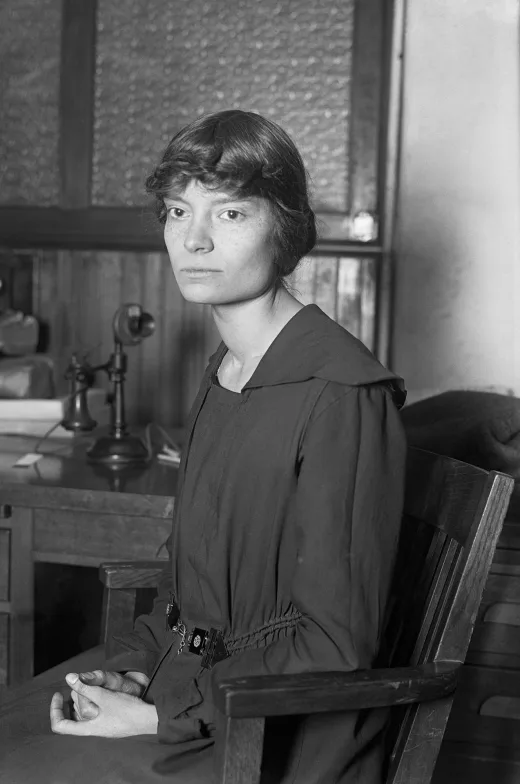
Dorothy Day was born as one of five children to John and Grace Day in Brooklyn, New York on November 8,1897. Her father was a sports writer and later became a sports editor. A few years after Dorothy’s birth he moved the family to San Francisco, California to take a better job. The Days family lived in California until the Great Earthquake in 1906 which destroyed her father’s place of employment. Before they left California Dorothy and her mother tried to help those who had been left homeless from the earthquake. This probably influenced Dorothy in such a way that years later it became her life’s work to help others in need.
The Day family then moved to Chicago, Illinois and lived in one of the poorer sections of Chicago until her Father found work that allowed him to move his family to a better neighborhood. Dorothy never seemed to forget what it was like to be poor and perhaps that is what led her to make the choice of helping the poor and less fortunate.
College Years
While still living in Chicago Dorothy won a scholarship which allowed her to go to The University of Illinois and she attended there for two years from 1914 until 1916. Dorothy loved reading and learning and she especially enjoyed reading the works of Dickens and Poe as well as others. It was at the university that her journalistic career began when she went to work for a small local paper. The friends she chose while in college were generally socialists who influenced her to join the Socialist Party. With her friends she became involved with radical causes concerning poor working people.
Life as aNew York Reporter
Two years later, she gave up her studies at the university and moved to New York. She was just eighteen years old at the time. Here she found her first real job as a reporter working for the New York Call where she worked for a few months before leaving The Call to work for The Masses. As a reporter she covered labor meetings, protests and riots as well as other social causes. Here in New York, she made friends with other journalists, liberals, socialists, labor collaborators and communist that she met through her work. During this time, Dorothy was like most young women, enjoying life, her first relationships with men and love. She also became pregnant during this time period and she chose to have an abortion rather than raise the child
Occoquan Prison:The Night of Terror
While working as a reporter for The Masses, Dorothy traveled to Washington, DC to join with a women’s suffrage protest organized by Alice Paul, Lucy Burns and The National Women’s Party. As a result, Dorothy and several of the other women were arrested and spent several weeks in jail. Dorothy asked for and was given a Bible which she took much comfort from. After being arrested and sentenced to thirty days in jail, Dorothy and the other women went on a hunger strike which drew the attention of President Woodrow Wilson who ordered the women to be released from jail. Later these women dubbed their time in the Occoquan Prison as “The Night of Terror”.
Love and Heartbreak
n 1918, Dorothy thought it was time to look for a possible new career and tried nursing by enrolling at Kings County Hospital in New York. It was while she was in nurse’s training that she met and fell in love with a fellow newspaper associate, Lionel Moise. She became pregnant with his baby which he insisted that she abort, so in an attempt to keep the man she thought she loved she had the abortion. She was only 21 at the time. Dorothy often stated how deeply she regretted making that decision because within a short period of time Lionel had walked out and left her anyway.
After Lionel walked out Dorothy was heartbroken and she married Berkely Tobey on the rebound. The two of them traveled for some time together but the marriage was a brief one and ended in divorce shortly afterwards. After divorcing Berkely Tobey, Dorothy entered into a relationship with Forster Batterham for several years and became pregnant for the second time. To Dorothy, this was a miracle because she had believed that she could not have children after having the abortion. She gave birth to a daughter she named Tamar Theresa on March 4,1926. This was the beginning of the end of her relationship with Forster who had not wanted either marriage or children and soon after the two went their separate ways.
The Beginning of a Lifetime of Serving God
Between 1932 and 1933, Dorothy met Peter Maurin an illegal immigrant who was also a scholar with leanings toward the catholic faith. On May 1,1933 the two of them published their first issue of The Catholic Worker and began focusing on their mission of promoting Biblical teachings, morals, mercy and justice, which was also committed to forming a nonviolence peaceful society. Together these two would work for social change, better working conditions for workers and help and comfort for the poor.
Achievements of Dorothy and Peter
Started the newspaper (The Catholic Worker
Opened the first House of Hospitality in 1933
Started farming communes for people in need who could live on the commune and help to raise food and animals to meet their needs
Peter Maurin, Dorothy’s close friend and co-founder of the Catholic Worker’s Movement
Books Written by Dorothy Day
The Eleventh Virgin
From Union Square to Rome
House of Hospitality
On Pilgrimage
The Long Loneliness
Selected Writings
Loaves and Fishes
The Reckless Way of Love (notes on following Jesus)
The Duty of Delight
All the way to Heaven
Peter Maurin Apostle to the World
Dorothy Day and the Catholic Worker
Meditations
In My Own Words
This is a short list of the books that Dorothy Day wrote. She also wrote over three hundred articles for various newspapers that she worked for over her lifetime. Many of her books are books of faith and stories of how she spent her lifetime and her faith in service to others.
Dorothy Day Honors and Achievements
Dorothy achieved so much that it is hard to comprehend everything this woman did but this is a short list of some of the most memorable events of her life.
Dorothy had the honor of meeting Mother Teresa in 1970. It’s believed that Mother Theresa gave Dorothy one of her crosses
Received Communion with the Pope 1967
Received birthday wishes from the Pope on her 80th birthday in 1977
University of Notre Dame honored her with the Laetare Medal which is given for outstanding service to the Catholic church and society
Dorothy had a long and deep impact on the Catholic church
This is only a few of the achievements and honors that Dorothy received during her lifetime.
In Conclusion
Dorothy Day was a determined and courageous woman who found her faith and her strength in the Catholic Church. Upon finding her faith, she worked hard and tirelessly for the poor. She gave more of herself than most of us are capable of. She was jailed several times in her efforts to help women fight for their rights in addition to other causes that she felt strongly about. She spent most of her adult life serving her God, her church and her fellow human beings. Let us all strive a bit harder to be more like Dorothy Day and make the world a better place. A world more like Dorothy Day’s vision of caring and loving our fellow human beings.
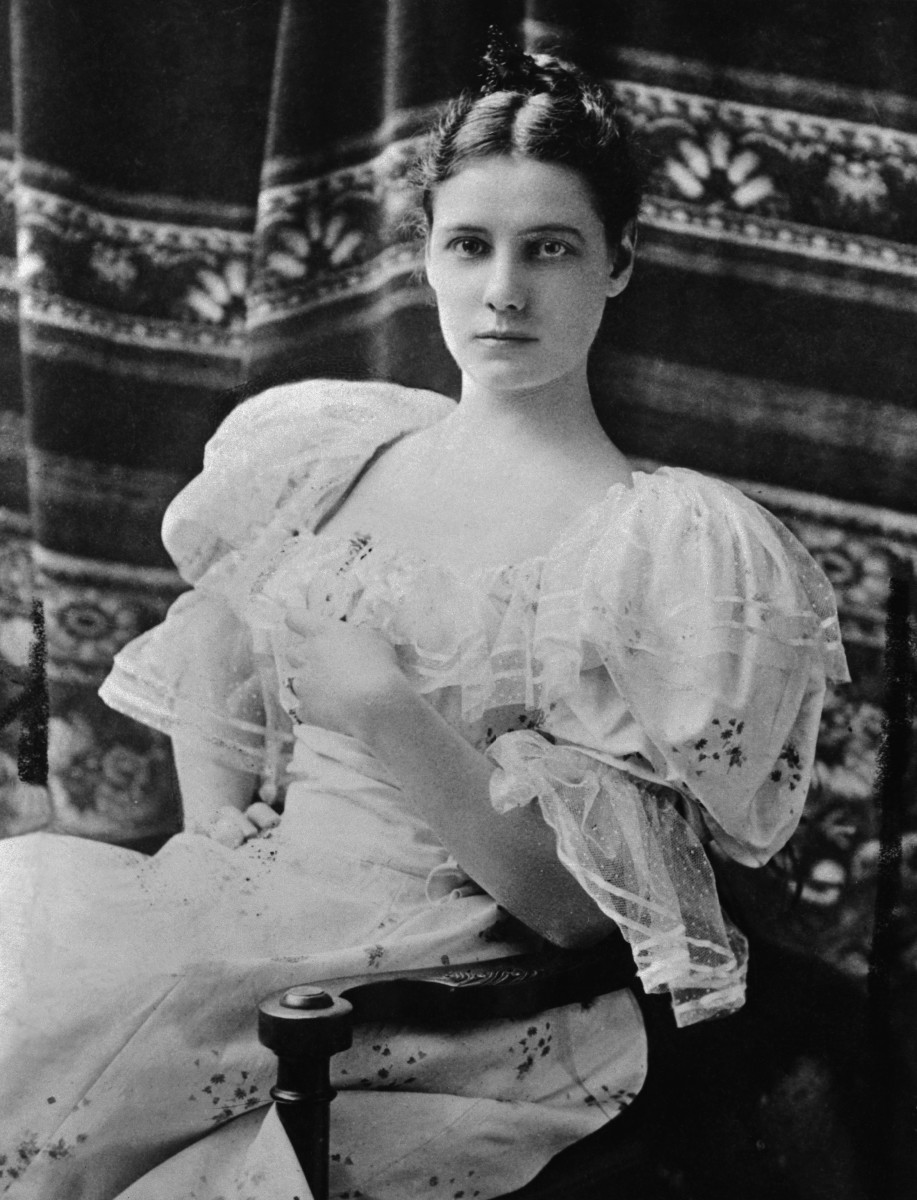
Nellie Bly was born in 1864 in Cochran Mills, Pennsylvania at a time when women were expected to stay at home, have babies, take care of their men and be happy doing that. Women had very few rights at that time, little education and they rarely had good career choices. Nellie was born into a large family of fifteen. Her father had ten children before he married Nellie’s mother, who then gave birth to another five children. Nellie was named Elizabeth Jane but was also nicknamed “Pink or Pinky”. Later when she began her career as a newspaper woman, she changed her name to Nellie Bly as her pen name. Nellie’s father died when she was six years old and the family fell into hard times. Her mother remarried but it is said that her new husband was abusive. Sometime later her mother divorced the stepfather leaving Nellie and her mother to support the family by operating a boarding house just outside of Pittsburgh.
Nellie had wanted to become a teacher and briefly attended the Indiana Normal School, now know as Indiana University of Pennsylvania. However, the family’s finances forced her to give up her teaching dream. It was at this time that Nellie left school to help her mother run the boarding house but she still had dreams of what she wanted to do with her own life.
Nellie Begins Her Career as a Reporter
Nellie began her career as a writer and reporter in 1885 at the Pittsburgh Dispatch newspaper. She had written an angry letter to the paper’s editor in response to an article that she felt disrespected young girls and women. After reading Nellie’s letter, the editor offered her a job working for the paper. Very few women were ever offered opportunities like this and Nellie quickly accepted the offer. She was generally given assignments that were considered of interest to women. Here Nellie could give a voice to issues that concerned women such as poor women who had to support themselves as well as the working conditions these women found themselves in. Of course, some of her articles didn’t sit well with the business class and this was the reason she was reassigned to writing just for the women’s page such as society news. Nellie soon grew tired of these boring assignments and wanted more of a challenge. She found her challenge by going to Mexico as a foreign correspondent for the paper where she spent several months writing about the lives and conditions she found in Mexico. After a few months however, she drew the displeasure of the Mexican dictator Porfirio Diaz when she wrote articles critical of his leadership and government. Nellie was forced to leave the country but later she published her book “Six Months in Mexico”. It seems Nellie’s honesty as a reporter was not always appreciated and tended to get her into trouble.
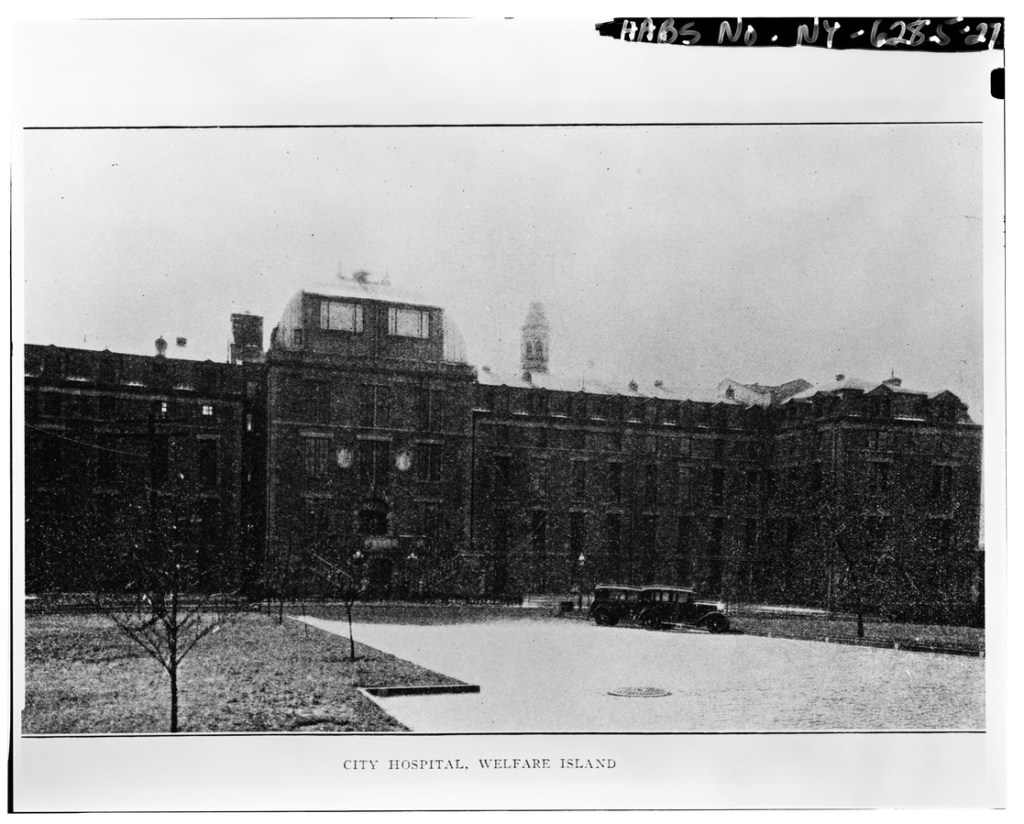
Nellie Exposes the Insane Asylum Blackwell Island
In 1887 Nellie decided it was time to move to New York where she took a job at The New York World paper as a reporter. Her first real assignment with the New York World paper was to go undercover as an insane girl to the Blackwell Island mental institute. How many of us would willing have ourselves committed to an insane asylum? Not very many of us I am sure. Here she spent ten days living locked up with insane women. She saw and experienced everything that a truly insane person would experience. As a result, she wrote a series of articles exposing the mental health facility and she was able to bring about awareness for the mentally insane and instigate an investigation into Blackwell Island. This brought about much needed reforms for mental health institutions. Her story of her time in the mad house later became the movie, “Ten Days in a Mad House”. It was an awesome movie but I believe it was rather dramatized as they tend to do with movies.
Some of the reforms that were brought about by Nellie’s daring venture into Blackwell Island institute for the mentally insane included:
Better food for the patients
Better health care
Warmer clothing and more blankets
More oversight into the doctors and nurses treatment of the patients
Warm baths instead of icy cold baths
Cleaner clothing, towels and personal care items
Blackwell Island for the Mentally Insane Asylum
The Blackwell Mental Institute for the insane where Nellie Byl spent confined for ten days
Nellie Travels the World in Seventy Two Days
Nellie also had the opportunity to travel around the world to beat the previous fictional world record of eighty days. When Nellie brought up the idea of beating the old record her editor told her it wasn’t a job for a female so Nellie challenged him to send both her and a man at the same time. Her editor gave her the assignment. She left Hoboken, New Jersey on Nov 14th, 1889 by ship, traveling to London. From London she took trains to Paris and throughout Europe. From there she traveled to Egypt then on to the Suez Canal then headed towards Middle Eastern countries. From there, she next journeyed through Asian countries and into Japan. From Japan she headed home to San Francisco, Ca. Her journey consisted mostly of travel by trains and ocean liners but there are also reports of various other means of transportation such as horses and Asia rickshaws. Nellie completed her journey in record time with a total of twenty one seven hundred and 40 miles in seventy days, six hours and eleven minutes. I am not sure Nellie was aware at the time she began her journey that the Cosmopolitan magazine was also sending another female reporter, Elizabeth Bisland, on the same mission.
During those seventy two days as Nellie traveled the world, the editor of The New York World used her trip to drive up circulation of the newspaper. Nellie would send dispatches to the paper on where she was every day. The newspaper sponsored a contest offering a prize of a trip to the person who made the most accurate guess as to how long her trip would take.
Upon her return arrival in San Francisco on Jan 25th 1890 Nellie was greeted with crowds of admirers and was given a special train to make her trip back to New York. When she arrived in New York she was honored with parades, brass bands and fireworks to celebrate her victory and safe return. She later wrote her book titled “Around the World in Seventy Two Days”.
Nellie’s Many Accomplishments
Nellie Bly was certainly a woman ahead of her time. In a time when women were looked on as nothing more than a wife, mother, housekeeper and laundress, she blazed a path of her own. In 1895 Nellie married Robert Livingston a man quite a bit older than her. After his death, Nellie wrote numerous articles covering the women’s suffrage movement. Her words and her stories were a powerful tool for women everywhere. Nellie also covered the First World War reporting from the Eastern front lines. Nellie received numerous awards for her work throughout her lifetime and she certainly left her mark on the journalist world. In 1998 Nellie Bly was indicted into the National Women’s Hall of Fame.
Nellie Bly was a leader whose work influenced women’s lives in many ways. Her early work exposed factories and influenced changes in safety. She became a role model for young women who dreamed of becoming something more than a wife and mother.













 History Lovers Corner